
Precise Picoamperes: Mastering Metrology from 10 µA down to 100 fA
16334_Techniques for Traceable Measurements of Small Currents.
The paper presents the development of two traceable small-current sources at INRIM, extending Italy's national DC current standards down to the 100 fA range. It utilizes a resistor-based method for 10 µA – 10 pA and a capacitor-based trapezoidal wave method for 100 pA – 100 fA, achieving traceability to national voltage, resistance, and capacitance standards.
Executive Summary
TL;DR: Researchers at INRIM have successfully extended the Italian national standard for direct current to the femtoampere range by developing two distinct traceable sources. By balancing Ohm’s law for "higher" small currents (up to 10 µA) and capacitive displacement current for ultra-low ranges (down to 100 fA), the team has bridged a critical gap in electrical metrology, providing a robust calibration path for high-sensitivity picoammeters.
Positioning: This work is a foundational metrological study, providing the physical realization (Standard) and validation of primary current measurements beyond the capabilities of commercial multi-function calibrators.
The "Invisible" Noise: Why Small Current is Hard
In the world of standard metrology, generating 1 Ampere is trivial; generating 1 Femtoampere ( A) is an engineering nightmare. Traditionally, we use Ohm’s law (). However, once you require resistors above 1 GΩ, the components become unstable, drifting with the slightest change in humidity or temperature.
Even worse is High-Frequency (HF) Noise. Most metrology-grade calibrators use pulse-width modulation (PWM). As the authors discovered, this creates HF harmonics that, when coupled with the parasitic capacitance of high-value resistors, generate "phantom" currents much larger than the DC signal we intend to measure.
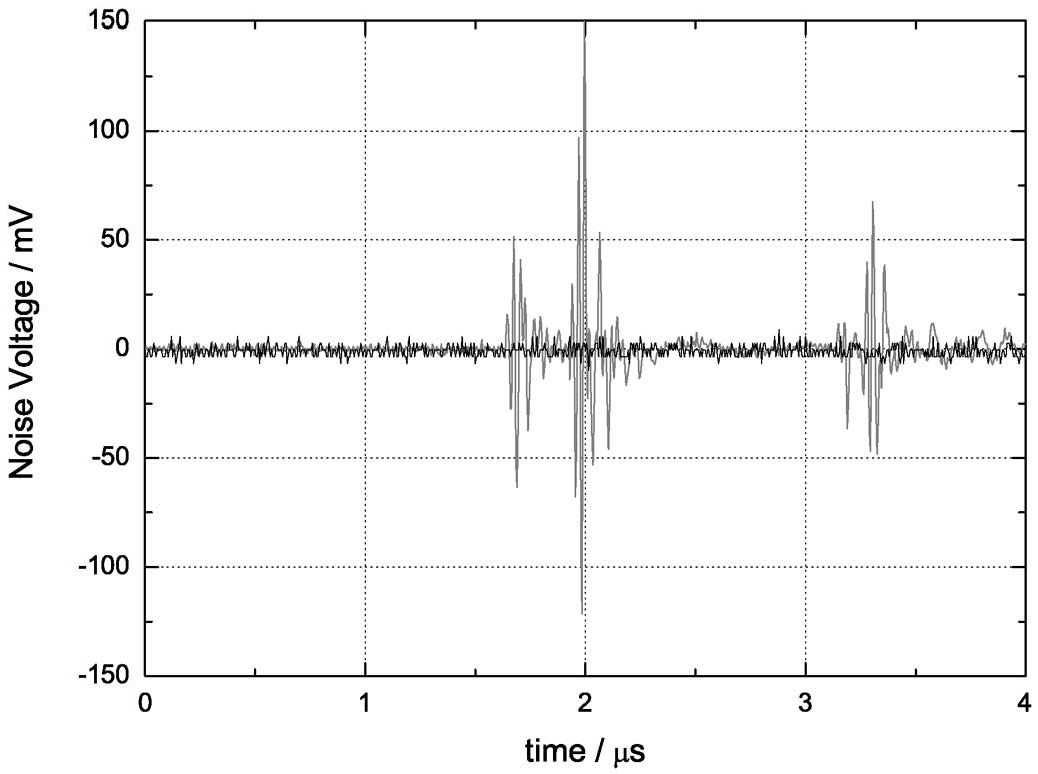 Fig 1: High-frequency noise observed in standard calibrators, a major barrier to low-current precision.
Methodology: A Two-Pronged Attack
1. The Resistor-Based Source (10 µA to 10 pA)
To solve the noise problem, the team swapped switching calibrators for high-quality linear power supplies. To combat the "Voltage Burden" (the error caused by the ammeter's own input resistance and offset), they implemented a signal reversal sequence: . This allowed them to mathematically cancel out linear drifts and the instrument's internal current offsets.
2. The Capacitor-Based Source (100 pA to 100 fA)
Below 10 pA, resistors fail. Here, the team used the principle: . Instead of a simple ramp, which is prone to non-linearity, they used a trapezoidal wave.
- Core Logic: By measuring the voltage at regular intervals and calculating the discrete derivative, they could track the actual generated current in real-time.
- The Hardware: They utilized gas-dielectric capacitors (essentially air-gapped) to minimize dielectric absorption, which acts like a "memory effect" in standard capacitors and ruins DC accuracy.
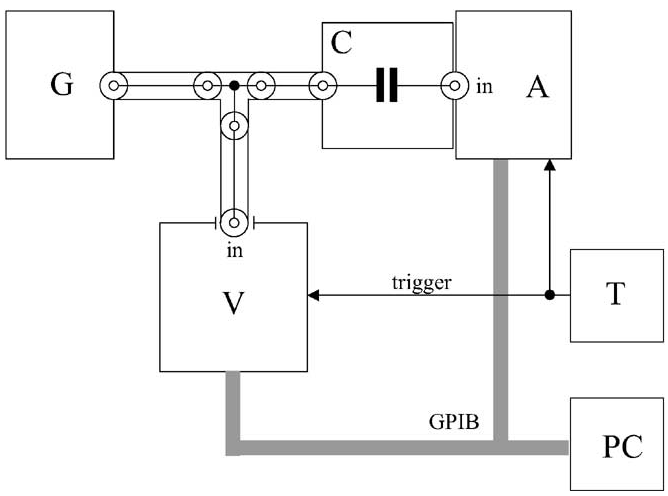 Fig 2: Data processing for the capacitor source. The difference between measured and calculated current is fitted to account for capacitance leakage.
Experimental Results & Validation
The beauty of this research lies in the Overlap Comparison. By measuring a transfer standard (a Keithley 6517) using both methods at 10 pA and 100 pA, the authors proved the methods were consistent.
| Range | Source Method | Uncertainty (k=2) |
|---|---|---|
| 100 fA | Capacitor | 12 aA (0.012 fA) |
| 10 pA | Resistor | 2.7 fA |
The capacitor source, in particular, demonstrated extraordinary precision, achieving an uncertainty of just 12 attoamperes ( A) at the 100 fA level.
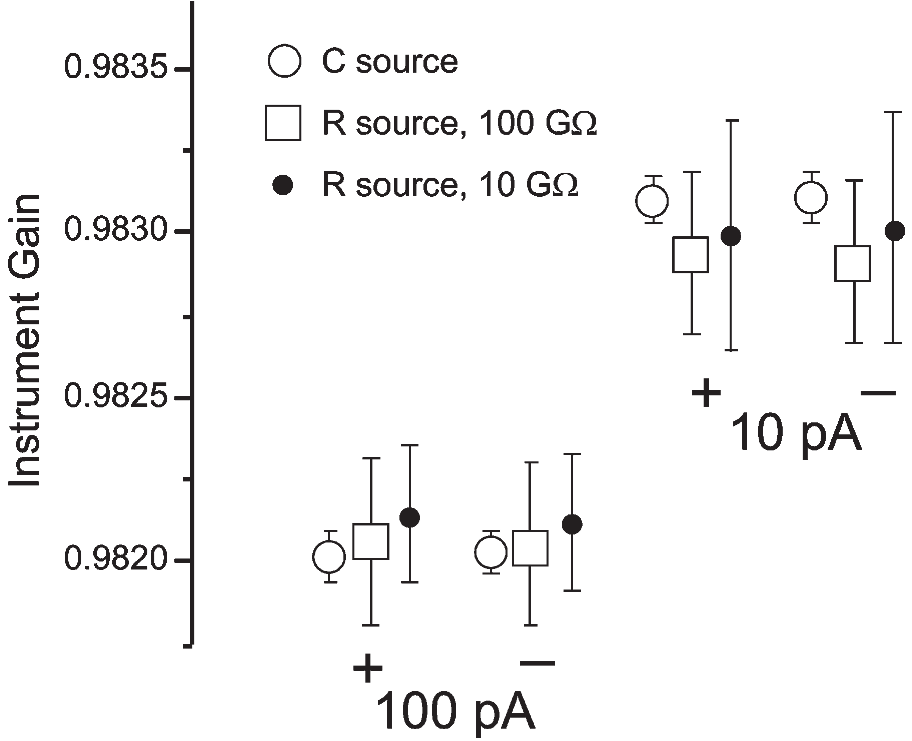 Fig 3: Comparison of instrument gain results between resistor and capacitor sources, showing high compatibility.
Critical Insight & Conclusion
The achievement here isn't just "building a source," but rather the systemic elimination of parasitic errors. The transition from switching power supplies to linear ones and the rigorous use of trapezoidal derivatives represent a high-water mark in traceable electronics.
Future Outlook: While these methods are robust, the next frontier in this field involves "Single Electron Transport" (SET) devices, which define current by counting individual electrons per second—essentially moving from classical physics to quantum metrology. For now, INRIM's dual-source approach remains the state-of-the-art for practical calibration laboratories.