
Beyond the Screen: The Fragile Digital World of Low-Vision Seniors
Technology learning and use among older adults with late-life vision impairments
This qualitative study investigates how older adults with late-life vision impairments learn and use Information and Communication Technologies (ICTs). Through in-depth interviews with 15 participants (aged 60-99), it identifies specific barriers to digital adoption and the high value placed on traditional "low-tech" communication channels.
TL;DR
Access to a computer does not equal digital inclusion. For older adults who lose their sight later in life, the "digital divide" is exacerbated by the complexity of assistive software and the constant evolution of UI/UX. This paper highlights why many seniors revert to "old" tech—like landlines and paper mail—not out of stubbornness, but as a rational response to the instability of modern digital tools.
The "Double Burden" of Late-Life Disability
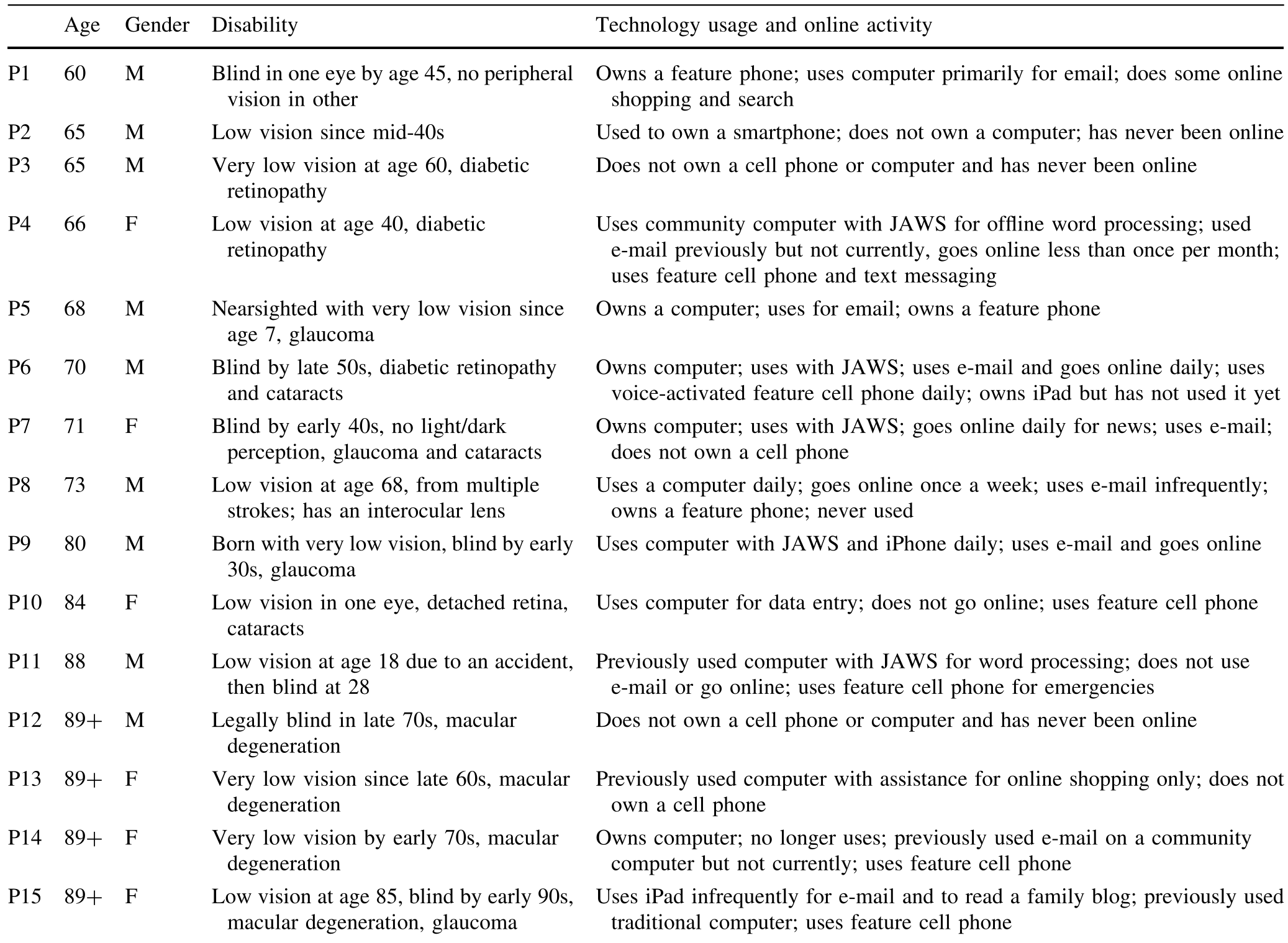
In the hierarchy of tech adoption, older adults with late-life vision impairments (from macular degeneration, cataracts, etc.) occupy a uniquely difficult position. Unlike those blind from birth who receive early training in braille and screen readers, these "digital immigrants" must learn complex new modalities of interaction (audio-only or high-contrast) while simultaneously dealing with aging-related cognitive and motor changes.
The study finds a heartbreaking cycle: an individual invests hundreds of dollars and dozens of hours learning a specific screen reader (like JAWS), only for a software update or a change in community center equipment to render their hard-won skills obsolete.
Methodology: Listening to the Lived Experience
The researchers moved beyond laboratory settings, visiting 15 participants (average age 77) in their homes. This allowed them to witness the "workarounds" seniors use, such as using a physical video magnifier to read an iPad screen—a literal bridge between the analog and digital worlds.
Key Insight: The Resilience of the Traditional Phone
One of the most profound findings is the central role of the traditional phone. While younger generations move toward asynchronous, text-heavy communication, seniors with vision loss prioritize the phone for three reasons:
- Tactile Feedback: Physical buttons provide certainty that a touch screen lacks.
- Audio Clarity: Landlines often offer better fidelity for those with hearing issues.
- Social Immediacy: It matches the "generational value" of meaningful, long-form conversation.
Information seeking for this group is often a cooperative process. Many participants reported calling friends and saying, "Can you Google this for me?" This "proxy searching" highlights a massive opportunity for social-collaborative design.
Accessibility as a Moving Target
The paper emphasizes that vision impairment in old age is rarely static. Participants described "winter eyes" vs. "summer eyes" and fluctuations based on blood sugar levels.
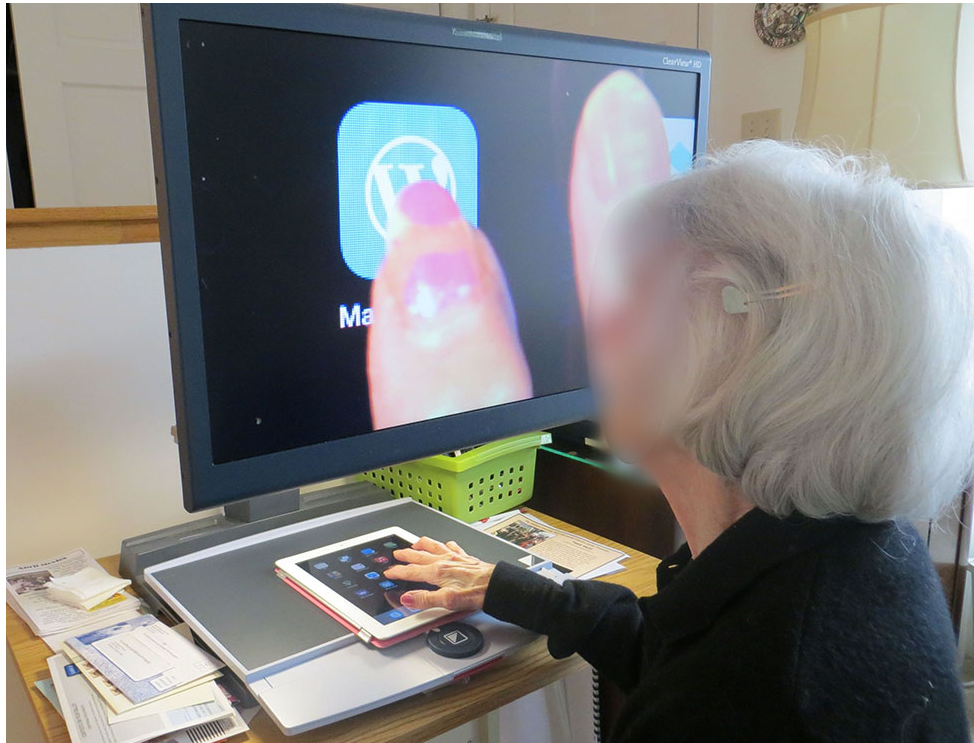 Figure: A participant using an iPad via a hardware video magnifier—illustrating the friction between modern sleek design and functional accessibility.
Standard software design assumes a user with consistent abilities. However, for a user whose vision "deteriorates like muscles and joints," a static interface is a barrier. When software updates change keyboard shortcuts or menu layouts, it doesn't just annoy these users—it locks them out.
Critical Analysis & Design Implications
The "Technology Acceptance Model" (TAM) traditionally looks at "Perceived Usefulness" and "Ease of Use." This paper argues we must add "Social Support Availability" and "Stability of Interface" to the equation for seniors.
Takeaways for Designers:
- Remote Maintenance: Build tools that allow family members to fix technical issues remotely.
- Tactile-Digital Hybrids: Don't abandon physical buttons entirely; they are the ultimate "failsafe" for low-vision users.
- Voice-First Support: Information seeking should be as simple as a phone-based query.
Conclusion
The paper serves as a sobering reminder that "inclusion" requires more than providing a device. We are designing for a population whose "visual landscape" is shifting daily. Success in this field won't come from the next flashy app, but from creating stable, predictable, and socially-integrated systems that honor the communication values of the oldest generation.