
Technology and the Immigrant Journey: Beyond Digital Connectivity to Social Capital
16096_Technology to Support Immigrant Access to Social Capital and Adaptation to a New Country.
This study investigates how Information and Communication Technologies (ICTs) support recent immigrants' social capital development and adaptation in the US. By categorizing ICT use into four groups based on motivation and population diversity, the authors identify critical gaps in how technology addresses cultural and emotional needs compared to settlement tasks.
TL;DR
Coming to a new country is a monumental life transition. While we often assume "being online" solves the information gap, this paper reveals that for immigrants, the type of digital space matters more than the access itself. While ICTs are great for finding an apartment, they often fail to bridge the deep cultural and emotional divides that determine long-term success.
The Problem: Connectivity is Not Adaptation
For a recent immigrant, "survival" depends on social capital—the resources embedded in one's social network. Existing research highlights a divide between:
- INTRA-ethnic ties: Connecting with one's own community (Bonding).
- INTER-ethnic ties: Connecting with the local-born population (Bridging).
The "digital divide" is no longer just about having a smartphone; it's about the functional divide. Current ICTs help immigrants find "what" they need (a car, a room) but struggle to help them find "who" they need to truly integrate into the host society.
Methodology: The Four-Quadrant ICT Framework
The authors categorize ICT use through two lenses: Motivation (Are you looking for a friend or a job?) and Diversity (Are you looking within your community or outside it?).
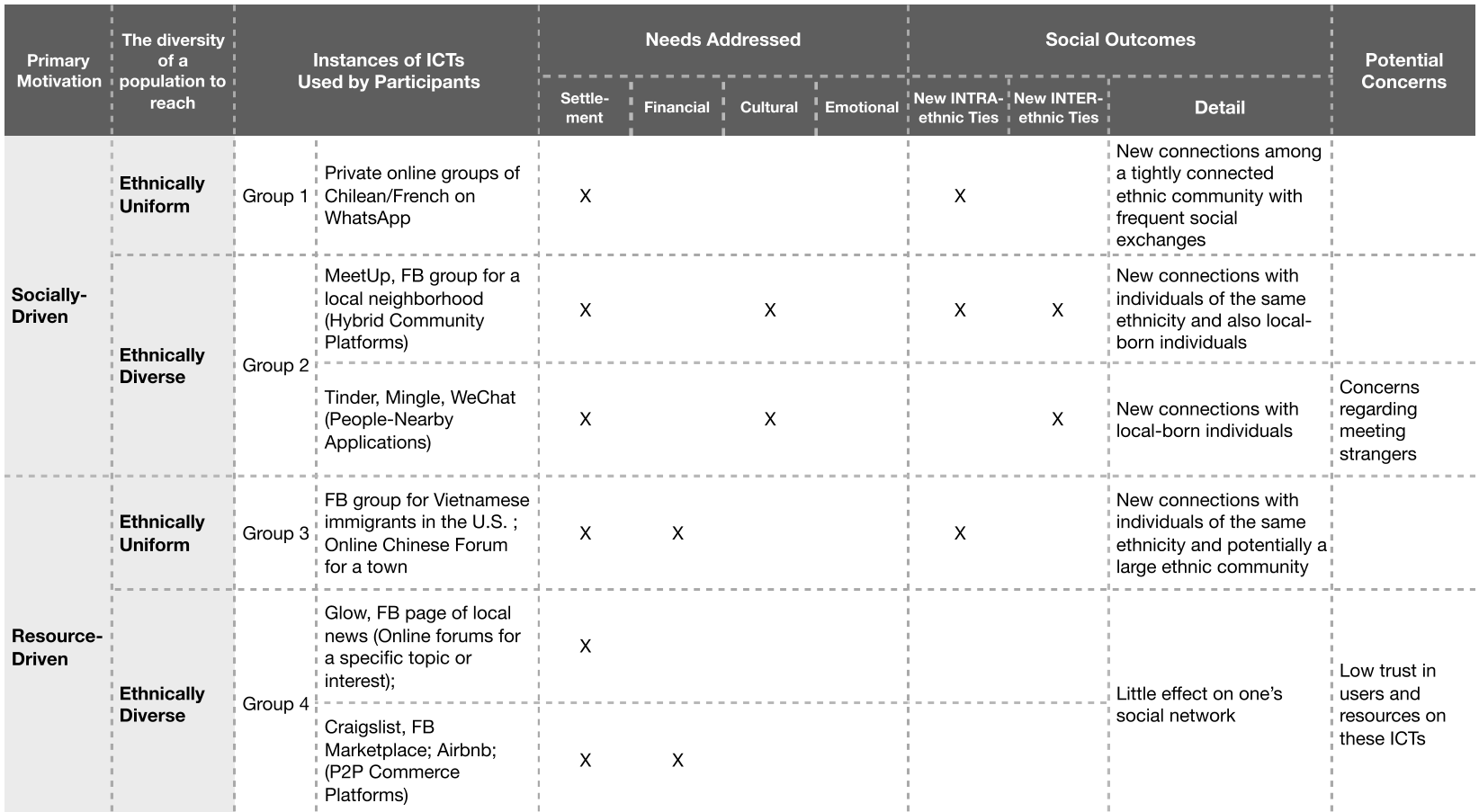
- Group 1 (Social/Uniform): Private WhatsApp/WeChat groups. High trust, high reciprocity, but "redundant" info.
- Group 2 (Social/Diverse): Meetup, Tinder. High potential for "bridging" but high social anxiety.
- Group 3 (Resource/Uniform): Public Facebook groups for specific ethnicities. The "Gold Mine" for job referrals.
- Group 4 (Resource/Diverse): Craigslist, Airbnb. High utility, but plagued by "fraud and scam" fears.
Core Insights: Why Some Apps Fail Immigrants
1. The Paradox of the "Weak Tie"
Granovetter’s classic theory suggests "weak ties" (acquaintances) provide the best job leads. This study confirms this in a digital context: Group 3 (Public Ethnic Groups) provided more job referrals than Group 1 (Private Inner Circles) because they reached a wider net of the diaspora who had already "made it" in the host country.
2. The Cultural Invisible Wall
Even when immigrants use "bridging" apps like Meetup (Group 2), they hit cultural barriers. One participant (Antonio) noted that while he spoke English well, the obsession with American sports like baseball made him feel excluded, leading him to avoid local men and stick to language-exchange circles.
3. The Trust Deficit
For marginalized populations, the "Review and Rating" systems of the 1% (like on Craigslist) aren't enough. Immigrants reported a much higher reliance on "Vouched-for" information within their own ethnic forums due to past experiences with fraud and the lack of a legal safety net.
Experimental Findings & Profiles
The study profiled 18 participants across various backgrounds (China, Nigeria, Chile, etc.).
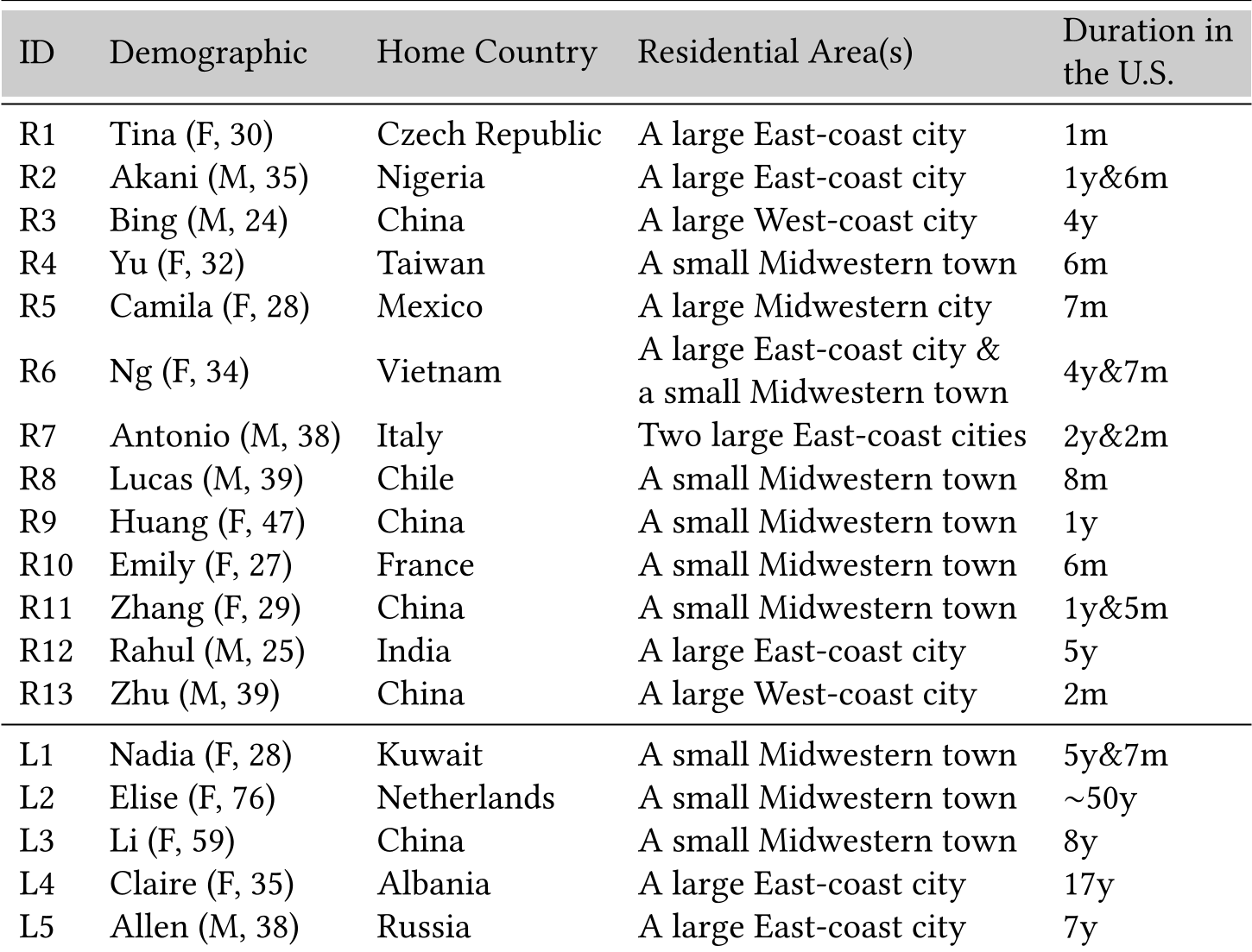
Key Outcome: Settlement needs (housing, ridesharing) were mostly solved via Group 1 and 3. However, Emotional Needs were strikingly absent from ICT interactions. Immigrants still look "home" (to their country of origin) for emotional support, creating a "transnational" emotional life that prevents them from forming deep roots locally.
Critical Analysis & Future Directions
The paper concludes with three powerful design provocations:
- Safety via Intermediaries: Organizations (NGOs, Universities) should act as the "Trust Anchor" for P2P exchanges.
- Reducing Meeting Uncertainty: Designing features that highlight "commonalities" rather than just proximity.
- Formalizing Reciprocity: Applying "Sharing Economy" models (like ridesharing) to immigrant communities to turn "survival" help into "thriving" networks.
Verdict: This is a seminal study for anyone working in Human-Centered Computing (HCC). It moves the conversation beyond "usability" and into "socio-technical integration," reminding us that code cannot replace the complex human need for belonging.