
Digital Security: How Our Gadgets Are Quietly Reducing Relationship Anxiety
Changes in technology use and adult attachment orientation from 2002 to 2012 q
This longitudinal study examines the impact of increasing technology adoption on adult attachment orientations using a massive Internet sample (N = 123,554) from 2002 to 2012. It concludes that attachment anxiety significantly decreased over this decade, particularly among younger adults, while attachment avoidance remained stable.
TL;DR
A decade-long study of over 120,000 adults reveals a surprising shift in our collective psyche: as mobile phones and social media became ubiquitous between 2002 and 2012, attachment anxiety—the fear of being abandoned or ignored—significantly declined. Meanwhile, attachment avoidance (discomfort with intimacy) remained untouched, suggesting that technology makes us feel more "connected" but not necessarily "closer."
The Empathy Paradox vs. Perceived Availability
In the early 2010s, psychologists were worried. The "Empathy Paradox" suggested that despite being more connected than ever, we were becoming more isolated. However, Chopik and Peterson (2014) proposed a different perspective: what if technology serves as a "security blanket" that reduces the stress of wondering where our loved ones are?
The research focused on two dimensions of attachment:
- Anxiety: Worrying about the availability and responsiveness of others.
- Avoidance: Maintaining distance and self-reliance to avoid the vulnerability of intimacy.
The authors hypothesized that if you can text your partner or check a friend's Facebook wall at any second, the "hyperactivation" of the attachment system (the panic of disconnect) should naturally subside.
Methodology: The Macro-Micro Link
The researchers combined individual psychological data from authentichappiness.com with societal-level indicators:
- Sample: 123,554 US adults.
- Technology Metrics: Mobile phone subscriptions per 100 people and total Facebook user counts.
- The Model: Multiple regression and multilevel random-coefficient models to control for age and gender.
Key Finding 1: The Decline of Anxiety
The data showed a robust negative association between the passage of time and attachment anxiety. Interestingly, this shift was almost entirely driven by the "digital natives"—younger adults under 35.
 The table above shows the significant interaction between Year and Age for Anxiety (p < .01), while Avoidance remains stagnant.
Key Finding 2: The Role of Facebook and Mobile Phones
As mobile phone subscriptions rose toward 95 per 100 people in 2012, anxiety scores dropped. The "perceived availability" provided by a device in one’s pocket seems to fulfill the evolutionary need for proximity to attachment figures.
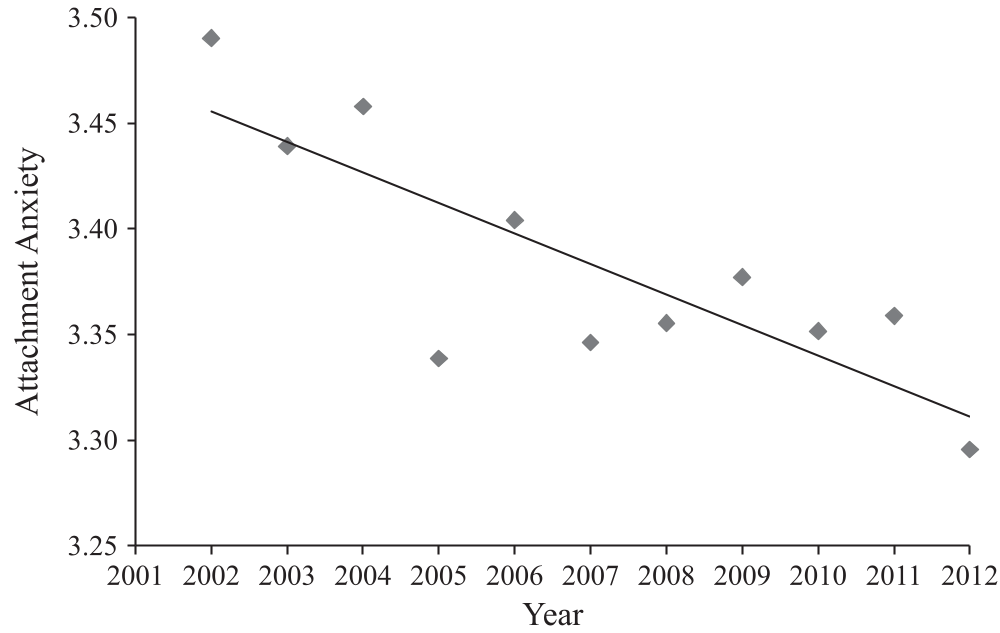 Visual representation of declining anxiety among younger cohorts compared to older, less tech-integrated groups.
Critical Insights: Why It Works (and Why It Doesn't)
The drop in anxiety without a corresponding drop in avoidance is a critical distinction.
- Proximity-Enhancement: Technology is excellent at solving the "Where are you?" problem. It provides instant reassurance-seeking mechanisms that lower anxiety.
- The Intimacy Ceiling: Technology does not appear to solve the "How deep is our bond?" problem. Because avoidance didn't change, the authors suggest that while digital tools make others accessible, they don't necessarily increase the comfort level with emotional vulnerability or psychological closeness.
Conclusion and Limitations
This study provides a fascinating look at "societal-level" psychological change. However, as the authors note, the data is correlational. We cannot say for certain that Facebook caused the drop in anxiety, only that they rose in tandem. Furthermore, modern social media (post-2012) has introduced new stressors like "Fear of Missing Out" (FOMO) and social comparison, which may have reversed these trends in the years since this paper was published.
Takeaway for the Future: Technology acts as a digital tether. It keeps us from drifting away, reducing our panic, but the work of building deep, secure intimacy still requires more than just high-speed data.