
Tele Echo Tube: Engineering Mythological Presence through HCBI
18889_Tele echo tube beyond cultural and imaginable boundaries.
The paper introduces Tele Echo Tube (TET), a novel Human-Computer-Biosphere Interaction (HCBI) interface that enables real-time acoustic interaction with remote mountain echoes through a satellite network. Developed by researchers at the University of Tokyo, it leverages network latency to simulate the presence of the Japanese mythological creature "Yamabiko."
TL;DR
Tele Echo Tube (TET) is an installation that allows urban dwellers to shout into a tube and hear their voice reflected back from a remote mountain forest over 100 km away. By embracing satellite network delays as a feature rather than a bug, the researchers create a bridge to "Yamabiko"—the mountain echo spirit of Japanese mythology—pioneering a field known as Human-Computer-Biosphere Interaction (HCBI).
Problems in Human-Centric Design
Modern HCI is largely transactional and anthropocentric. We build tools for productivity or human-to-human social connection, but we have lost our "spiritual and emotional connection" to the wilderness. Previous attempts at "nature interfaces" were often passive (one-way livestreams) or lacked the tactile feedback required for a sense of believable presence.
The authors argue that the "beauty of nature" is often found in non-linguistic, background interactions—the sound of trickling water or a distant bird. This study seeks to recreate that "atmosphere" through a culturally grounded metaphor.
Methodology: The Architecture of an Echo
The system is a complex feat of remote engineering. It bridges a local interface in a city with a remote station in the Chichibu University Forest (1,200m elevation).
System Components:
- Remote System: Weatherproof microphones and solar-powered satellite dishes located in uninhabited mountains.
- The Interaction Loop: A user shouts "YO-HOOO!" into the TET interface. The signal travels via satellite to the mountain, plays through speakers, is captured by microphones (recorded along with the natural soundscape), and sent back to the user.
- Haptic Synchronization: The local interface doesn't just play sound; it vibrates. This physical feedback "anchors" the remote sound, making the experience feel tangible.
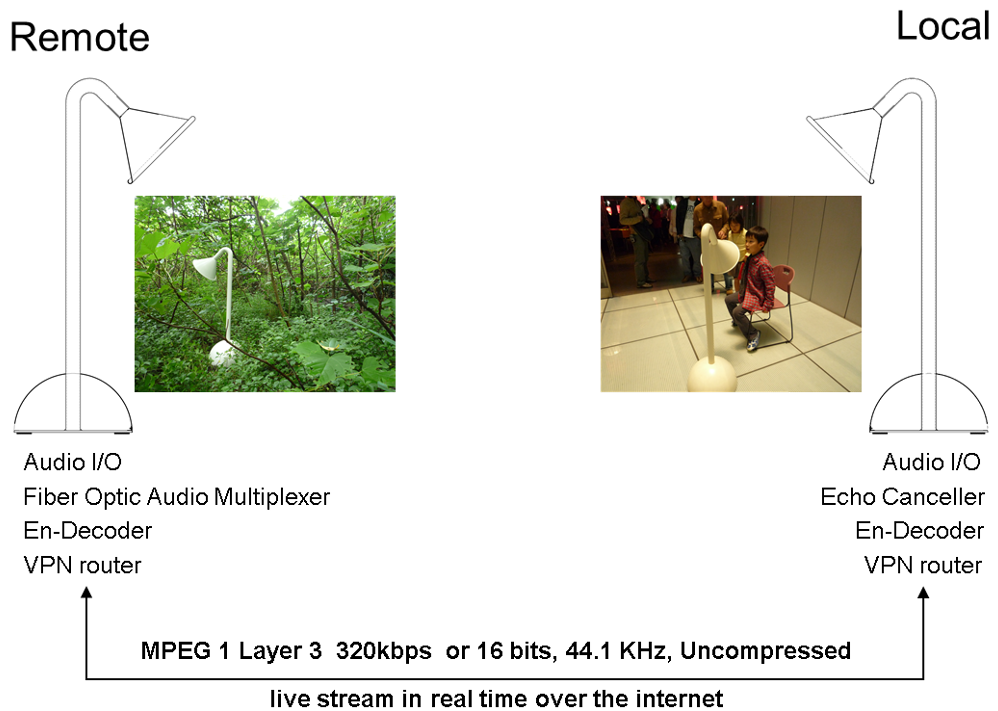 Figure: The interaction between the local installation and the remote mountain site via satellite.
The "Fickle" Network Delay
While most engineers try to eliminate latency, Kobayashi et al. utilized it. In their trials, the processing time () ranged from 33 to 40 seconds. Instead of frustrating users, this delay was framed as the "fickleness" of the mountain nymph, creating a character for the interface.
Experimental Results & User Perception
The system was tested at high-profile venues like ACM Multimedia and ASIAGRAPH. By monitoring facial expressions, the researchers found that:
- Emotional Resonance: 31 out of 50 users broke into smiles upon hearing their "echo" return from the mountain.
- Believability: Users treated the acoustic reflection as a cue for a "mythological metaphor," demonstrating that non-verbal, non-linguistic sounds (like a delayed echo) can create a profound sense of connection.
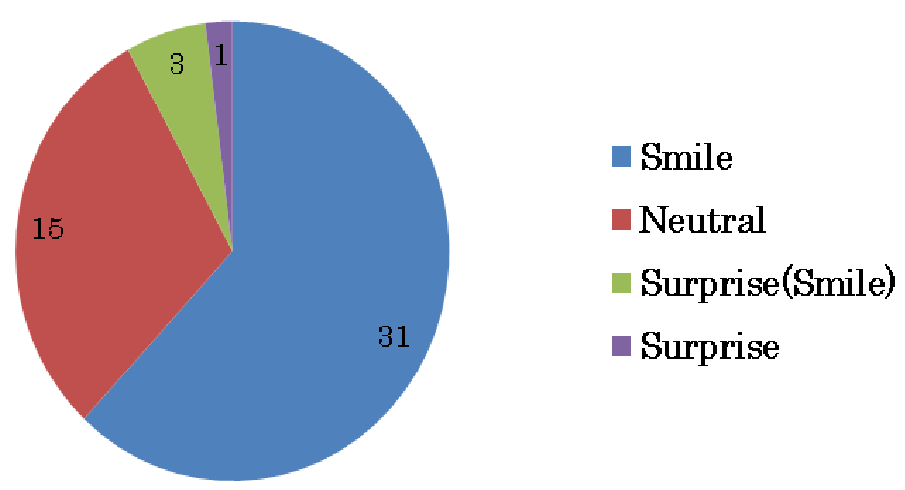 Figure: Analysis of user facial expressions (Surprise/Smile) upon receiving the echo.
Critical Insights: Beyond the Machine
The paper’s true value lies in its application of Jakob von Uexküll’s Umwelt theory. It suggests that every living being inhabits its own subjective "surrounding world." Through TET, the computer acts as a translator between the human Umwelt and the "Biosphere" Umwelt.
Limitations and Future Work
The primary challenge was technical: maintaining hardware in high-humidity forests. The team solved "memory leaks" and CPU overheating by implementing 12-hour alternating shifts between two identical systems—a clever solution for long-term unmanned deployment.
Future work, represented by projects like the "Wearable Forest," aims to expand these interactions into clothing, allowing users to feel "at one" with the nature even while navigating a concrete jungle.
Conclusion
Tele Echo Tube proves that "presence" is not about high-resolution video or zero-latency audio. It is about context. By leveraging traditional mythology and the functional cycles of nature, we can design technologies that don't just serve us, but reconnect us to the world we inhabit.