
Telecom Business Strategies: The Evolution of Corporate Blogs from Web 2.0 to 3.0
The Telecom Business Strategies: a Comparative Study of Corporate Blogs
This paper presents a comparative study of corporate blog strategies within the Polish telecommunications industry, evaluating them as critical E-marketing tools. It introduces a multi-dimensional evaluation methodology and identifies "Blog A" as a leader in leveraging interactive Web 2.0/3.0 features and agent-oriented technologies.
Executive Summary
TL;DR: This paper analyzes how major telecommunications players in Poland utilize corporate blogs as strategic e-marketing assets. By comparing three major entities, it highlights that the most successful strategies move beyond simple "virtual logs" toward integrated ecosystems utilizing agent-oriented technologies and interactive communication channels to build brand authority and customer trust.
Positioning: This work serves as an empirical bridge between early social media marketing and the emerging "Semantic Web" (Web 3.0), providing a standardized evaluation framework for digital corporate communication.
The Core Problem: The Participation Gap
Traditional corporate marketing frequently suffers from a "broadcast" bias—companies push information but fail to listen. The author argues that in the era of Web 2.0 (The Architecture of Participation), companies that treat blogs as static notice boards miss out on the crucial "social aspect." The difficulty lies in balancing brand control with the spontaneity and sincerity required by the blogosphere.
Methodology: A Multi-Dimensional Evaluation
The research employs a rigorous 5-step comparative methodology to evaluate three Polish telecom blogs (referred to as A, B, and C). The evaluation is built on five pillars:
- GUI: Aesthetic alignment with corporate identity and clarity.
- Functional Structure: Searchability, archiving, and RSS capabilities.
- Content Publication: The use of multimedia and the frequency of author-reader interaction.
- Marketing Solutions: SEO positioning and the presence (or absence) of intrusive advertising.
- Web Technology: The sophistication of CMS and "Agent Oriented" support.
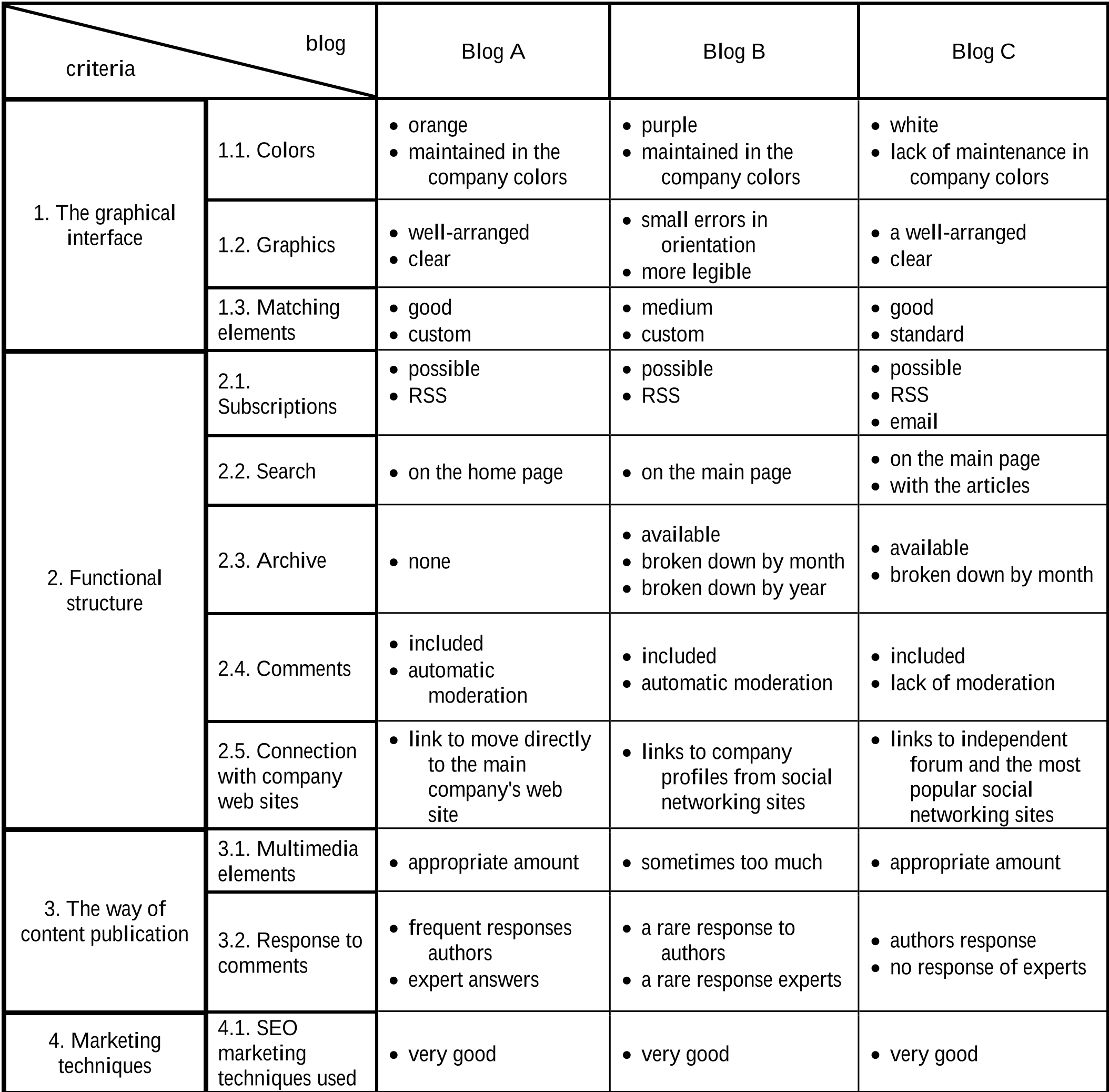 Above: The systematic breakdown of criteria used to differentiate the three telecom strategies.
Detailed Findings: The Rise of the "Virtual Advisor"
The study reveals a stark contrast in how technology is utilized:
- Blog A (The Winner): Utilizes a dedicated CMS and, crucially, a Virtual Private Client Advisor. This reflects a shift toward Web 3.0, where machines (agents) help process information to assist users. It also uses a "cluster" approach, dividing the blog into specialized niches (Sports, Tech, Strategy).
- Blog B: Heavily reliant on WordPress with excessive advertising. It suffers from a "one-way" communication feel where authors rarely respond to comments, leading to lower user trust.
- Blog C: While it has good engagement, it lacks a formal corporate structure, existing more as an independent network, which limits its strategic utility for the firm.
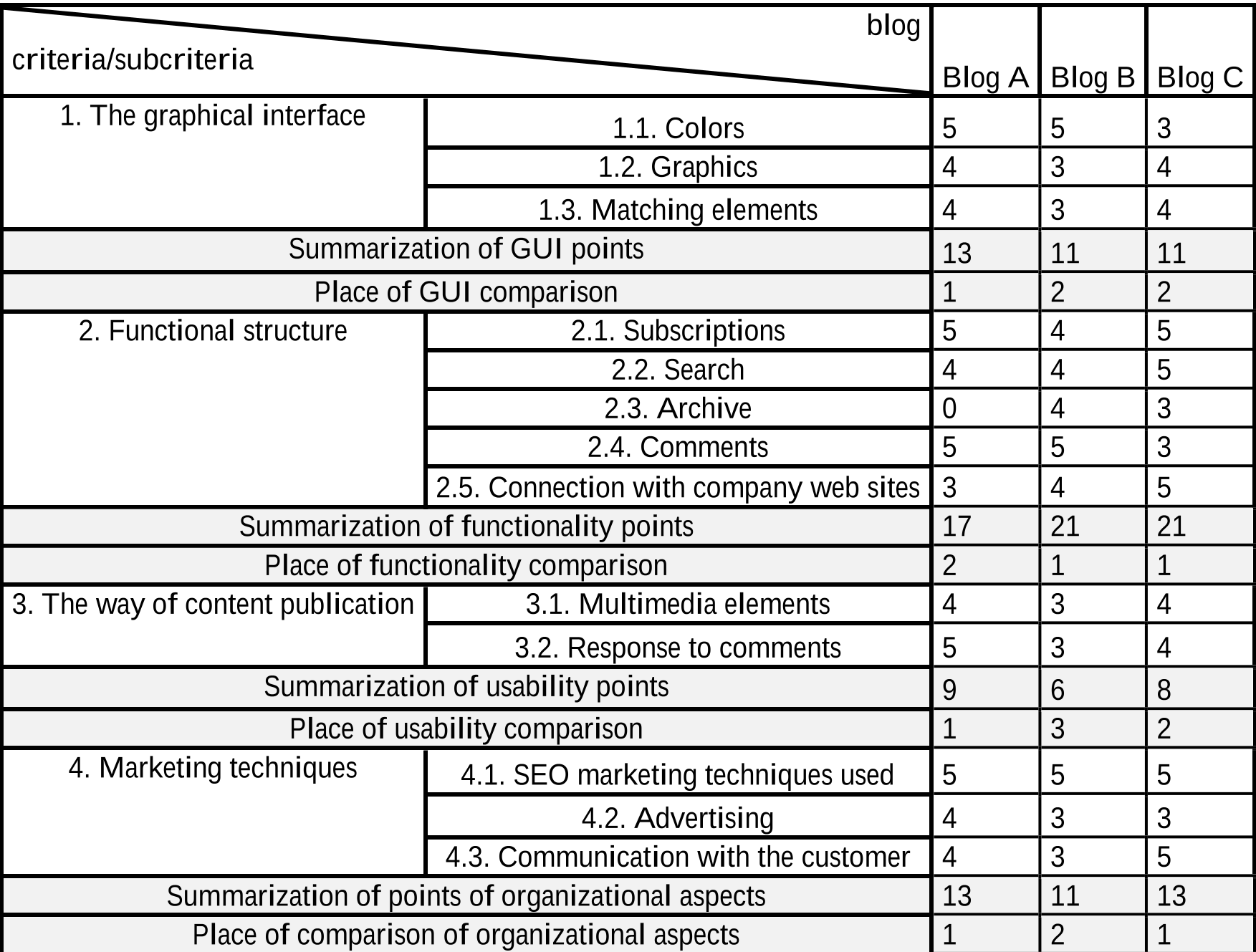 Above: Final evaluation scores showing Blog A's dominance in technological and organizational aspects.
Methodology Insight: Why Agent-Oriented Tech Matters
A standout point of the methodology is the emphasis on Semantic Web concepts. The author posits that the future of corporate blogging (Web 4.0) will be "agent-oriented." Instead of searching for keywords, users will interact with agents that understand meaning (metadata). Blog A's high score is largely attributed to its early adoption of these automated interaction layers.
Critical Analysis & Future Outlook
Takeaways
- Interaction is Currency: Blogs that don't moderate or respond to comments (like Blog B) fail as strategic tools.
- Avoid Ad-Clutter: Telecommunications is a high-trust industry; using a corporate blog for intrusive banner ads (as seen in Blog B) actively degrades the relationship.
Limitations
The study is localized to the Polish market and focuses on a 2014 snapshot. Since then, the rise of platforms like TikTok and LinkedIn has decentralized the "corporate blog," perhaps making a single-domain blog less central to e-marketing than it was a decade ago.
Conclusion
The paper concludes that the "best" blog isn't just the one with the best writing, but the one that most effectively integrates Agent Oriented Technologies to facilitate a knowledge-based organization. As we move toward Web 4.0, the "Smart Grid" of information will require companies to shift from being content creators to being "knowledge node" managers.