
Social Media as a Catalyst for Virtual Learning: Insights from the Digital Native Generation
Telematics and informatics
This study investigates the influence of Social Networking Sites (SNSs) and Internet perception on the assessment of Virtual Learning Environments (VLEs) among social sciences students. Using a Structural Equation Model (SEM) on 381 college students in Spain, the research highlights that both topical social networks and general Internet experience significantly dictate VLE effectiveness and learning efficiency.
TL;DR
Is the university digital platform just a place to download PDFs, or can it be as engaging as Facebook? This study reveals that a student's experience with the broader Internet and their involvement in Social Networking Sites (SNSs) directly dictate how they perceive and value Virtual Learning Environments (VLEs). By analyzing 381 students in Spain, the research argues for a "merging" of social habits and academic tools to boost learning efficiency.
Problem & Motivation: The Gap Between Leisure and Learning
Digital natives—students born into the era of constant connectivity—interact with software through a lens of "social capital" and collaborative intelligence. However, many universities treat VLEs (like Moodle) as mere repositories. The authors noticed a disconnect: students are masters of multitasking and information sharing on SNSs for friendship, yet find academic platforms rigid. The motivation behind this study was to determine if a student's confidence and experience with the social web could be leveraged to improve their formal academic assessment of learning tools.
Methodology: The Structural Equation Model (SEM)
The researchers didn't just look at usage stats; they looked at Latent Variables—psychological and social constructs that aren't directly observable.
They categorized these into:
- Internet Assessment: Measured by reliability (accuracy), confidence (security), and experience (frequency).
- Topical SNSs: Evaluated through the students' knowledge of functions, the perceived value of networks for relationships, and general usage patterns.
- VLE Assessment: Focused on five key utilities: downloading, content value, functional utility, learning efficiency, and its role as a supplement to traditional classes.
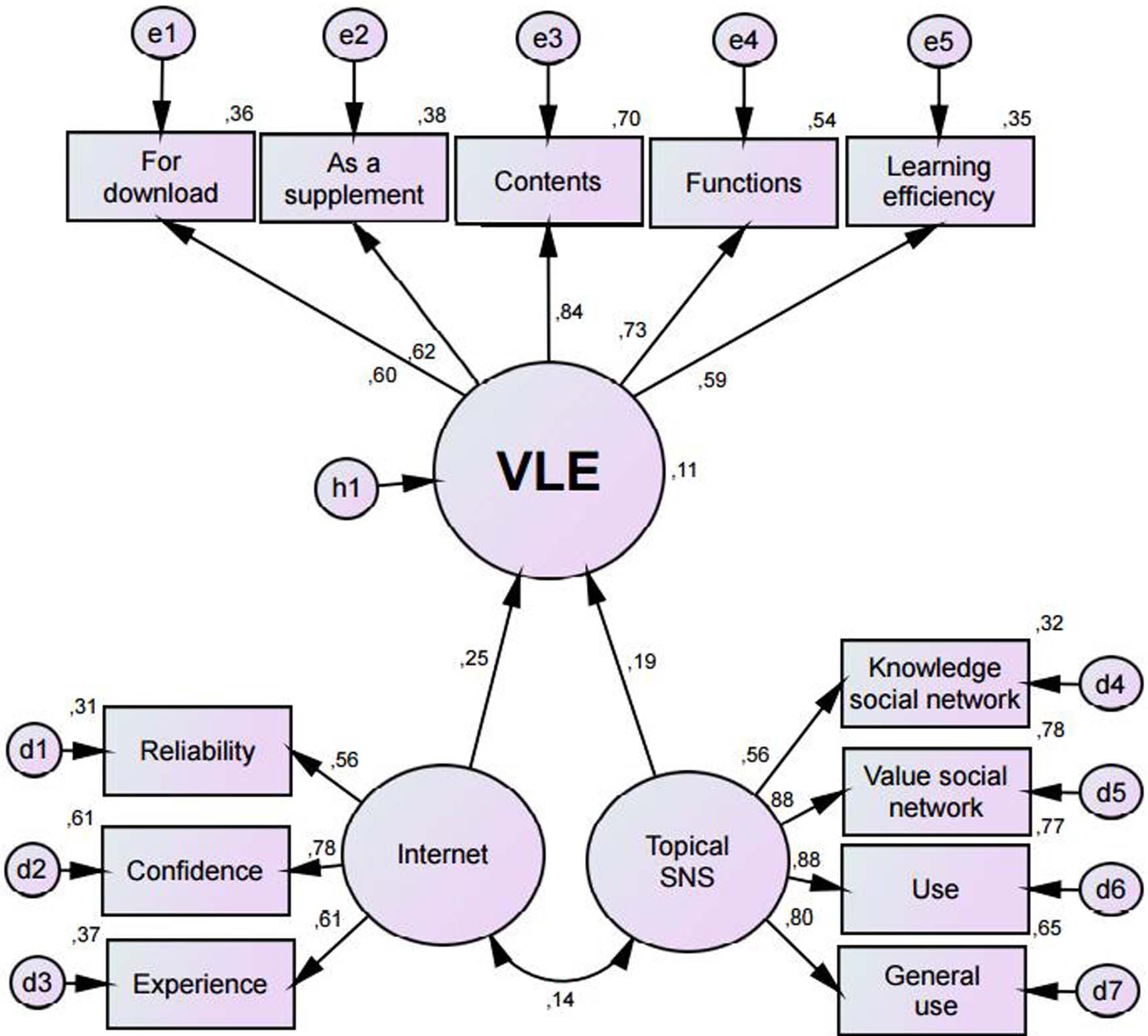 Figure 1: The Structural Equation Model showing the causal interactions between Internet Assessment, SNS usage, and VLE valuation.
Key Results: Trust is the Currency of Learning
The study yielded several high-impact insights:
- Confidence over Content: In Internet assessment, Network Security/Confidence (0.78) was more important to students than the actual accuracy of information (0.56).
- The Social Spillover: There is a significant bi-directional influence (0.14) between social network use and Internet proficiency.
- VLE Drivers: The "Contents" (0.84) and "Functions" (0.73) of platforms like Moodle are the primary drivers of student satisfaction. However, "Learning Efficiency" (0.60) showed room for improvement, suggesting that current VLEs aren't quite hitting the mark on making studying "faster or easier."
 Table 1: Standardized regression weights showing the significant impact (p < 0.001) of Internet and SNS factors on VLE assessment.
Critical Insight: Why Policy Producers Should Listen
The most striking takeaway is that SNS value for learning was not originally the primary driver for students—they use it for friendship. However, those who are social-network-savvy are objectively better at navigating and valuing VLEs.
The Opportunity: If universities want to increase "Learning Efficiency," they shouldn't just add more files. They should implement features that mimic the social dynamics of the web:
- Relational Tools: Integration of forums and messaging that feel more like "social networking" and less like "emailing a professor."
- Personalization: Allowing students to design their own "Personal Learning Environments" (PLEs).
- Training: Since only 11% of students receive formal ICT training, there is a massive untapped potential to improve academic performance by teaching students how to bridge their social skills into professional/academic contexts.
Conclusion & Limitations
This work confirms that the "Social Constructionist Pedagogy" (learning through building and interacting) is naturally suited to the modern student. While the study is limited to the Spanish university context, it serves as a blueprint for global higher education institutions. The future of the VLE isn't just a digital bookshelf; it's a social ecosystem where "learning by doing" and "learning by sharing" become one and the same.