
SNTrust: Decoding the Interplay of Trust and Influence in Social Communities
Telematics and informatics
The paper introduces SNTrust, a comprehensive trust computation model that evaluates node reliability through local (Direct Trust) and global (Indirect Trust) lenses across Social Networks (SN). By integrating multiple centrality measures (K-core, PageRank, etc.), it establishes a statistically significant positive correlation between a node's trustworthiness and its influence within both the overall network and specific communities.
TL;DR
Is the most "central" person in your network also the most "trustworthy"? The SNTrust model suggests the answer is a resounding yes. By analyzing complex interactions across Facebook, Blogcatalog, and organizational datasets, this research proves that trust is not just a social feeling—it is a structural driver of influence. The study establishes that nodes with high influence centralities are almost always the most trusted members of their specialized communities.
The "Centrality-Trust" Gap
For years, Social Network Analysis (SNA) focused on Influence Maximization—the art of finding "hubs" to spread information. However, current SOTA structural models (like PageRank or Closeness) suffer from a blind spot: they measure reach, not reliability. An influential node could be a malicious actor or a "noise" generator.
The authors argue that for influence to be effective (e.g., a blogger promoting a brand), it must be underpinned by a quantifiable Trust Model. The difficulty lies in the subjective, asymmetric, and non-transitive nature of trust.
Methodology: The Architecture of SNTrust
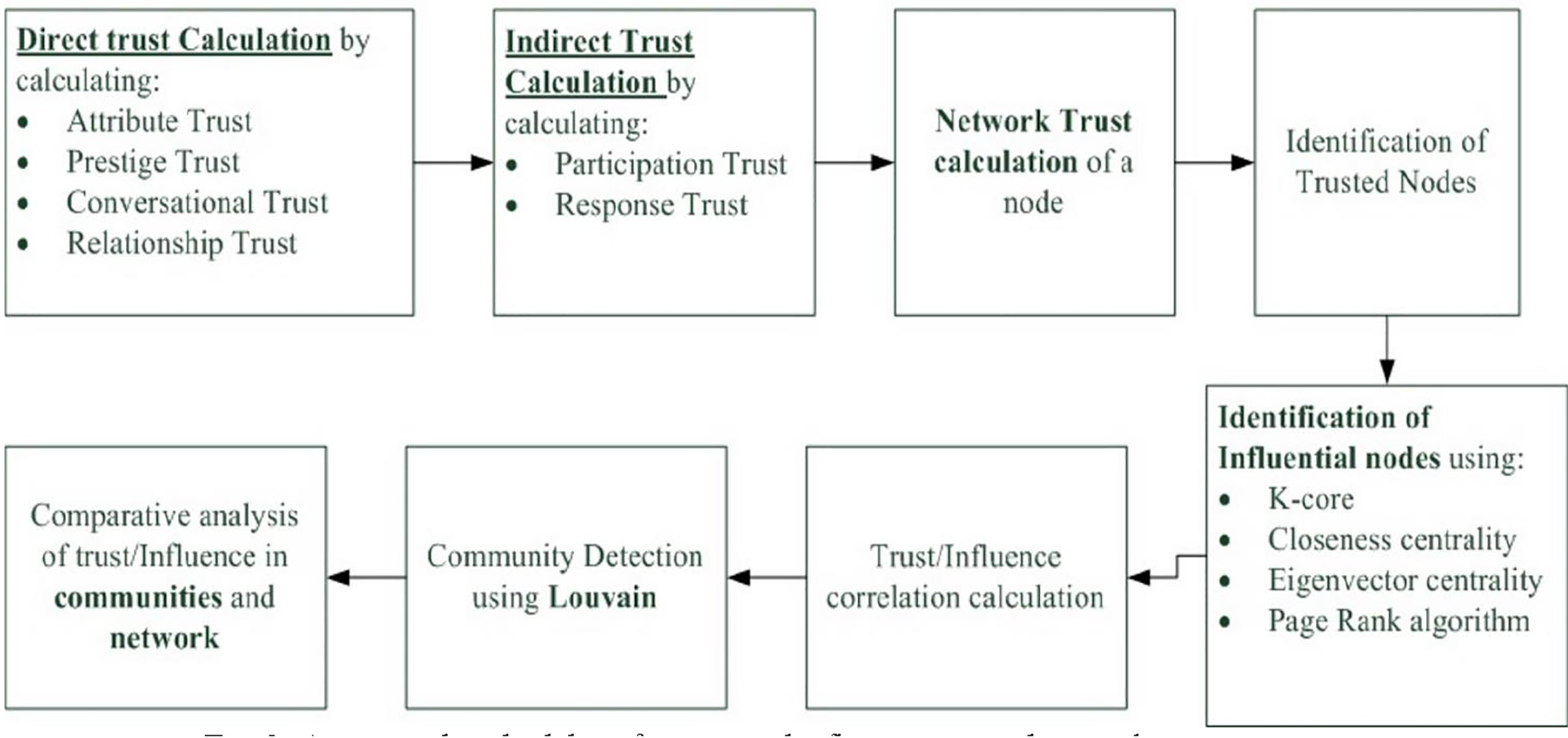
The SNTrust model decomposes trust into a hierarchical structure, moving from micro-level interactions to macro-level network standing.
1. Direct Trust (The Micro View)
This calculates the "ego-centric" trust between a trustor and trustee based on four pillars:
- Attribute Trust: Do you share the same location, education, or workplace?
- Prestige Trust: A variation of in-degree prestige focusing on positive vs. negative arcs.
- Conversational Trust: The raw frequency of communication.
- Relationship Trust: A weighted hierarchy where "Natural Relationships" (family) outrank "Follower Relationships."
2. Indirect Trust (The Macro View)
This captures the reputation of a node within a group, even without direct interaction:
- Participation Trust: Is the user active above the group average?
- Response Trust: A weighted sum of reactions. Crucially, the model distinguishes between a "Share" (weight 1.0) and a "Like" (weight 0.25), while penalizing "Angry" reactions (weight -1.0).
Core Findings: Trust is Local and Global
The researchers applied SNTrust to several real-world datasets, including a Consulting Company and the Freeman EIES researcher network.
The Correlation Peak
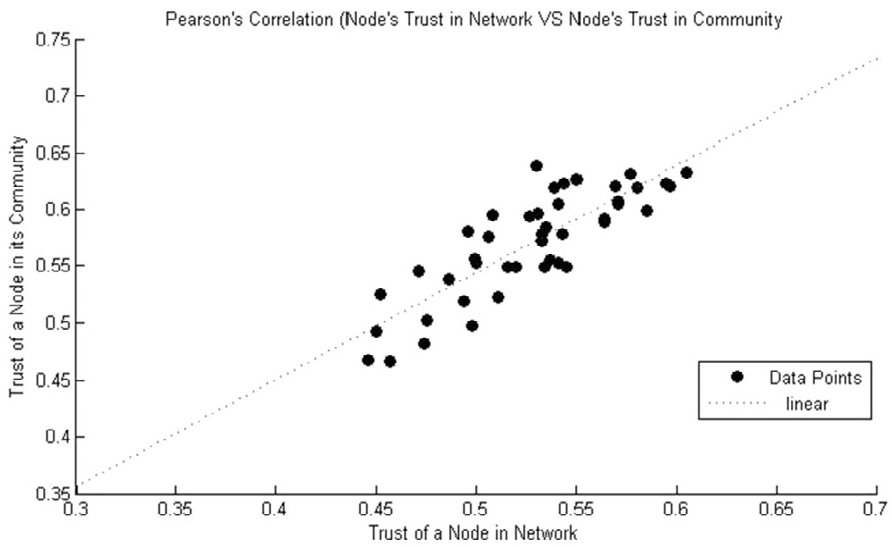
The study found a positive linear correlation across the board. In the Consulting Company dataset, nodes identified as "Influential" by Eigenvector Centrality showed a moderate to strong correlation with Direct Trust (). This suggests that in professional environments, expertise and influence are inherently tied to interpersonal trust.
The Community Cohesion Effect
By using the Louvain Algorithm for community detection, the authors discovered that:
- Trust Scales Down: Nodes trusted in the global network maintain even higher trust levels within their sub-communities ().
- Density & Trust: Communities with high average trust scores exhibit significantly higher Network Density and Transitivity (Triads).
Experimental Results: The Facebook Proof
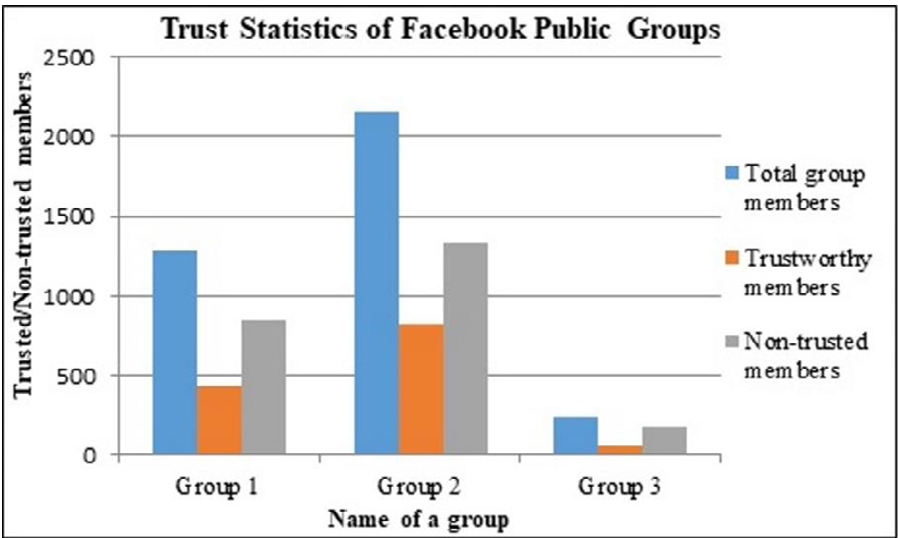
When looking at Facebook Groups (Unofficial Cheltenham Township, etc.), the model revealed a stark reality of digital engagement. In "Group 3" (Free Speech Zone), only 25.71% of members were found to be "Trusted" via Indirect Trust, highlighting a large population of passive or non-reputable observers.
Critical Insights & Future Outlook
Takeaway for Marketers & Researchers: Stop chasing raw "Follower Counts." The SNTrust model proves that a node's influence is reinforced by their community-level trust. Selecting a blogger who is "trusted" in a specific niche is mathematically more effective than a generic "high-reach" hub.
Limitations: The current model relies on static snapshots. In real-world social networks, trust is dynamic and decays over time. Furthermore, calculating multi-layered trust for "Big Data" scales (millions of nodes) remains a computational bottleneck that the authors identify as future work.
Conclusion: SNTrust provides a rigorous framework for bridging the gap between structural centrality and social psychology. It validates the intuition that we are most influenced by those we trust, and that this trust is clearly visible in the data "trails" of our attributes and reactions.