
Relational Governance: The Secret to Crowdsourcer Loyalty in the Digital Age
Telematics and informatics
This study investigates the relational governance antecedents (Information Exchange, Conflict Resolution, Trust) and loyalty consequences of service quality in online crowdsourcing. Using an empirical survey of 240 crowdsourcers, the authors validate a multidimensional service quality model comprising Interaction, Outcome, and Environment quality.
TL;DR
Why do firms stop using crowdsourcing platforms even when they save money? This study reveals that the "human element"—Relational Governance—is the silent engine behind service quality. By analyzing 240 crowdsourcers, researchers found that trust, information exchange, and conflict resolution are vital for building loyalty. However, as crowdsourcers gain more experience, they care less about individual task results and more about the platform's overall environment.
The "Anonymity" Problem in Crowdsourcing
Traditional outsourcing relies on professional contracts and long-term relationships. Crowdsourcing is different: it is anonymous, short-term, and often chaotic. While most researchers focus on how to write better contracts, this paper argues that informal relationships (unwritten norms) are what actually drive quality and loyalty. The core challenge is that crowdsourcers often view the "crowd" as unreliable, leading to a "one-and-done" mentality rather than long-term platform loyalty.
Methodology: The Core Framework
The authors break down Service Quality into 3 dimensions, moving beyond a simple "good or bad" rating:
- Interaction Quality: The "how" of service delivery.
- Outcome Quality: The "what" (the final solution).
- Environment Quality: The "where" (the platform's usability and support).
 Figure 1: The Research Model illustrating the path from Relational Governance to Loyalty.
Deep Dive: Why Relational Governance Works
The study highlights three pillars of relational governance:
- Information Exchange: Timely, proactive communication.
- Conflict Resolution: Open-minded, solution-focused disagreement handling.
- Trust: Confidence that the crowd won't act opportunistically.
Key Intuition: Trust had an insignificant effect on Interaction Quality. Why? Because in a virtual, anonymous world, crowdsourcers don't expect to "know" the person; they rely on the platform to mediate the interaction. However, trust and information exchange were crucial for the perceived Outcome Quality.
Results & The "Experience Paradox"
The most fascinating finding involves Crowdsourcing Experience.
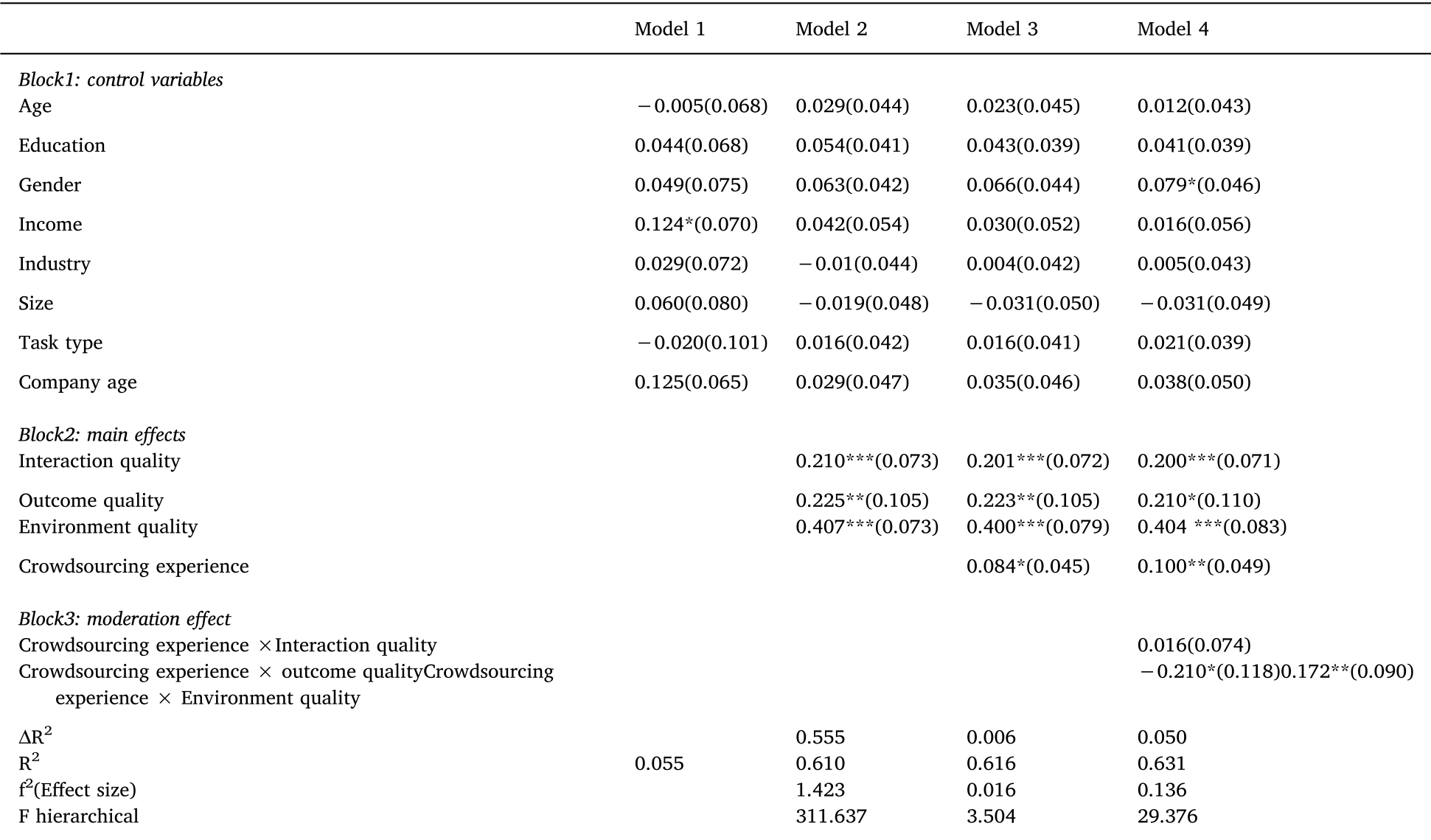 Table 5: Hierarchical regression results showing the moderating role of experience.
- The Outcome Quality Trap: For experienced users, high outcome quality actually has a weaker effect on loyalty. This suggests they become "jaded" or have higher expectations that the platform struggles to meet as it matures.
- The Environment Win: As users become proficient, they value the platform's Environment Quality much more. They learn to navigate the roadblocks, and a smooth interface becomes their primary reason for staying.
Critical Analysis & Conclusion
This paper shifts the focus from the crowdsourcee (the worker) back to the crowdsourcer (the client).
Takeaway for Platform Managers: Don't just focus on the final deliverables. To keep your best clients, you must invest in the Environment. Experienced users want a stable, high-tech ecosystem that assists in conflict resolution and information flow.
Limitations: The study is focused on a Chinese platform (Zhubajie.com), and the results might vary in Western contexts like Upwork or Amazon MTurk due to cultural differences in "Trust" and "Relational Norms." Future work should investigate whether AI-curated matching can replace these human relational elements.