
Convergence or Divergence: The Dual Logic of Digital NGO Alliances
Telematics and informatics
This study utilizes Social Network Analysis and Exponential Random Graph Modeling (ERGM) to compare offline alliances, hyperlink networks, and Twitter networks among international children’s rights organizations. It reveals that while "status-seeking" logic persists across all platforms, online networks uniquely enable "boundary-spanning" by transcending geographic constraints that typically limit offline collaboration.
Executive Summary
TL;DR: Do an NGO's Twitter followers and website hyperlinks actually matter for their real-world mission? This paper proves they do—but not in the way you might think. While offline alliances remain trapped by geography and resource exchange, online networks serve as a representational stage where status is signaled globally, and geographic distance is rendered irrelevant.
Academic Context: This work sits at the intersection of Social Network Analysis (SNA) and Organizational Sociology. It challenges the "mirror hypothesis"—the idea that the internet simply reflects offline power structures—by demonstrating a clear divergence in how ties are formed across different technological affordances.
The "Status" Trap vs. The "Proximity" Constraint
In the offline world, NGOs face two major forces:
- Resource Dependence: They need partners nearby to share physical tools, staff, and local expertise.
- Institutional Legitimacy: They need to be seen with "the cool kids" (high-status organizations like UNICEF) to prove they are trustworthy.
The authors hypothesized that while status-seeking would dominate the public-facing online world, the "burden" of geographic distance would disappear. Their intuition was that the Internet acts as a boundary-spanning tool, allowing a small NGO in the Global South to connect with a major power in the Global North without the friction of physical distance.
Methodology: Mapping the Invisible Infrastructure
The researchers tracked 228 organizations across three distinct network layers:
- The Offline Layer: Formal partnerships reported to the Union of International Associations (UIA).
- The Hyperlink Layer: Outbound web redirects crawled via Java-based Nutch.
- The Twitter Layer: "Follower-Followee" relationships extracted via API.
To analyze this, they used Exponential Random Graph Modeling (ERGM), which allows researchers to determine if a specific pattern (like "connecting with localized partners") occurs more often than would be expected by pure chance.
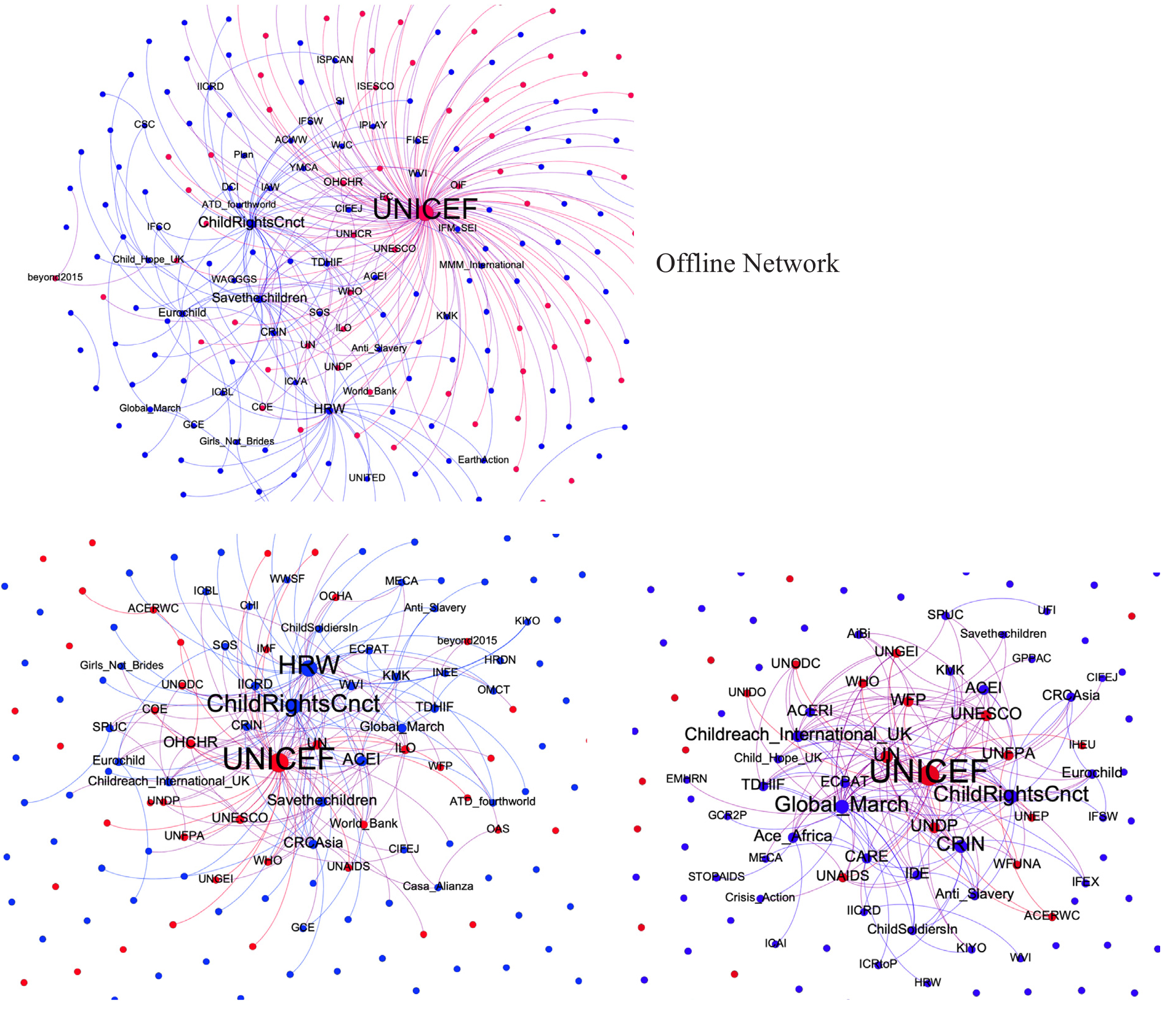 Figure 1: Visualization shows that while UN agencies remain central, the density and clustering of NGOs vary significantly between Twitter and Hyperlink layers.
Key Findings: The Digital "Youth" Advantage
The study produced two counter-intuitive results:
1. The Death of Distance
Geography was a significant predictor for offline ties (p < .05), but it held zero predictive power for Twitter or Hyperlinks. This confirms that ICTs are truly decentralizing who we talk to, even if they don't change who we formally partner with.
2. The Liability of Newness
In traditional sociology, "older" means "better." However, the ERGM results showed that younger organizations were more active online. For every year younger an organization is, its likelihood of forming Twitter ties increases. This suggests that younger NGOs use digital platforms to "buffer" their lack of historical legitimacy.
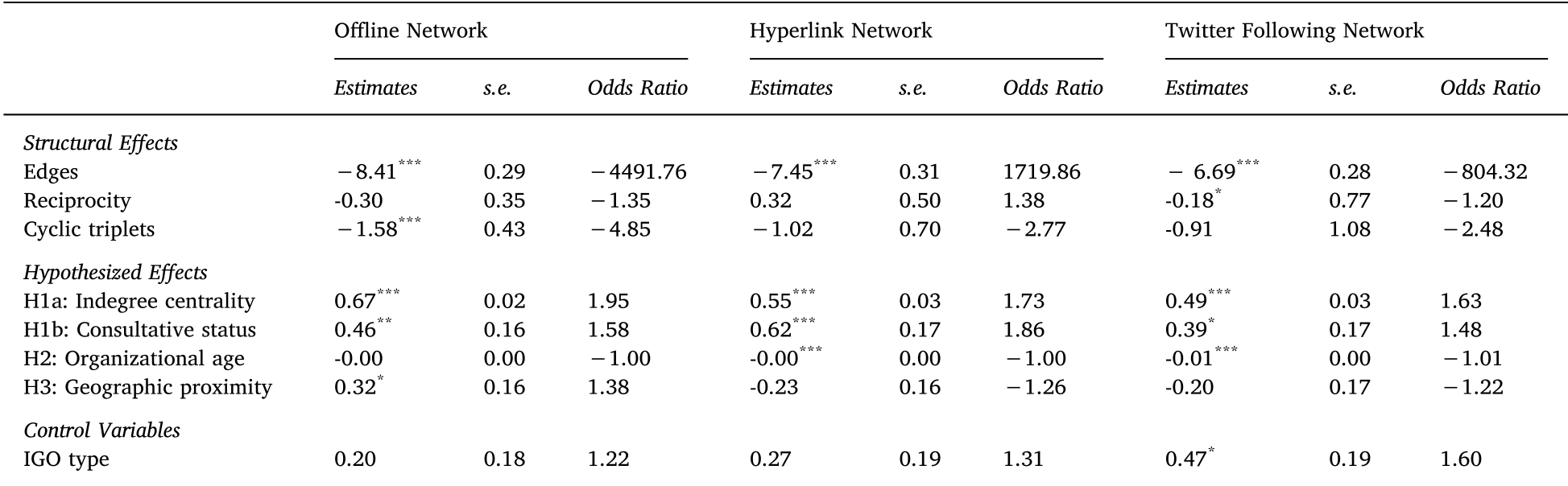 Table 2: Notice the negative estimate for Organizational Age in online networks and the significant positive estimate for Geographic Proximity only in the offline network.
Critical Insights & Future Outlook
Takeaway for Practitioners: If you are a young NGO, your digital strategy shouldn't just be about "posting updates." It should be about Strategic Representational Signaling. Using Twitter to follow high-status IGOs and establishing hyperlinks to global partners can compensate for a lack of local, offline resources.
Limitations: The study focuses only on Children's Rights. Would the same logic apply to more controversial sectors like political reform or religious NGO work? Furthermore, while Twitter is a proxy for "information flow," it does not necessarily result in "resource flow." The next frontier of this research lies in Cross-platform Influence: does a Twitter mention today lead to a formal partnership agreement next year?
Conclusion
This paper effectively refutes the idea that "online activity is just noise." By separating Status-seeking Logic from Resource-exchange Logic, Liu and Shin provide a roadmap for how humanitarian organizations can navigate the hybrid reality of modern advocacy.