
Scaling Social Presence: How One Human Can "Be" Four Robots at Once
15411_Teleoperation of Multiple Social Robots.
This paper introduces a semi-autonomous framework for the teleoperation of multiple social robots by a single operator. It proposes "Proactive Timing Control" (PTC) to manage auditory multitasking, enabling one human to successfully control up to four conversational robots with 100% supervision in critical sections.
TL;DR
Researchers have cracked the code for a single operator to manage four social robots simultaneously by treating human attention as a scheduled resource. Using a technique called Proactive Timing Control (PTC), the system manages social "traffic" by inserting natural fillers and chat behaviors, ensuring the operator is only "present" during the most critical conversational moments.
The Bottleneck of Social Teleoperation
In search-and-rescue, if a robot gets stuck, it can wait. In social interaction, silence is a failure. If a robot stops talking or fails to respond to a question for 10 seconds, the user walks away.
Current speech recognition and social reasoning still fail 70%+ of the time in noisy public environments like shopping malls. The "Wizard of Oz" (WoZ) method—where a human controls the robot—is the gold standard for quality, but it doesn't scale. How do we move from a 1:1 operator-robot ratio to a 1:N fleet without sacrificing the "human touch"?
Methodology: High-Level Autonomy meets Human Intervention
The authors solve this by breaking social interaction into a binary state machine:
- Critical Sections: Moments where the robot asks a question and must recognize the user's intent to proceed.
- Non-Critical Sections: Scripts, greetings, and explanations where the robot can safely "fly on autopilot."
The Secret Sauce: Proactive Timing Control (PTC)
Instead of waiting for a conflict to happen, the system reserves the operator. If Robot A is busy with the operator, and Robot B is about to ask a user a question, Robot B will proactively engage the user in a "filler" conversation—like talking about the weather or store promotions—to buy time.
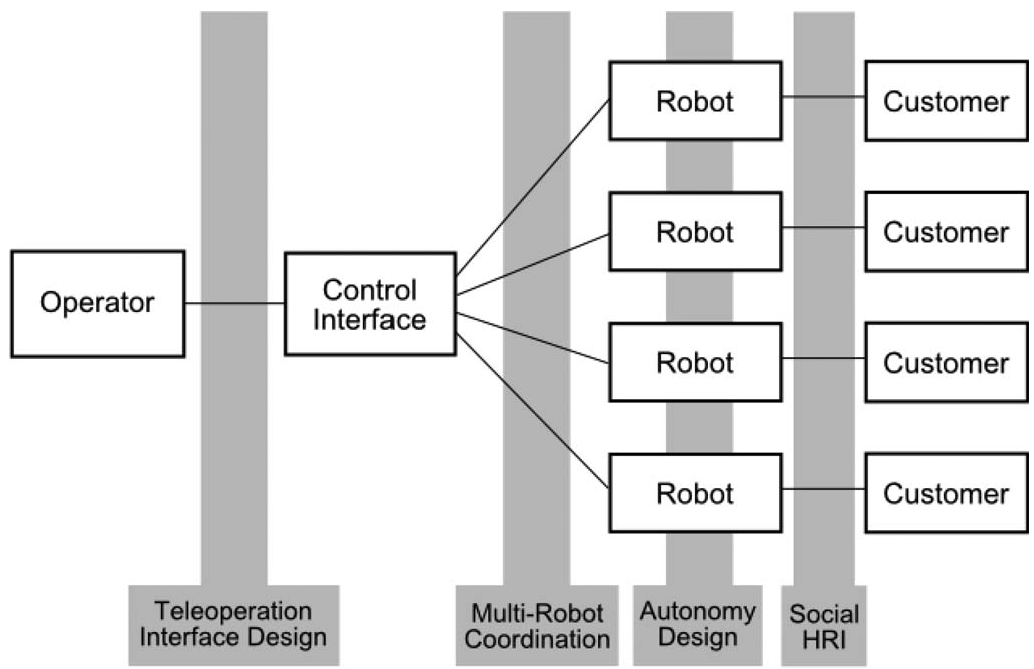 Figure 1: The general overview of the multirobot control system, highlighting the coordination between autonomy and manual control.
Experimental Results: Breaking the Fan-Out Limit
The team tested the system with one expert operator and 16 participants acting as customers in a route-guidance scenario.
- Success Rate: While a purely autonomous robot failed ~73% of interactions due to speech recognition errors, the teleoperated system achieved 100% success even when the operator was managing 4 robots simultaneously (using PTC).
- User Satisfaction: Surprisingly, users did not mind the "filler" talk. Satisfaction levels for the 4-robot setup with PTC were nearly identical to having a dedicated 1-on-1 human operator.
- Operator Experience: Without PTC, operators reported high stress and frustration (the "flashing red light" syndrome). With PTC, the workflow became a smooth "mesh" of scheduled tasks.
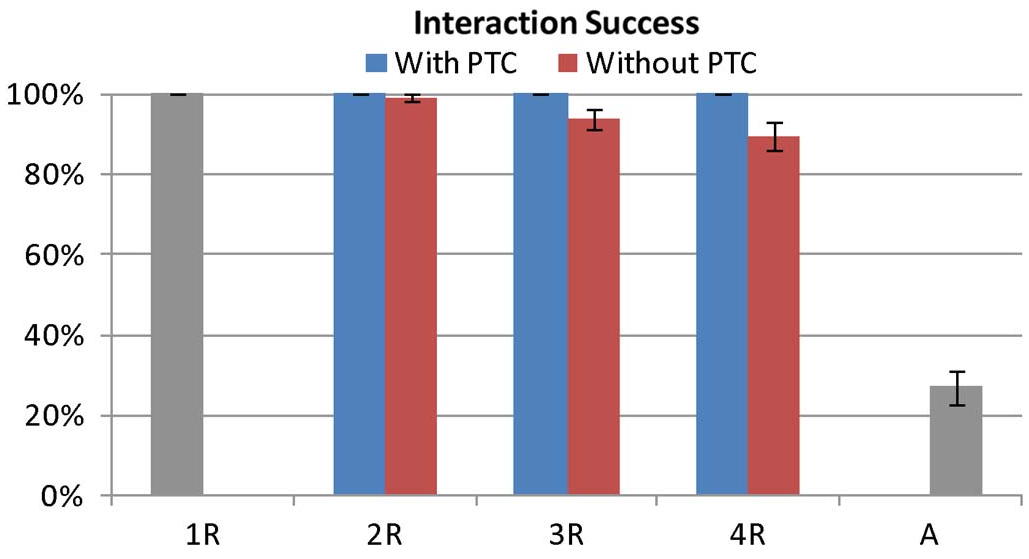 Figure 2: Interaction success rates across different robot counts. Note the dramatic delta between autonomous (A) and teleoperated modes.
Deep Insight: "Gears that Mesh"
The paper uses a brilliant analogy for multi-robot coordination: Gears. The "teeth" are critical sections, and the "gaps" are non-critical sections. To have four robots running, you must ensure the teeth never collide. PTC acts as a clutch, slowing down a gear (the robot) until its tooth lines up with an available gap in the operator's schedule.
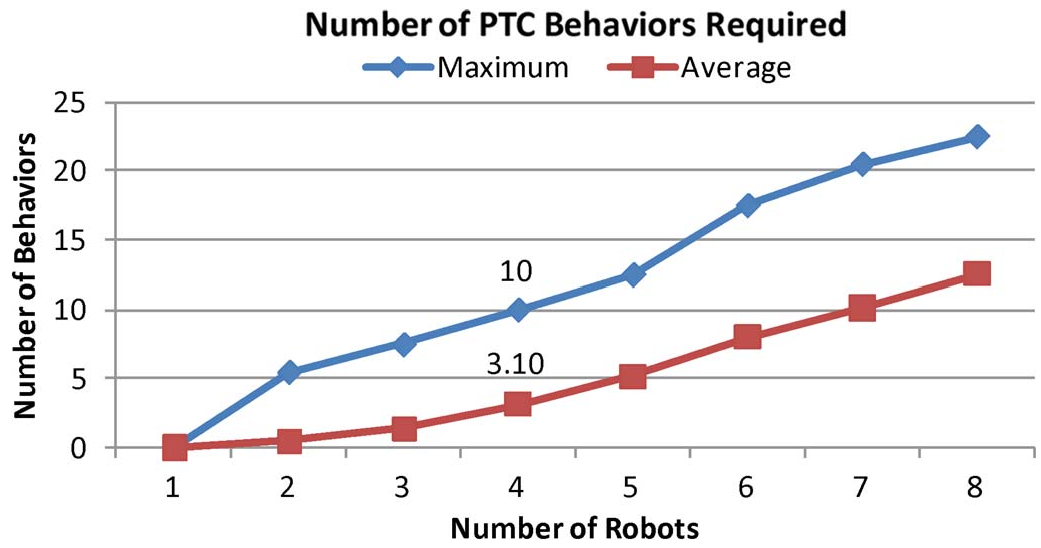 Figure 3: Simulation data showing how as the number of robots (N) increases, the system requires more PTC behaviors to stagger the interaction start times.
Conclusion and Future Outlook
This work shifts the focus of HRI from "making better AI" to "making better human-AI workflows." By acknowledging that AI will fail in complex social settings, we can design robots that are smart enough to know when they need help and social enough to hide the fact that they are waiting for it.
Limitations: The study used a laboratory setting. In the "wild," users might be in a rush and less tolerant of filler talk. However, for service industries like hospitality and information kiosks, this 1-to-4 scaling provides a viable economic path for social robots today.