
A Tempest in a Teacup? Deconstructing the Anatomy of Twitter Firestorms
A Tempest in a Teacup? Analyzing Firestorms on Twier
This study provides a large-scale empirical analysis of "Firestorms" on Twitter—sudden bursts of public outrage targeting institutions or public figures. By analyzing 80 major events (e.g., #myNYPD, #CancelColbert) using a 10% "decahose" Twitter sample, the authors quantify firestorm longevity and investigate their impact on social network structures.
TL;DR
Digital "firestorms"—those sudden tidal waves of negative mentions and hashtag hijacking—are a nightmare for PR departments. However, this study from Carnegie Mellon University reveals that these events are structurally isolated. By analyzing 80 major controversies, researchers found that firestorms are "socially transient": they don't emerge from existing friendships, and they don't result in lasting new connections. They are intense bursts of outrage that leave the underlying social fabric virtually unchanged.
Background: The Era of Outrage
Whether it's a corporate blunder or a controversial political statement, Twitter (now X) has a unique ability to aggregate negative sentiment into a "Firestorm." For years, brands and institutions have feared these moments as existential threats. The researchers set out to answer a fundamental sociological question: Do these events actually matter in the long run, or are they just "slacktivism" with no staying power?
Methodology: Mapping the Outrage
The team identified 80 candidate firestorms between 2011 and 2014, eventually drilling down into the 20 most viral cases. To understand the social dynamics, they used a 10% random sample of all tweets (the decahose).
Directly following the logic of the "biographical consequences of activism," the researchers analyzed mention networks. If a firestorm was significant, it should either:
- Arise from an existing, tight-knit community (indicating mobilization).
- Forge new, lasting ties between participants (indicating the birth of a movement).
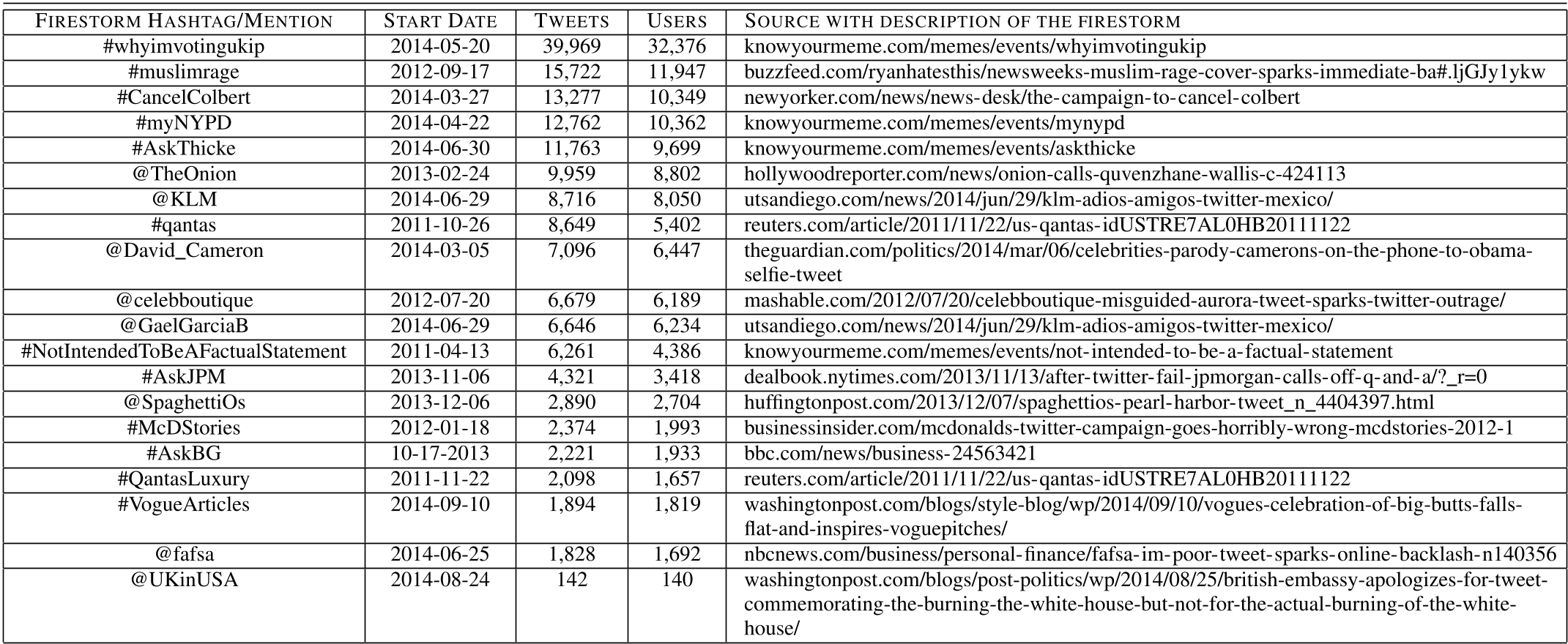 Table 1: The Top 20 Firestorm events analyzed, showing the diversity of targets from the NYPD to JP Morgan.
Key Insights: Why Firestorms are Transient
1. The Decay is Swift
Most firestorms reach their peak within 24 hours. Surprisingly, the size of the firestorm (volume of tweets) does not correlate with its longevity. Whether it's 1,000 tweets or 200,000, the "outrage cycle" typically burns out within 10 days.
2. Radical Structural Shifts
The researchers used the Jaccard Index to measure the similarity between directed mention networks over weeks. They discovered a "U-shaped" pattern of social stability.
The mention networks the week before and the week after the firestorm looked nearly identical. However, the week during the firestorm showed a massive departure from the norm. The usual "conversational" structure of the network was replaced by a centralized, chaotic mention system focused solely on the target.
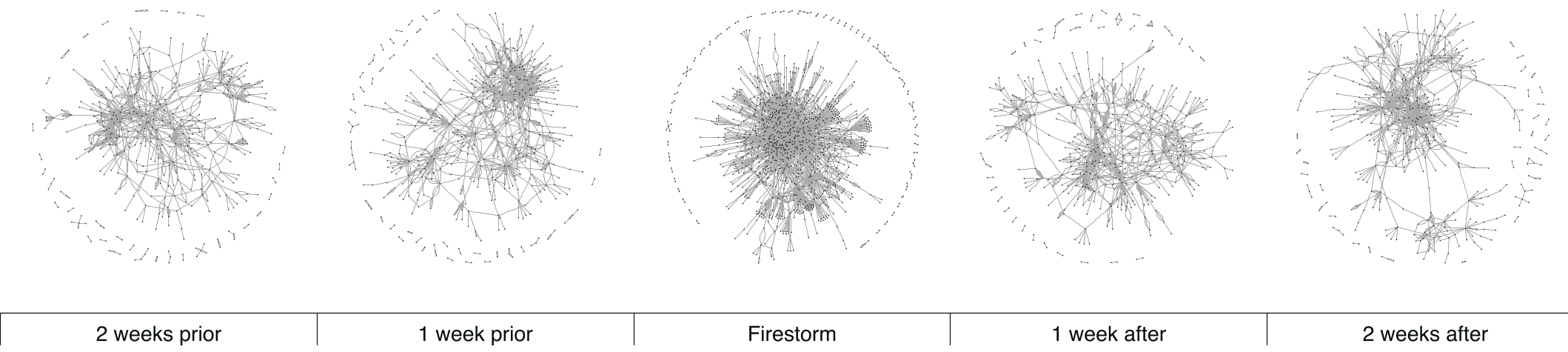 Figure 1: Evolution of the #AskJPM mention network. Note how the "During" phase (center) looks fundamentally different from the "Before" and "After" phases, which retain similar structures.
Case Study: #CancelColbert vs. #myNYPD
- #CancelColbert: Started by activist Suey Park, this firestorm showed a spike in volume but was quickly "diluted" by a second peak of people making jokes about the event weeks later. The network didn't hold.
- #myNYPD: A textbook case of "hashtag hijacking." While it successfully generated negative PR, the participants were largely a "churning" group of users who didn't continue interacting after the incident.
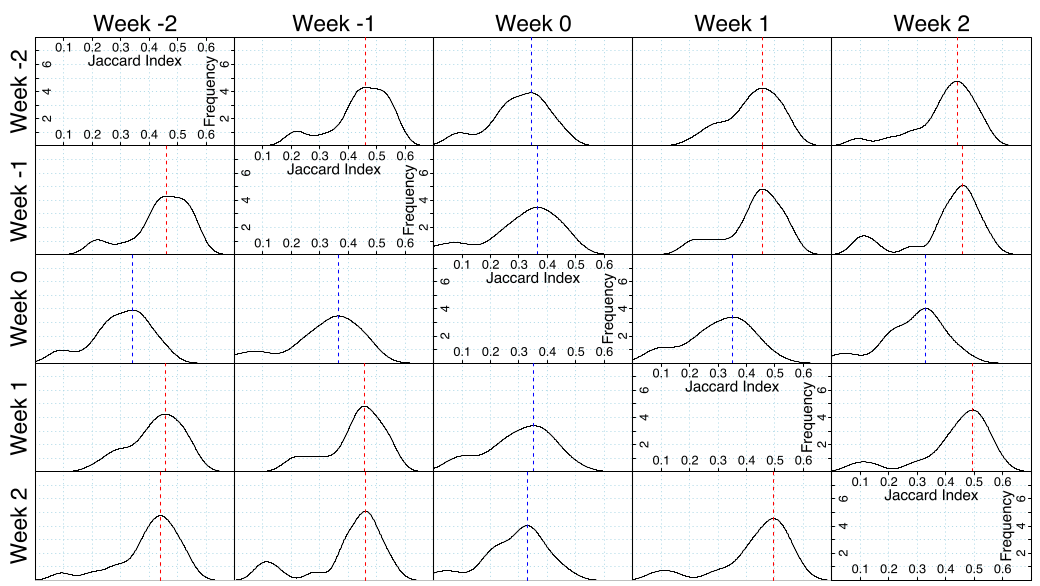 Figure 2: Jaccard index distributions. The matrix confirms that Pre- and Post-event weeks are more similar to each other than to the event itself.
Critical Analysis & Conclusion
The study concludes that firestorms are not the start of revolutions; they are temporary departures from normal social patterns.
Why does this happen? The authors suggest that because firestorms are often spontaneous and triggered by a single event (rather than a coordinated movement), they lack the "social glue" required for long-term impact. For participants, it's a low-cost way to signal virtue or anger without needing to commit to a community.
Limitations: The study focuses on mention networks as a proxy for social ties. While mentions are more significant than follows, they don't capture offline actions or hidden private messages. Furthermore, in the decade since this paper, "cancel culture" has become more institutionalized, potentially changing these dynamics.
The Takeaway for Brands: If you find yourself in the middle of a Twitter storm, remember: it’s likely a "tempest in a teacup." The social structure of your audience will likely return to baseline within two weeks, provided you don't provide a secondary trigger.