
Sequencer: Decoding the Evolution of Social Contexts via Temporal NER
Exploring Social Contexts along the Time Dimension: Temporal Analysis of Named Entities
This paper introduces Sequencer, a scalable pipelined information extraction system designed for the temporal analysis of Named Entities (NE) in news articles. By combining web crawling, hierarchical clustering, and Maximum Entropy-based NER, the system tracks how social contexts and entity relationships evolve over time in both official media and user-generated content.
TL;DR
Social dynamics are not static; they evolve. Sequencer is a technical framework designed to move beyond traditional, static Named Entity Recognition (NER). By analyzing news articles as chronological sequences, it identifies how entities (people, places, organizations) fluctuate in importance, providing a "weather map" of social contexts over time.
Background: Static Extraction in a Dynamic World
Most NLP pipelines treat documents as isolated snapshots. However, a news story about an election or a natural disaster is a living entity. The "Who" and "What" of a story today might be entirely different from the "Who" and "What" of the same story next week. Existing systems often struggle with Entity Linking across documents and fail to capture the velocity of change in social relationships.
Methodology: The Four Pillars of Sequencer
The authors proposed a pipeline architecture designed for scale and adaptability:
- Crawl: Utilizing Apache Nutch and Hadoop to ingest massive amounts of unstructured text from news sites like CNN.
- Cluster: Documents are grouped using agglomerative hierarchical clustering. The system measures Cosine Similarity of TF-IDF vectors to determine if a new article belongs to an existing thread or starts a new one.
- Extract: A Maximum Entropy approach is used for NER. Unlike binary classifiers, this provides a probability distribution, allowing the system to handle the inherent ambiguity of news language.
- Visualize: Transforming raw counts into cognitive insights.
Detecting Change-Sets
One of the most sophisticated parts of the methodology is how the system handles "Shifting" clusters. By calculating an Entity Overlap Score (Equation 3 & 4), the system can detect when the underlying topic of a cluster has radically changed even if the URLs remain the same.
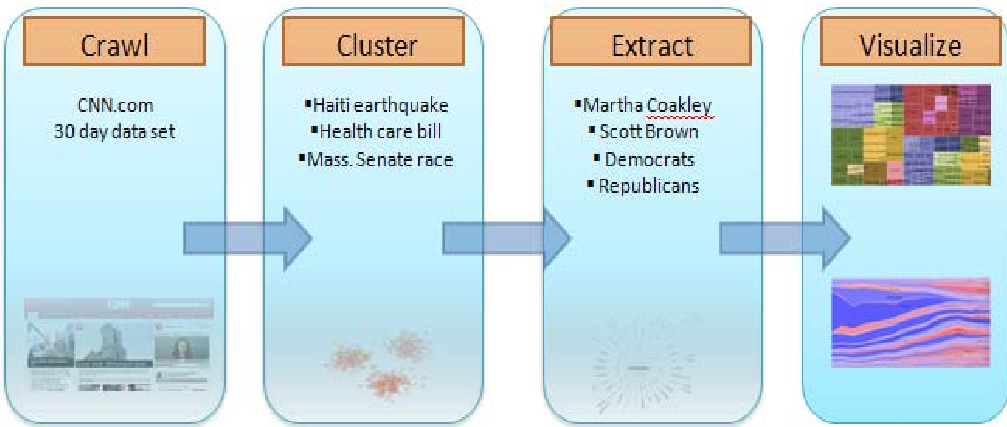 Figure 1: The processing phases used in Sequencer: from raw web crawling to visualization.
Experiments & Insights: The Massachusetts Election Case Study
The researchers tested the system on a 30-day snapshot of CNN data. A standout example was the coverage of the Massachusetts Senate election.
Early in the sequence, the "social context" was dominated by broad political terms (Republicans, Democrats, Obama). As the election date approached, the entities Scott Brown and Martha Coakley rapidly gained "temperature," eventually dominating the discourse.
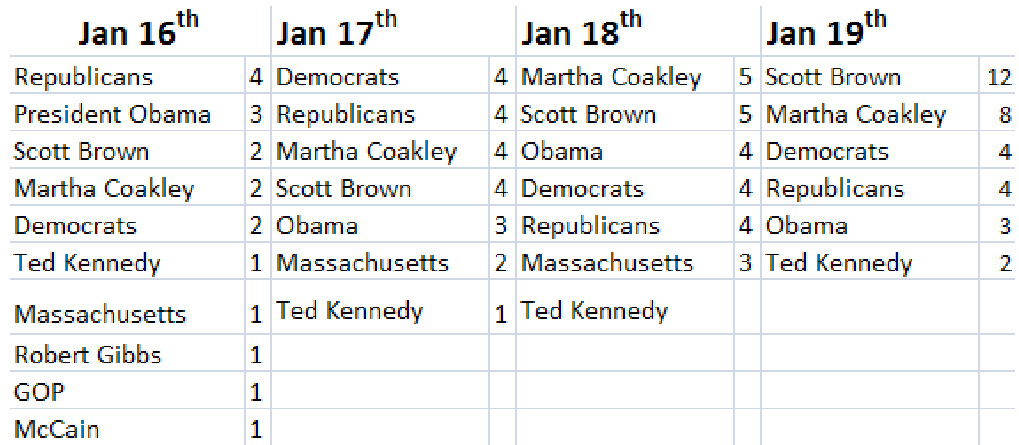 Table 1: Evolution of entity prominence leading up to the election.
Visualizing "Temperature"
The system uses two primary visualization modes:
- Stacked-Time-Series: Shows the relative volume of entities over time, highlighting when one person "overtakes" others in media attention.
- TreeMaps: Uses color (red for increase, blue for decrease) to represent the "temperature" or rate of change of specific entities.
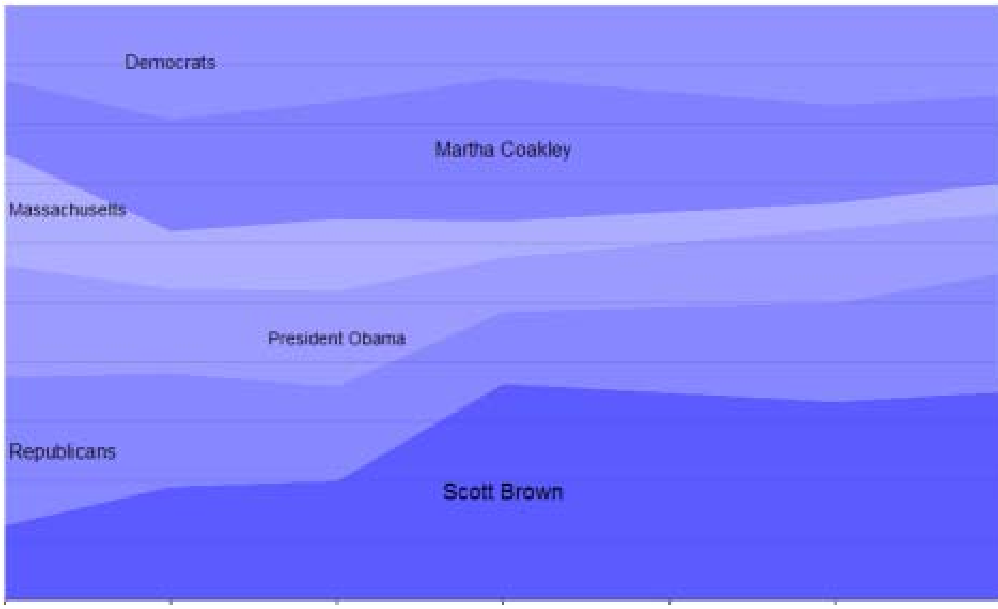 Figure 2: Stacked time series showing the shift in focus from political parties to specific candidates.
Critical Analysis & Future Outlook
Strengths: The system is highly modular and addresses the "temporal drift" problem that many current RAG (Retrieval-Augmented Generation) systems still face today. Its ability to distinguish between media viewpoints and user-generated content (like iReport) offers a path to quantifying media bias.
Limitations: The NER model was trained on a relatively small dataset (1,000 sentences), which is below the recommended 15,000+ for production-grade robustness. Furthermore, the handling of misspellings and informal grammar in user-generated content remains a significant hurdle.
Conclusion: Sequencer proves that by adding a time dimension to NER, we can transform simple text extraction into a powerful tool for social dynamic analysis. Future iterations that leverage modern Transformers could likely solve the linguistic "noise" issues identified by the authors.