
Beyond Static Rules: Capturing Agricultural Dynamics via Inter-transactional Data Mining
Temporal Approaches in Data Mining. A Case Study in Agricultural Environment
This paper presents a comparative study of data mining techniques applied to Integrated Control in agriculture. It proposes the adoption of the Inter-transaction Association Rule model to capture complex temporal dependencies between biological pests, chemical treatments, and environmental factors.
TL;DR
In the complex ecosystem of "Integrated Control" (managing pests through biological and chemical means), static data mining is insufficient. This paper explores why traditional association rules fail in dynamic agricultural contexts and advocates for Inter-transaction Association Rules. This approach allows for the discovery of temporal dependencies across different days or weeks, transforming historical logs into a robust knowledge base for expert decision systems.
The "Static" Trap in Dynamic Domains
The core challenge in Integrated Control is the strict timing requirement: biological agents have "persistence" periods, and certain chemicals are incompatible if applied too close together.
When the authors applied standard Apriori algorithms to agricultural databases, the results were underwhelming. By segmenting data into arbitrary windows (days, months, or years), they found that the "support" (frequency) of rules dropped drastically. Why? Because agriculture is a flow, not a snapshot. A treatment today is biologically linked to an observation three days ago, a connection that intra-transaction mining—which only looks at items within a single record—completely misses.
Methodology: The Inter-transactional Leap
To solve this, the paper shifts the paradigm from Intra-transaction (A and B happen together) to Inter-transaction (A happens, then B happens at interval ).
How it Works:
- Extended Database Transformation: Each transaction is mapped into a multidimensional space using a "dimensional attribute" (usually Time).
- Relative Addressing: Instead of looking at absolute dates, the algorithm looks at the distance between events.
- Pattern Synthesis: It extracts "Large Extended Itemsets."
For example, a traditional rule might find that "Pest X and Chemical Y occur together." The inter-transactional version finds: {Δ0(Pest_X), Δ3(Chemical_Y)}.
Interpretation: "If Pest X is detected, Chemical Y is typically applied 3 time units later."
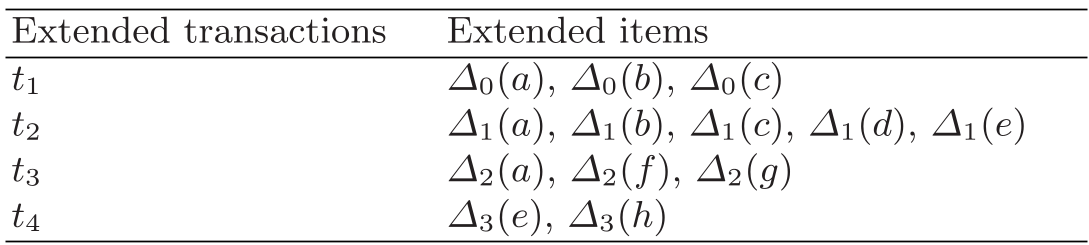 Table: Comparison of standard records vs. extended inter-transactional items.
Experimental Insights
The authors conducted a case study using a database reflecting species like Pepper and Grapes across various areas (APIs). Their visualization of "Number of Rules vs. Minimum Support" across different time scales (Day, Month, Year) proved that as the time window shrinks to increase precision, the statistical significance of non-temporal rules vanishes.
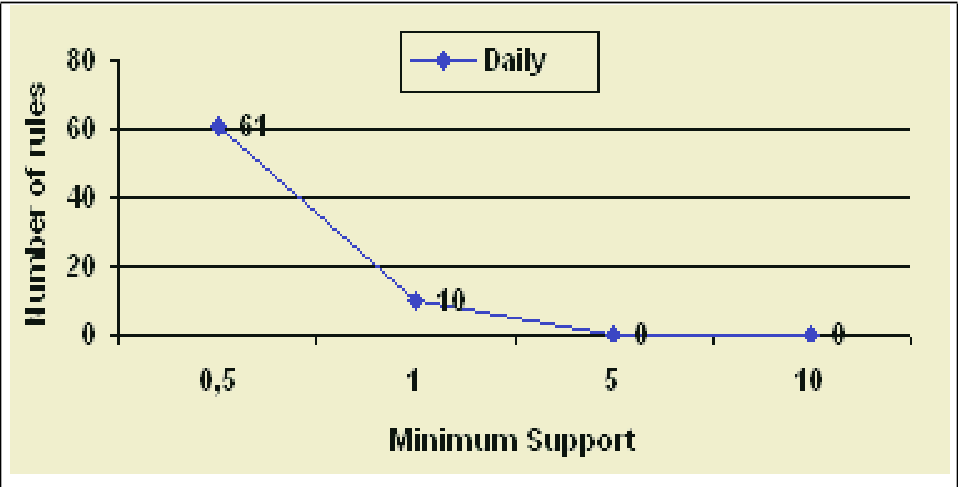 The decline in discovered rules as temporal precision increases highlights the limitations of traditional Apriori.
The breakthrough comes from using these inter-transactional patterns to feed into a Disjunctive Fuzzy Temporal Constraint Network. This allows the system to not only "describe" what happened but to "prescribe" future actions by anticipating biological persistence and chemical overlaps.
Critical Analysis & Future Outlook
The primary contribution of this work is the bridge it builds between Data Mining and Expert Systems (SAEPI).
- The Duality Property: The authors correctly identify that a discovered temporal pattern is essentially a temporal constraint. This is vital for validating expert knowledge—if the data says a chemical is applied 3 days after a pest, but the expert says 7 days, there is a gap to investigate.
- Limitations: The paper acknowledges that the current model is one-dimensional (time). In real-world agriculture, spatial dimensions (the distance between greenhouses) are just as critical.
- Future Impact: Integrating fuzzy logic into this temporal framework will be the next frontier, allowing the system to handle the "vagueness" of biological growth cycles that don't always follow strict calendar days.
Conclusion
This study serves as a technical manifesto for moving away from "flat" data analysis in favor of context-aware, temporal models. In the high-stakes environment of Integrated Production, understanding the when is just as important as understanding the what.