
Digital Apostles: How Influencers Drive the Global Rise of Veganism
Using a Temporal-Causal Network Model for Computational Analysis of the Effect of Social Media Influencers on the Worldwide Interest in Veganism
This paper presents a computational investigation into the growth of veganism using a temporal-causal network model to simulate social contagion on Instagram. The study demonstrates how a single social media influencer can drive widespread lifestyle changes across a population, successfully replicating the global rise in vegan interest observed between 2012 and 2018.
TL;DR
Why did veganism go from a niche lifestyle to a global phenomenon in less than a decade? This paper uses Temporal-Causal Network Modeling to prove that the "Influencer Effect" isn’t just marketing jargon—it is a measurable mathematical driver. By simulating Instagram’s social contagion, researchers showed that a single high-impact node can shift an entire population's sentiment, matching real-world Google Search trends with striking accuracy.
The "Why" Behind the Peak: More Than Just Salads
Traditional research into veganism often asks why individuals change (e.g., "I love animals"). However, these qualitative insights fail to explain the network dynamics—the "how" of the rapid, exponential growth seen since 2012.
The researchers identified a gap in existing literature: we understand the motivation, but we don't understand the transmission. They hypothesized that social media influencers act as the primary engines of Social Contagion, leveraging Cialdini's principle of Social Proof: when we see many people (or the "right" popular people) doing something, we perceive it as the correct behavior.
Methodology: Mapping the Mind and the Network
The study employs a Network-Oriented Modeling approach. Unlike static models, this framework treats causal relations as dynamic entities that manifest over time.
1. The Scale-Free Architecture
Real social networks aren't random; they follow a "scale-free" pattern where most people have few connections, and a few "hubs" (Influencers) have many. The researchers built a 50-agent network divided into clusters to simulate realistic social silos.
2. The Math of Persuasion
To simulate how an opinion changes, the model uses a differential equation where the change in an agent's state () depends on:
- Connection Weight (): How much Agent A trusts Agent B.
- Speed Factor (): How quickly an individual adopts new information.
- Advanced Logistic Function: A sophisticated threshold-based formula that aggregates multiple influences (e.g., seeing five friends post about veganism vs. just one).
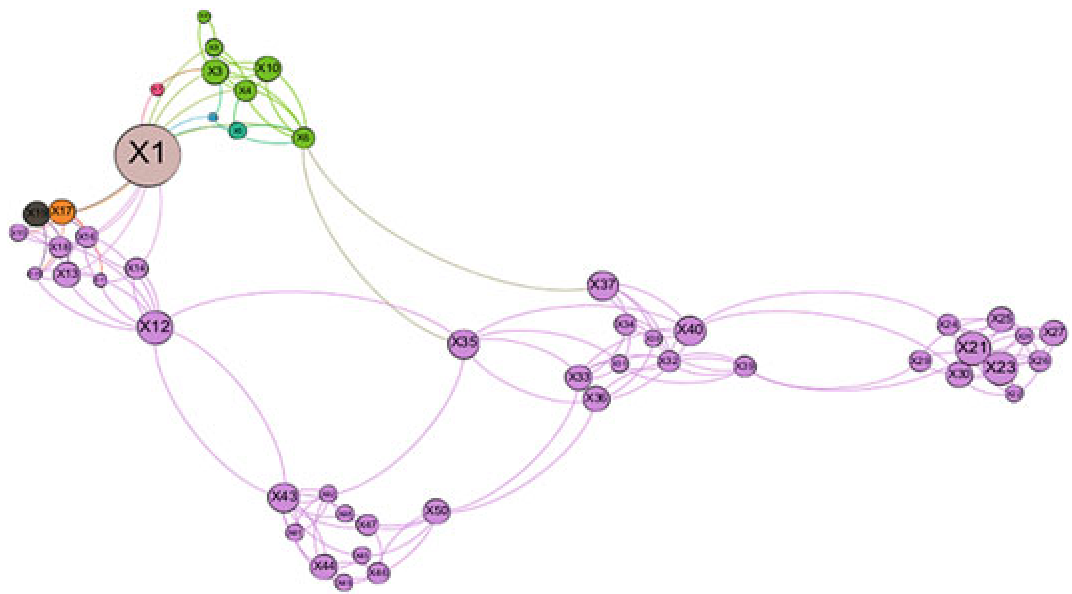 Figure 1: Conceptual representation of the network clusters and the influencer's reach.
Experiments: The Influencer is the Variable
The researchers ran two distinct scenarios to isolate the impact of the social media personality:
- Scenario 1 (With Influencer): One "Influencer" node (high outgoing connections) consistently posts vegan content.
- Scenario 2 (Without Influencer): The same network structure exists, but the high-impact node is silenced.
The Results
The difference was night and day. In Scenario 1, the "interest level" of the entire network climbed steadily, mimicking the monotonically increasing trend of real-world Google search data. In Scenario 2, the network stagnated. Without the central "push" of the influencer, even agents who were initially vegan failed to convert their peers, and some even reverted due to the surrounding non-vegan influence.
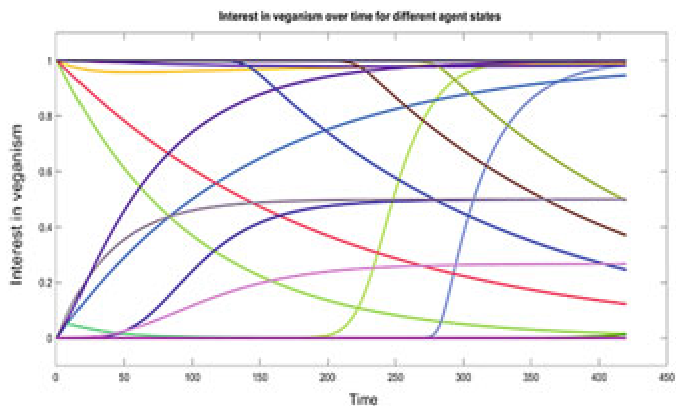 Figure 2: Multi-agent simulation showing the spread of interest (Left: With Influencer, Right: Without).
Validation: Tuning the Model to Reality
To ensure the model wasn't just theoretical, the team used Parameter Tuning via MATLAB. They compared their simulated "Average Interest" against 2012–2018 Google Search data for the word "Vegan." By adjusting the Speed Factor (), they achieved a Root Mean Square (RMS) error of only 0.0076, indicating an almost perfect fit with empirical human behavior trends.
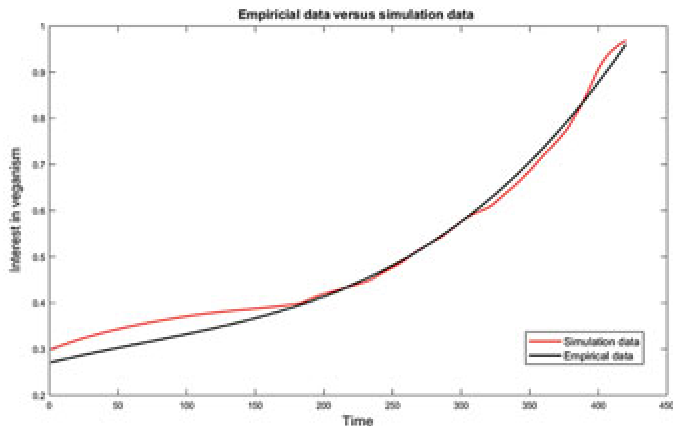 Figure 3: The model's output (blue) aligned with calibrated Google Search data (red).
Critical Insight & Future Outlook
The takeaway is clear: Network topology matters as much as the message.
The study's limitation lies in its simplified view of "interest" (using search data as a proxy for belief). However, it provides a powerful proof of concept for using Temporal-Causal networks to understand lifestyle trends. For future AI and sociology research, this suggests that if we want to promote "green" behaviors or public health initiatives, identifying and activating the "Hub Nodes" (Influencers) within a temporal-causal framework is far more effective than broad-spectrum advertising.
The future of social change is not just what is being said, but who is saying it—and at what speed the network is designed to listen.