
Hierarchical Defense: Why Human Mobility is the "Hidden Carrier" of Social Worms
16058_The Temporal Characteristic of Human Mobility Modeling and Analysis of Social Worm Propagation.
This paper introduces a novel analytical model for social worm propagation that incorporates the temporal characteristics of human mobility within hierarchical networks. By utilizing a discrete model and difference-equation methods, the authors mathematically define the upper and lower bounds of infection scale and identify the conditions for maximum spread speed.
TL;DR
Recent research from Tianbo Wang et al. reveals that current network security models are dangerously optimistic. By ignoring the fact that humans move between physical locations and use multiple devices, traditional models underestimate the "infection scale" of social worms. This paper introduces a hierarchical analytical model that proves social worms spread fastest when human behavior—specifically checking messages and moving locations—becomes synchronized.
Background Positioning
In the landscape of network security, social worms are unique because they exploit trust and behavior rather than just software bugs. This work moves beyond simple graph theory to a "hierarchical network" perspective, positioning itself as a vital theoretical correction to the SOTA (State of the Art) models like SII (Susceptible-Infected-Infected) that treat network topology as a flat, static entity.
Problem & Motivation: The Mobility Gap
Why do our current models fail? The authors point to a fundamental oversight: The one-to-many relationship.
- Topology Mismatch: Most models focus on the social layer (who follows whom) but ignore the physical layer (which computer is being used).
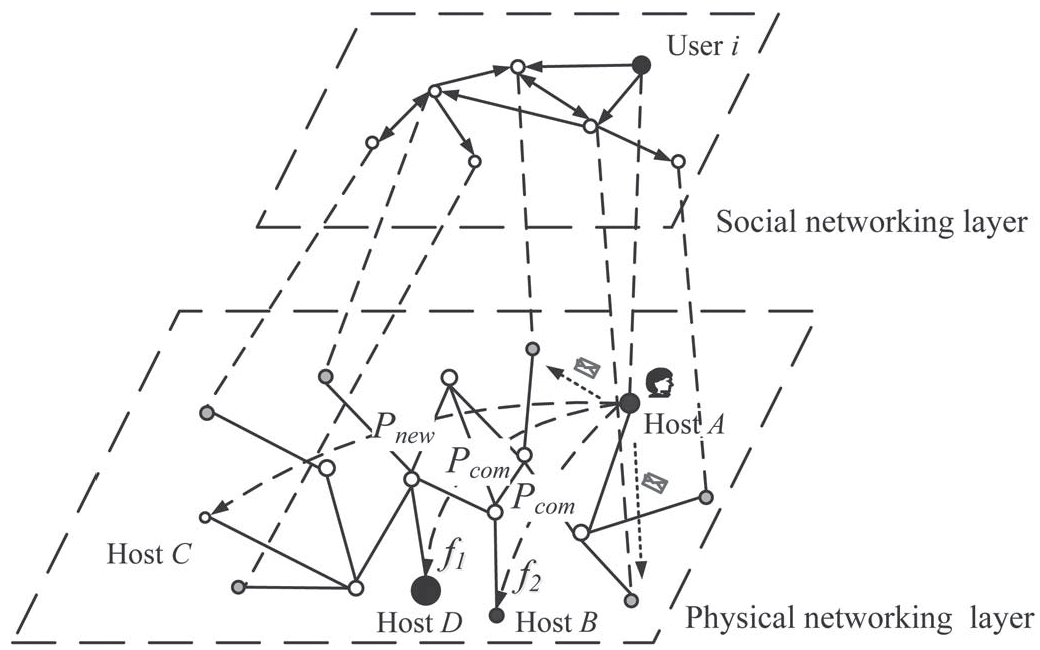
- Human Mobility: A user might check their social media at home, then at a café, and then at work. If their account is compromised, they don't just infect one "node"—they potentially seed the worm across three different physical subnets.
- Temporal Dynamics: The "when" is as important as the "where." The timing of when a user checks for messages vs. how long they stay at a location determines the window of opportunity for a worm.
Methodology: Mapping the Hierarchical Spread
The core of this paper is the mathematical fusion of social dynamics and physical mobility.
1. The Hierarchical Model
The authors visualize the network in two layers:
- Social Layer: Users and friend relationships (Nodes and Edges).
- Physical Layer: Hosts and interconnect devices.
2. The Mobility Matrix
To quantify this, the authors use a matrix representing the number of locations visited. The probability of infection is not just a static , but a function of:
- : Time interval between checking messages.
- : Time spent at a specific location.
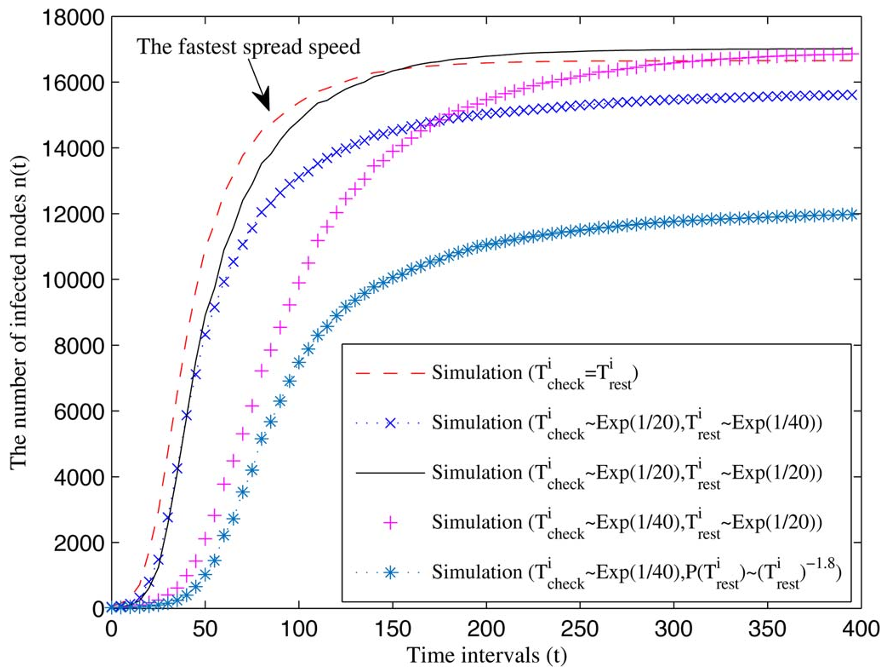
The most striking mathematical insight is the Speed Factor Theorem. The authors prove that the spread speed is maximized under a specific temporal condition: . This suggests that if your habit is to check your phone exactly as often as you change locations, you become the "perfect" carrier for a social worm.
Experiments & Results: Accuracy Recovered
The authors validated their model using a 10,000-node simulation with Power-law distribution (reflecting real-world social "hubs").
SOTA Comparison
As shown in the performance graphs, previous models (the dashed lines) plateaued much earlier than the actual simulation results. The authors' model (red line) tracked the ground truth with high precision.
The "Synchronicity" Effect
Figure 4 in the paper demonstrates that when the difference between checking time and resting time is minimized (high synchronicity), the infection curve becomes significantly steeper. This confirms that predictable human routines actually assist the "intelligence" of social worm propagation.
Critical Analysis & Conclusion
Takeaway
The paper successfully demonstrates that infection scale is bounded between . This means the potential damage is much higher than we thought—up to (the number of locations a user visits) times higher.
Limitations
While the model is robust, it assumes a Gaussian or Exponential distribution for human behavior. In the real world, "bursty" behavior (checked social media 10 times in 5 minutes, then not for 5 hours) might create even more chaotic propagation patterns that a discrete-difference equation might struggle to capture perfectly.
Future Outlook
This research opens the door for Behavioral Immunization. Instead of just patching software, companies could implement "behavioral throttling"—detecting when a user’s cross-device activity matches a high-risk mobility pattern and temporarily increasing the friction for link-sharing.
Conclusion: By factoring in the "human" in human mobility, this paper provides a more honest—and sobering—look at how vulnerable our interconnected lives truly are.