
Decoding the Student Mind: Temporal Data Mining in Intelligent Tutoring Systems
Temporal Data Mining for Educational Applications.
The paper presents a comprehensive survey of temporal data mining techniques applied to Intelligent Tutoring Systems (ITS), specifically Wayang Outpost and AnimalWatch. It introduces methods for classifying student actions, mining predictive rules with Very Predictive Ngrams (VPN), and inferring unobservable "engagement" states using Hidden Markov Models (HMMs).
TL;DR
This research explores how we can peek into the "black box" of student behavior using Intelligent Tutoring Systems (ITS). By applying temporal data mining—from simple action classifiers to complex Hidden Markov Models—the authors identify patterns of "gaming the system" and quantify the steady decline of student engagement over time. The results prove that how a student interacts with a system is just as important as whether they get the answer right.
Problem & Motivation: The "Help-Seeking" Paradox
In the era of educational accountability, we often focus on the final score. However, a score of 100% is meaningless if the student simply "abused" the system—repeatedly clicking for hints until the answer appeared.
The core technical challenge is that learning is an unobservable state. We can see a student click a button (the What), but we don't know their intent (the Why). Prior work often failed to account for the temporal dimension—how a sequence of actions over 30 minutes reveals a student's cognitive journey or their eventual exhaustion.
Methodology: The Core Analytical Scales
The authors tackle the data at three distinct scales:
1. The Micro-Scale: Action Classifiers
Instead of treating every click as equal, the authors developed classifiers that incorporate latency (time intervals).
- Guiding Intuition: A correct answer in 2 seconds on a difficult problem isn't "mastery"; it's a "guess."
- Action Patterns: They defined categories like Guessing, Learning via Multimedia, and Independent Solving based on the relationship between accuracy and time-on-task.
2. The Sequence Scale: Predictability with VPN
To predict what a student will do next, the authors used Very Predictive Ngrams (VPN).
- The Insight: Does a student's behavior depend on their entire history, or just the last few actions?
- The Result: The "Order-1" Markov property dominates—meaning the best predictor of the next action is almost always just the immediately preceding action.
3. The Latent Scale: Hidden Markov Models (HMM)
To solve the problem of unobservable intent, the authors employed HMMs with three hidden states representing Engagement Levels (Low, Average, High).
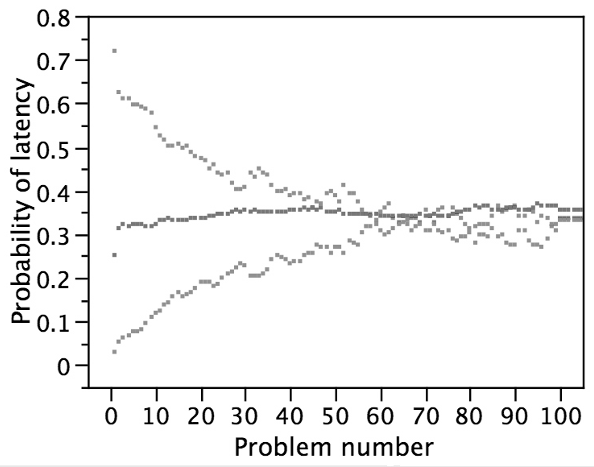 Fig 1: The Probability of High Engagement (top line) versus Low Engagement (bottom line) over the course of a session.
Experiments & Results: The Engagement Drop-Off
The research utilized data from two math tutors: Wayang Outpost (High School) and AnimalWatch (Middle School).
The "Rushing" Phenomenon
As shown in the temporal analysis, students' willingness to spend significant time on problems (the ">35 seconds" category) drops sharply as the session progresses.
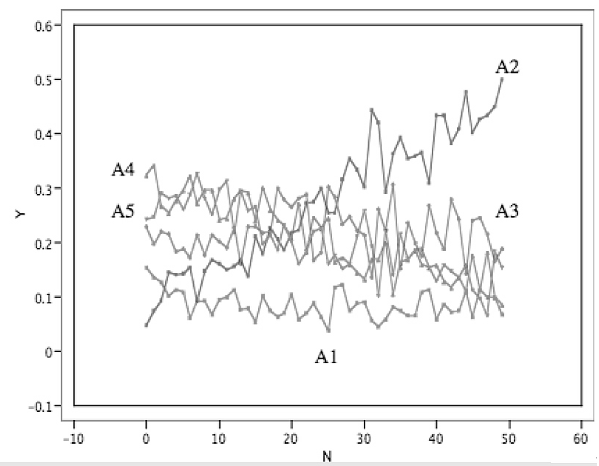 Fig 2: Students shift from deliberate problem-solving to "rushing" behavior as session length increases.
Learning Outcomes: Heuristic vs. Text
The study compared a "Heuristic" group (received interactive multimedia help) against a "Text" group (only accuracy feedback).
- Quantifiable Gain: The Heuristic group mastered 5.0 topics on average, compared to only 3.5 for the Text group.
- Why it matters: Multimedia hints don't just provide the answer; they maintain engagement and provide the scaffolding necessary for mastery in complex topics.
Critical Analysis & Conclusion
Takeaway
The paper successfully demonstrates that student engagement isn't a static trait but a dynamic, declining resource. By modeling this decline using HMMs, ITS systems can potentially "intervene" exactly when the model detects a transition from High to Low engagement.
Limitations
- Manual Feature Engineering: The "action patterns" were designed by experts, not learned. Future work should look at Deep Learning to automatically induce these patterns from raw clickstream data.
- Validation of Latent States: While the HMM correlates with performance, "Engagement" remains a psychological construct that is difficult to validate without external data (like video or physiological markers).
Future Outlook
This work sets the stage for Proactive Tutoring. Imagine a system that sees a student start to "guess" (via an Order-1 Markov transition) and automatically switches to a more gamified or interactive mode to recapture their drifting attention.