
Decoding Renal Decay: Why Multi-Task Learning is the Key to Temporal EHR Analysis
Incorporating temporal EHR data in predictive models for risk stratification of renal function deterioration
The paper introduces a Multi-task Learning (MTL) framework for predicting short-term renal function deterioration using longitudinal Electronic Health Records (EHR). By modeling time-windows as separate but related tasks, the authors achieved superior risk stratification (AUROC improvement) for patients with mildly compromised kidney function compared to aggregate non-temporal baselines.
TL;DR
Predicting the decline of kidney function is notoriously difficult due to the "noisy" nature of hospital records. This paper proves that Multi-Task Learning (MTL) excels where standard regression fails. By treating time intervals as correlated tasks, the researchers identified high-risk patients more accurately, showing that the "importance" of a symptom changes as a disease progresses.
Background: The "Static" Fallacy in Clinical AI
Most clinical predictive models treat a patient's history as a "bag of features." They aggregate five years of blood pressure readings into a single average, effectively ignoring the direction and velocity of the patient's health trajectory. In the context of Chronic Kidney Disease (CKD), where the transition to Stage 3b marks a point of no return for cardiovascular mortality, this lack of temporal nuance is a missed opportunity for early intervention.
The Challenge of "Dirty" Data
The authors identify two primary hurdles in Electronic Health Records (EHR):
- Irregular Sampling: Patients don't visit the doctor on a set schedule. One might have three visits in a week and then none for six months.
- Varying History Lengths: Some patients have decades of data; others have only two years.
Methodology: From Stacking to Multi-Tasking
The researchers compared three architectures to find the best way to handle time:
- Non-Temporal: The "Bag of Features" baseline.
- Stacked-Temporal: Concatenating features from different windows into one giant vector. (Prone to overfitting as dimensions explode).
- Multitask-Temporal (The Winner): This approach treats each 6-month window as a separate learning task.
The Secret Sauce: Temporal Smoothness
The brilliance of the MTL approach lies in the Temporal Smoothness Constraint. By adding a penalty to the loss function that discourages drastic changes in model weights between adjacent time windows (), the model remains stable even when a specific time window has very few data points.
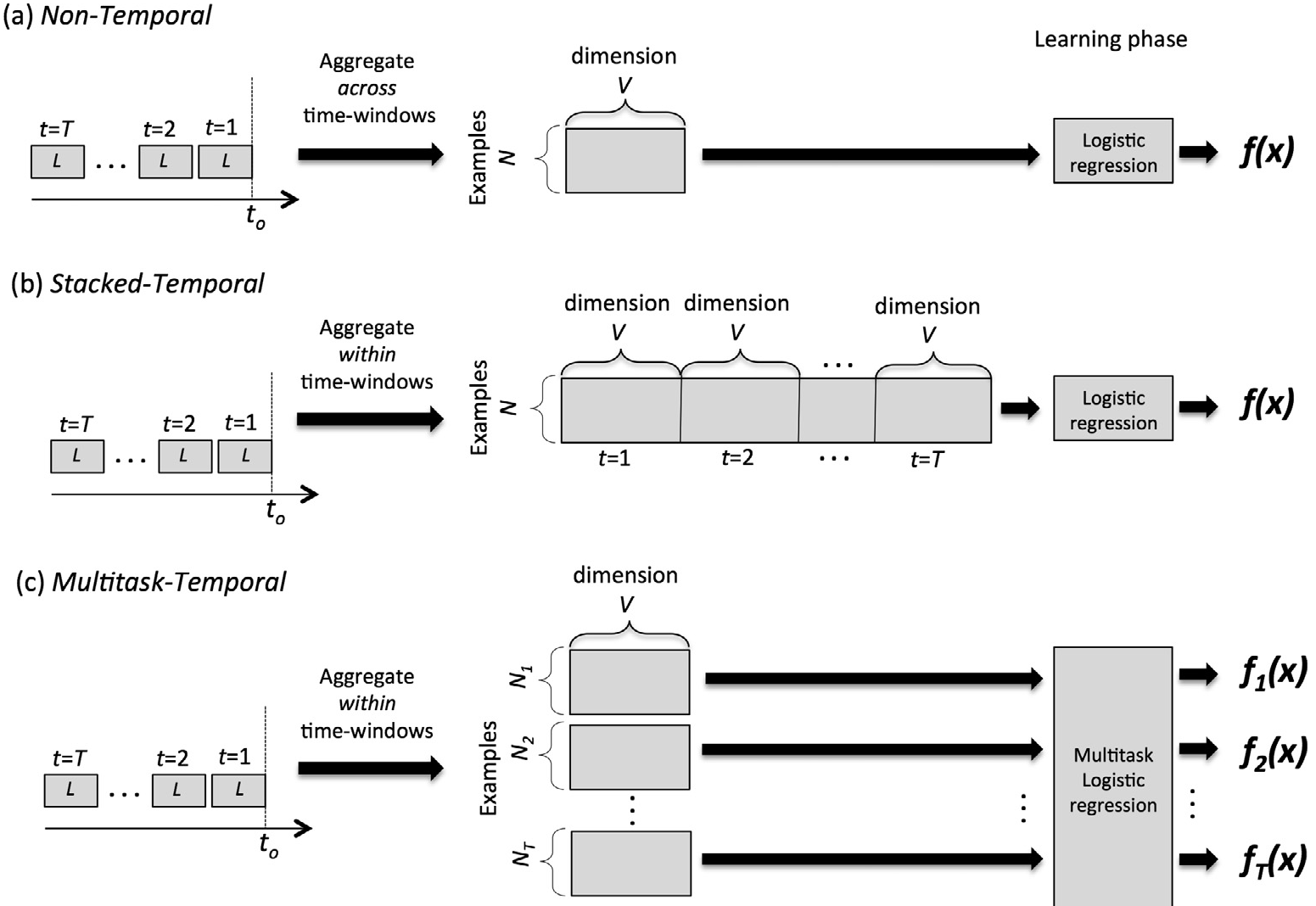 Figure 1: Comparison of Non-Temporal, Stacked, and Multi-task architectures.
Key Findings: The "Shifting" Importance of Symptoms
The study’s most insightful revelation is that the importance of a predictor varies over time. For example, certain ICD-9 codes (diagnoses) might be strong indicators of future decline when they appear 2 years prior, but lose predictive power as the "drop" event approaches, replaced by more acute lab values.
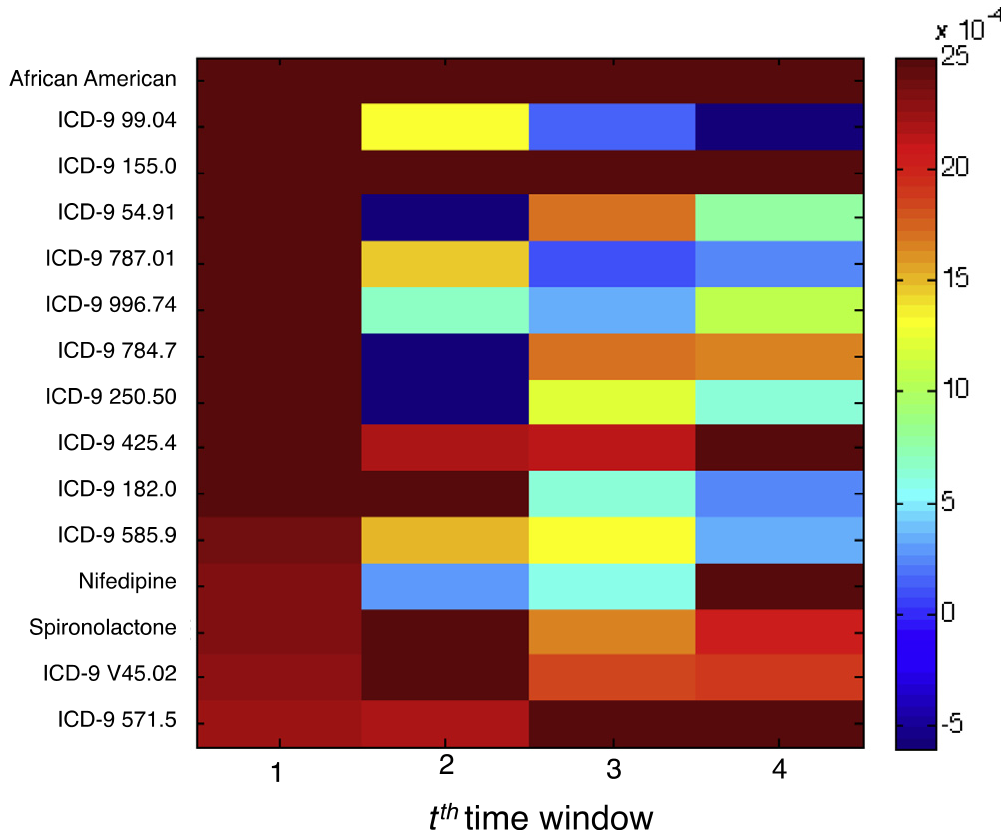 Figure 2: Visualization showing how normalized weights for specific variables fluctuate across time windows.
Results at a Glance:
- AUROC Improvement: The MTL model consistently beat the non-temporal baseline across different eGFR drop thresholds (10% and 20%).
- Risk Stratification: Patients in the highest quintile of the model's predicted risk were 7.7 times more likely to experience a 20% drop in kidney function than those in the lowest quintile.
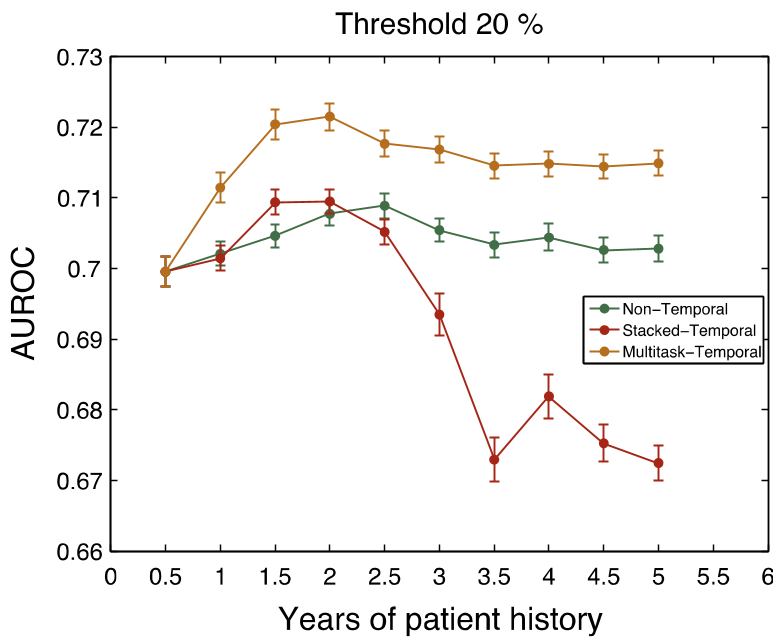 Figure 3: Performance (AUROC) vs. years of patient history. Note the dip in Stacked performance due to overfitting.
Critical Insight: Why Stacked Models Fail
The "Stacked" approach (simply adding more features for more years) initially improves but eventually suffers a performance dip (see Figure 3). This is a classic case of the "Curse of Dimensionality." As you add more time windows, the number of parameters grows until the model begins to memorize noise rather than learn patterns. The MTL approach fixes this by keeping the feature space per task manageable while sharing information across the "temporal" task boundary.
Conclusion and Future Outlook
This work demonstrates that for chronic conditions like CKD, how we incorporate history is just as important as what history we have. By using MTL to respect the arrow of time, we can create early warning systems that help clinicians intervene months or years before a patient reaches end-stage renal failure.
Future Work: The authors suggest integrating "Random Effects" (patient-specific parameters) into the MTL framework to further personalize the models, potentially combining the population-wide trends of MTL with individual-level nuances.