
TIB-Solver: Outsmarting Rumors with Temporal Precision
Temporal Influence Blocking: Minimizing the Effect of Misinformation in Social Networks
The paper introduces the Temporal Influence Blocking (TIB) problem, a social network intervention task focused on minimizing misinformation spread. It proposes TIB-Solver, a two-phase framework that integrates user login delays and propagation deadlines to strategically select truth campaign seeds, achieving state-of-the-art results on massive datasets like Weibo and Foursquare.
TL;DR
Researchers from the National University of Singapore have developed TIB-Solver, a revolutionary approach to stopping rumors in social networks. By accounting for the "deadlines" of rumors and the "login delays" of real users, this algorithm can save up to 55% more users from misinformation than previous state-of-the-art methods, all while maintaining near-linear efficiency on billion-scale graphs.
The "Time" Problem in Misinformation
The spread of rumors (e.g., fake news during an election or market panic) isn't just about who follows whom; it is a race against the clock. Most existing models assume that information spreads like wildfire—instantaneously. In reality:
- Users are not always online: Information only passes when a user "logs in."
- Deadlines exist: A rumor about a candidate is irrelevant after the polls close.
Previous strategies like Eventual Influence Limitation (EIL) ignored these temporal dynamics, leading them to pick "influential" nodes that are actually too slow to intercept a rumor.
Methodology: The Two Phases of TIB-Solver
TIB-Solver moves beyond static graph metrics (like PageRank) by introducing a dynamic, time-aware framework.
Phase I: Calculating the "Threat Level"
Not all infected nodes are equal. A node that gets infected early in a campaign has more time to spread the rumor to its neighbors. TIB-Solver builds a Directed Acyclic Graph (DAG) and uses dynamic programming to calculate the threat(u, t)—the expected number of nodes a user will infect if they catch the rumor at time .
Phase II: The Weighted Reverse Reachable (WRR) Tree
To stop a rumor, the "truth" must arrive first. The authors leverage a specialized sampling structure called WRR Trees.
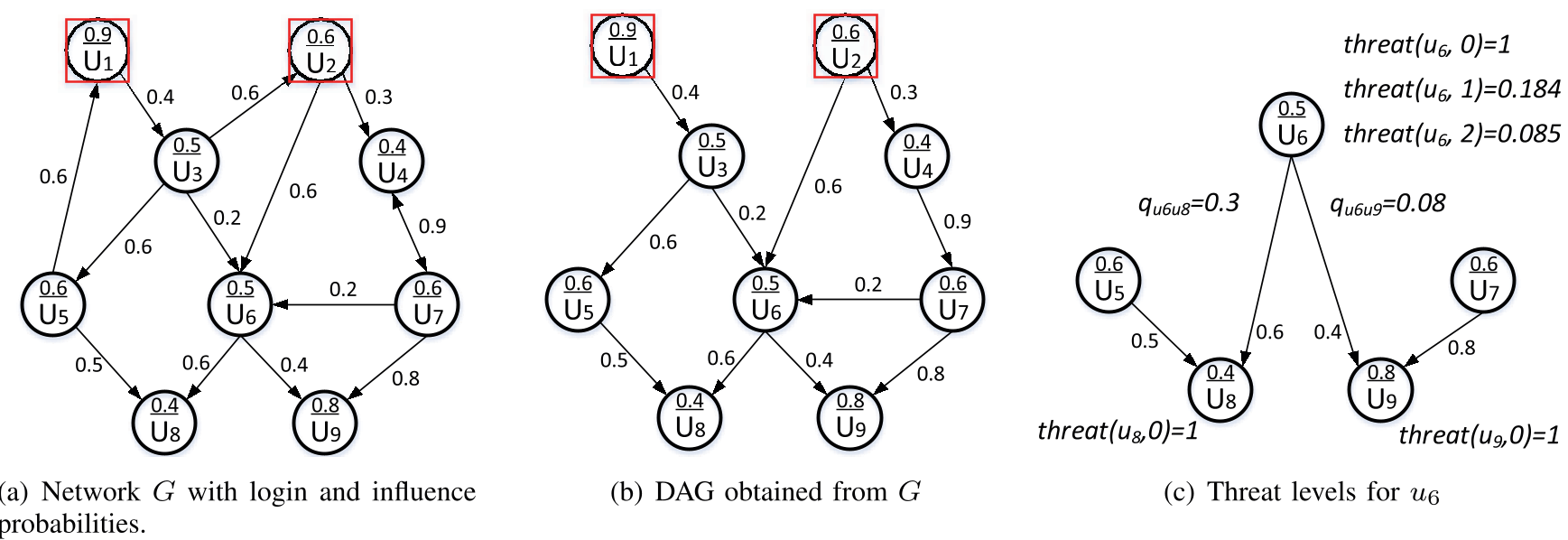 Fig: The DAG construction and threat level estimation workflow.
Unlike standard reachability models, WRR trees store a vector of probabilities m_v[j], representing the specific probability that node reaches the root exactly at time . This allows the algorithm to greedily select nodes that have the highest probability of "saving" nodes before the rumor starters can reach them.
Experimental Results: Dominating Reality
The authors tested TIB-Solver on massive datasets, including Twitter and Weibo (over 1 million nodes and 16 million edges).
Save Ratio Comparison
The Save Ratio (SR) measures what percentage of the "rumor damage" was prevented. In dense networks like Weibo, TIB-Solver's advantage is massive.
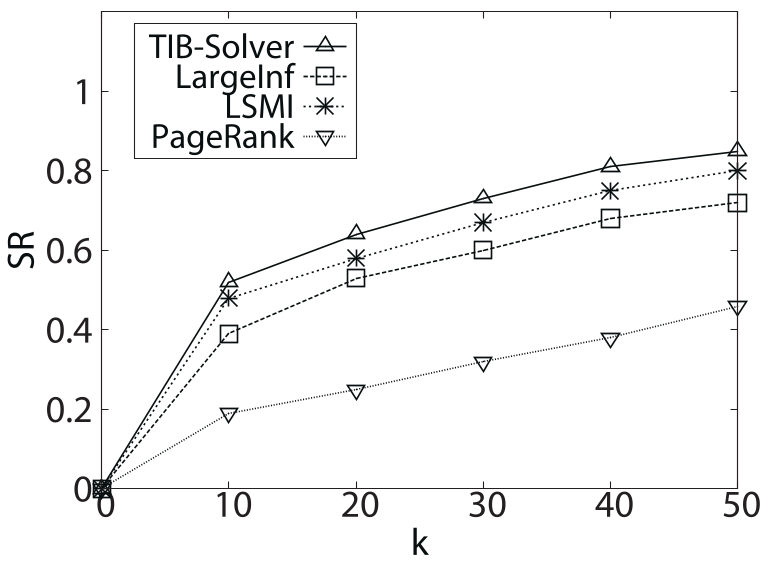 Fig: Save Ratio on Weibo. TIB-Solver (Blue line) consistently maintains the highest performance.
Performance highlights:
- Effectiveness: Consistently outperformed baselines like LSMI and LargeInf across all login probability settings.
- Efficiency: While simulation-heavy methods (LargeInf-L) took thousands of seconds, TIB-Solver processed million-node networks in under 100 seconds.
Critical Insight: Why it Works
The "Aha!" moment of this paper is the Sensitivity Analysis. The authors compared a version that only used threat levels (TIB-Threat) against a version that only used temporal estimation (TIB-WRR). They found that knowing the influencing time is more important than knowing the size of the threat.
In short: In the battle against fake news, it doesn't matter how loud your truth is if it arrives after the audience has already believed the lie.
Conclusion & Future Outlook
TIB-Solver provides a mathematically rigorous yet practical framework for platform moderators to deploy truth campaigns. By shifting the objective from "maximum influence" to "temporal interception," this work sets a new standard for social network security. Future iterations may combine this temporal logic with topic-modeling to ensure the truth campaign is not only fast but also relevant to the users it targets.