
Beyond Static Graphs: The Evolution of Temporal Link Prediction in Social Networks
Survey and analysis of temporal link prediction in online social networks
This paper provides a comprehensive survey and analysis of temporal link prediction in Online Social Networks (OSNs). It synthesizes various methodologies that transition from static graph metrics to time-aware approaches, highlighting a proposed framework that integrates temporal features with local similarity attributes to achieve state-of-the-art accuracy.
TL;DR
Link prediction—forecasting which users will connect next—is the engine behind "People You May Know" features. While early models treated social networks as frozen snapshots, this paper argues that time is the most critical dimension. By reviewing methods ranging from Time-Aware Rooted PageRank to Tensor Factorization, the authors demonstrate that modeling the evolutionary history of links significantly boosts prediction accuracy and relevance.
The Dynamic Bottleneck: Why Static Models Fail
The sheer scale and volatility of Online Social Networks (OSNs) like Facebook (now Meta) make them difficult to analyze. Traditional metrics like the Jaccard Coefficient or Adamic/Adar are time-agnostic: they treat a connection made five minutes ago the same as one made five years ago.
The authors identify two primary pain points:
- Noise: Old, dormant links interfere with the prediction of active, emerging relationships.
- Computational Inefficiency: Processing global graph metrics on billions of nodes is often unfeasible without temporal "windowing" or decay mechanisms.
Methodology: Giving Time a Seat at the Table
The paper categorizes the shift toward "Time-Aware" link prediction into several sophisticated technical approaches:
1. Extrinsic Temporal Metrics
Instead of just counting neighbors, authors introduce the Time Score (TS). This index weights a common neighbor based on how recently they interacted with the potential link pair.
This formula captures the "vibrancy" of a relationship—if two people interacted with the same friend recently and at similar times, they are far more likely to be connected soon.
2. Matrix and Tensor Factorizations
For periodic prediction (e.g., will these researchers collaborate next year?), the authors highlight CANDECOMP/PARAFAC (CP) tensor decomposition. By treating the network as a 3D block (User x User x Time), the model can learn latent patterns in how social structures fluctuate over long intervals.
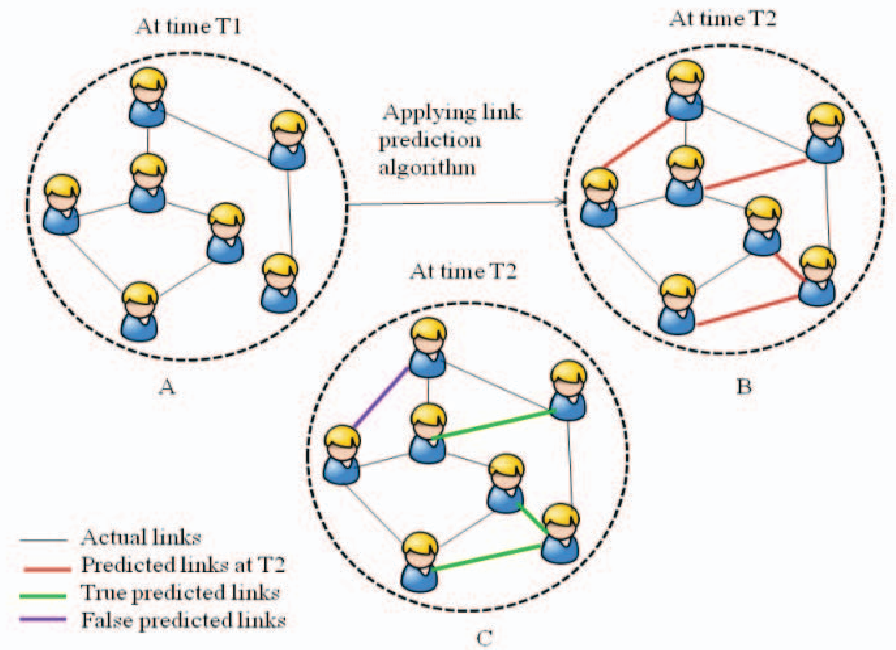 Fig 1: The visualization of link prediction, distinguishing between actual future links and false positives.
3. Exponential Decaying Models
To deal with time-evolving networks, the GRJMF (Graph Regularized Joint Matrix Factorization) model uses a weighted decaying model where older adjacency matrices are effectively "phased out":
Evidence of Superiority: Experimental Results
The survey aggregates data across multiple domains, from DBLP (academic citations) to Facebook interaction graphs.
- Ranking Performance: Time-aware versions of PageRank achieved significantly lower Average Normalized Rank (ANR), meaning the "true" future links were closer to the top of the recommendation list.
- Accuracy Boost: The inclusion of a Time Score improved F-measure results in co-authorship networks by up to 13%.
- Temporal Precision: Specialized models like GLM_exp (Generalized Linear Models) were not only able to predict if a link would form but also provided the best confidence intervals for when it would happen.
Critical Insight: The "Last Count" Heuristic
One of the most surprising findings in the survey is the power of the "Last Count" method. In many datasets, simply looking at the most recent interaction history (the "evolutionary history") outperformed complex global algorithms for repeated link prediction. This suggests that in social dynamics, recency is often a stronger signal than complex topology.
Conclusion and Future Outlook
The paper concludes that while temporal features have revolutionized accuracy, the field is moving toward heterogeneous and multi-modal integration.
- Future Work: The authors suggest incorporating geo-location data (where are the users?) and content analysis (what are they talking about?) into the temporal framework.
- Key Takeaway: For anyone building recommendation systems, ignoring the timestamp of an edge is no longer an option. The future of social AI lies in understanding the "pulse" or rhythm of the network, not just its shape.