
Deciphering the 3W Patterns: The Science of "When" in Social Media Marketing
Discovering Temporal Retweeting Patterns for Social Media Marketing Campaigns
The paper introduces the User Retweet Model (URM), a generative framework designed to discover "3W" (When, Who, What) temporal retweeting patterns on social media. By modeling retweeting behaviors through a "Shared Retweeting Context," it effectively predicts popular topics across different time slots and enhances tweet recommendations for marketing campaigns.
TL;DR
Optimization of social media marketing has long been obsessed with content—keywords, hashtags, and links. However, this paper argues that timing is the invisible hand of virality. By introducing the User Retweet Model (URM), the researchers model the "3W" patterns (When, Who, What) to prove that message engagement is a collaborative effect of the posting time, the author’s authority, and the topic's temporal relevance.
Background: Beyond the Content Trap
Most official accounts treat social media like a bulletin board, focusing solely on the "What." While prior research suggested that URLs or specific phrases increase retweet probability, these studies often ignored the human schedule. A tweet about a movie trailer might vanish at 9:00 AM during a busy work commute but go viral at 8:00 PM when users are in "entertainment mode."
The authors' central insight is that every user has a Temporal Context (habits of signing in) and a Social Context (trust in specific authors) that dictate their receptivity to certain topics at specific times.
Methodology: The 3W Generative Process
The core of the paper is the User Retweet Model (URM). Instead of treating time and topic as independent variables, URM introduces a latent variable: the Shared Retweeting Context ().
The Generative Logic:
- Context Selection: A user chooses a context based on their personal preference .
- Social Choice: The author (Who) is sampled based on the context .
- Temporal Choice: The timeslot (When) is sampled .
- Content Creation: Topics (What) and subsequent words are generated from the context.
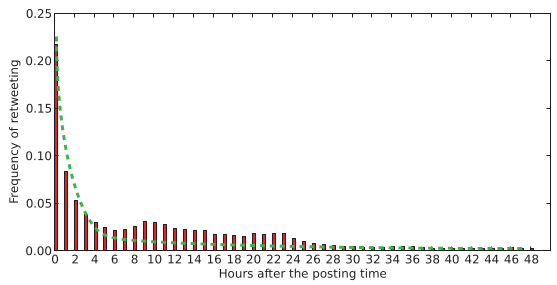 Figure 1: Comparison of retweeting patterns for different brands. Note how McDonald’s peaks during lunch (12:00-13:00) while movie trailers peak in the evening.
This structure allows the model to capture the Inductive Bias that certain times are naturally coupled with specific topics (e.g., "Business" topics during "Working hours").
Experimental Insights: Routine vs. Randomness
The researchers tested URM on a massive dataset from Sina Weibo. Two major findings emerged:
1. The Temporal Pulse of Topics
The model successfully mapped which topics "own" which parts of the day. For example, "Life Wisdom" and "News" dominate the early morning, while "Technology" and "Business" dominate the weekday morning. Interestingly, these patterns largely break down during weekends, where user behavior becomes significantly more random and less scheduled.
2. Superior Recommendation Accuracy
When used to recommend tweets within a user’s "online session," the URM crushed traditional baselines.
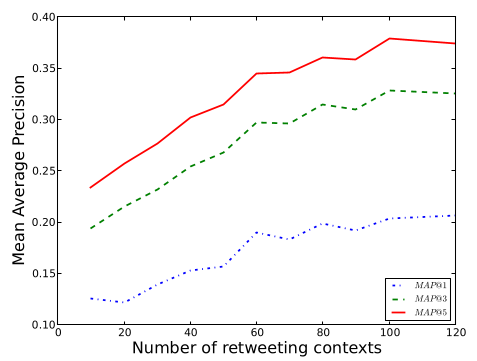 Figure 2: MAP@K comparison across different models. URM consistently outperforms content-only (LDA) and non-temporal models (sURM).
The model achieved a 41.86% boost in MAP@5. The comparison with sURM (the model minus the temporal component) is particularly revealing: it proves that removing "Time" from the equation leads to a significant drop in predictive power.
Critical Analysis & Takeaways
The brilliance of this work lies in its holistic view of the user. It moves away from the "viral content" myth and acknowledges that a user is a creature of habit.
- Strategic Advantage: For marketers, this provides a roadmap. Posting a product launch at the "global peak" of Twitter traffic is less effective than posting it when your specific target audience's context aligns with your topic.
- Limitations: The model assumes conditional independence between topics and time given the context, which might oversimplify complex semantic shifts. Furthermore, the reliance on "pseudo-online sessions" is a proxy for actual user presence.
- Future Work: The logical next step is integrating Spatial Context (Where) and Device Context (Mobile vs. Desktop), as retweeting a professional article on a phone during a commute is a different behavioral signal than doing so on a desktop at work.
Final Thought: In the attention economy, your "Voice" (Content) matters, but your "Timing" (Context) is what ensures your voice is actually heard.