
Behind the Screen: Decoding Student Sentiment in Public vs. Private Channels
Temporal Sentiment Analysis of Learners: Public Versus Private Social Media Communication Channels in a Women-in-Tech Conversion Course
This paper presents a temporal sentiment analysis of learners in a "Women-in-Tech" conversion course, comparing public (Twitter) and private (Microsoft Teams) communication channels. Utilizing BERT-based transfer learning, the study maps sentiment trajectories and identifies distinct behavioral patterns between open and restricted digital spaces.
TL;DR
Is the "face" a student puts on Twitter the same one they show in an internal course forum? This study analyzes the TechUPWomen program to reveal that while public posts track with celebratory events, private channels (Microsoft Teams) are the true breeding ground for negative sentiment and stress. By using BERT-based transfer learning, the researchers proved that if you want to know how students really feel about their workload, you have to look behind the "private" curtain.
The "Public-Private" Dichotomy in EdTech
Most social media research lives on Twitter because the data is easy to scrape. However, this creates a filtered view of reality. In education, learners navigate two worlds:
- The Public Channel: Where they represent themselves to the world and potential employers.
- The Private Channel: Where they seek peer support and vent about challenges.
The authors argue that we cannot understand learner behavior without comparing these two. They set out to see if public sentiment can "predict" private sentiment and where the differences in expressiveness lie.
Methodology: Transfer Learning for Unlabelled Data
Since the course data was unlabelled, the researchers turned to Transfer Learning. They fine-tuned a BERT-Base model on a polarized public dataset and then applied it to the TechUPWomen data.
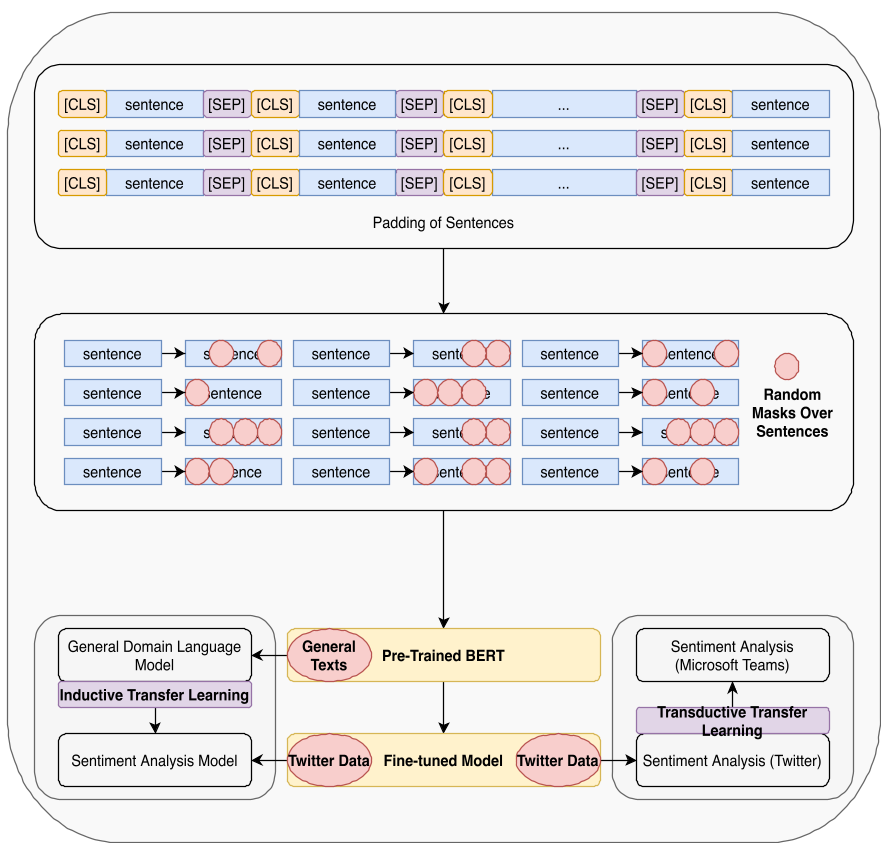
The core technical innovation is the Aggregated Sentiment () formula. It doesn't just look at a snapshot of sentiment; it uses a decreasing factor () to account for "emotional momentum"—the idea that a bad week has a lingering effect on a student's outlook in the following weeks.
Key Findings: The "Negativity" Gap
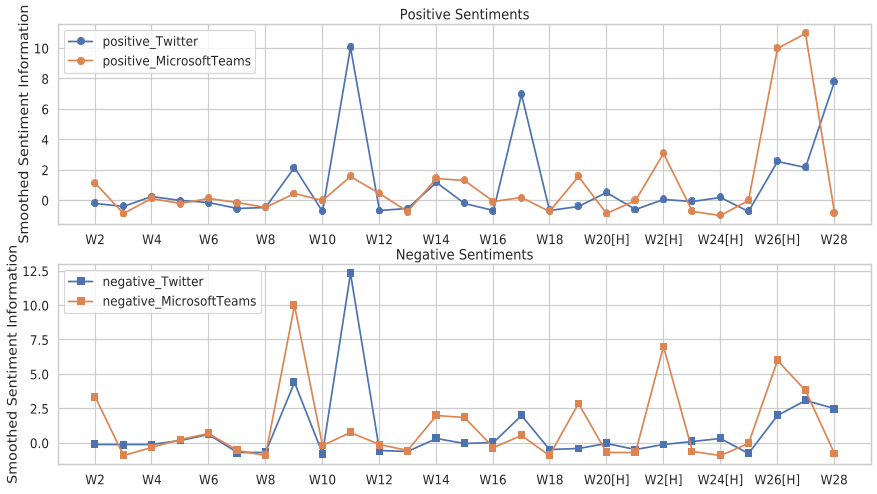
The most striking discovery was the disparity in negative expressions. While positive sentiment was shared relatively equally across both platforms, negative sentiment was significantly more prevalent in the private Teams channel.
1. Sentiment vs. Event Timeline
Public sentiment peaked during "Residentials" (face-to-face weekends). In contrast, private sentiment dropped (becoming more negative) around assignment deadlines in weeks 9 and 19.
2. The Smoothing Effect
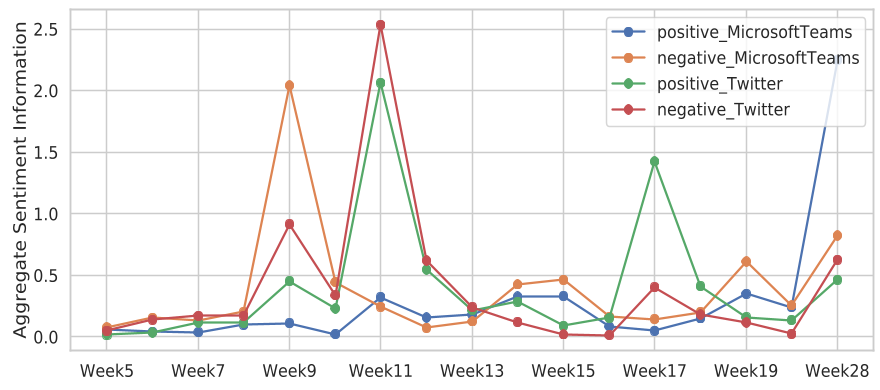
As the window size () for sentiment aggregation increases, we see a "momentum" effect. Smaller windows capture the volatility of a single deadline, while larger windows show the overall "vibe" of a course term.
Critical Insight: Why Does This Matter?
If course organizers only monitor a program's hashtag on Twitter, they are getting a sanitized, "PR-friendly" version of the student experience.
The study reveals that private channels are the authentic heartbeat of a course. The high level of negative expressiveness in private isn't necessarily a bad thing—it indicates a "closed-loop community" where participants feel safe enough to be vulnerable and seek help.
Conclusion & Future Outlook
This paper bridges the gap between NLP research and educational psychology. It proves that:
- Nowcasting is viable for real-time course adjustment.
- Negative sentiment in private spaces is a primary indicator of learner stress related to curriculum milestones.
Limitations: The model lacks a "Neutral" state, which might over-categorize mundane functional posts as negative. Future research should integrate multi-class classification and explore how these sentiment shifts correlate with actual student retention and grades.