
SmartInf: Cracking the Influence Code via Temporal Retweet Sequences
14294_Temporal Sequence of Retweets Help to Detect Influential Nodes in Social Networks.
The paper introduces SmartInf, an unsupervised algorithm for identifying influential nodes in social networks by analyzing the temporal sequence of retweets (cascades). It focuses on "anchor nodes" that facilitate information diffusion across different network localities, achieving superior influence spread compared to traditional structural-only methods.
TL;DR
To maximize information spread, you don't need a map of the entire social network—you need a clock. SmartInf is an unsupervised algorithm that identifies high-impact "anchor nodes" by spotting specific patterns in the timing of retweets. By focusing on users who bridge different "diffusion localities," it achieves massive influence spread while running up to 100x faster than traditional topology-based methods.
The Problem: The "Million Follower" Fallacy
In the world of social network analysis, we often assume that the most "central" people (those with the most followers or the most connections) are the best seeds for a viral campaign. However, this structural-only approach has two fatal flaws:
- Static Blindness: A user might sit at the center of the network but be effectively "dead"—rarely tweeting or only engaging in niche, non-viral topics.
- Information Overlap: Targeting three influencers who all share the same 90% of followers is a waste of resources.
Methodology: Listening to the "Pulse" of a Cascade
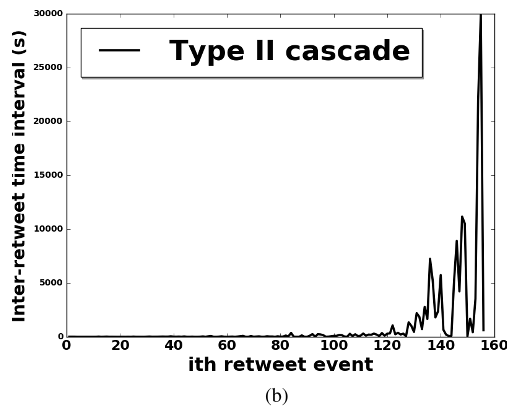
The core insight of the paper is that the "inter-retweet time interval" (the time between retweet event A and event B) acts as a signature of how a tweet is moving through the network.
1. The Anatomy of a Peak
The authors classify cascades into two types:
- Type I (Iterative Expansion): The tweet starts fast, slows down (a peak in the time interval), then speeds up again. That "speed up" signifies an anchor node has pushed the tweet into a brand-new community.
- Type II (Local Saturation): The tweet grows and stays within a single community until it dies out.
2. Identifying Anchor Nodes
By detecting these temporal peaks, SmartInf identifies the users active during the "activation period"—the golden window where a tweet jumps from one locality to another. These users are the true "bridges" of the internet.
3. Diversity Refinement
To solve the overlap problem, SmartInf uses a secondary phase that acts like a "Set Cover" algorithm. It only adds a candidate influencer to the final seed set if they provide access to a diverse/new population not already covered by higher-ranked candidates.
Experiments: Superior Speed and Reach
The researchers tested SmartInf against Heavyweights like K-Truss decomposition and MCDWE on real-world datasets (Arab Spring, Nepal Earthquake, IPL).
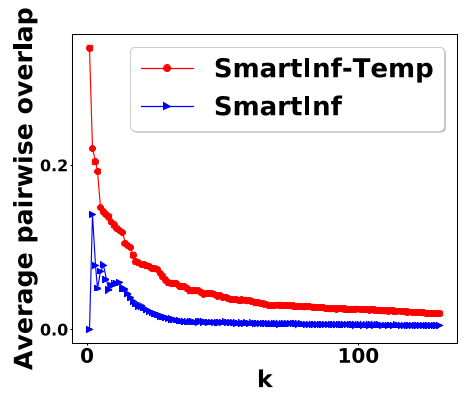
- Total Reach: In SI epidemic simulations, SmartInf seeds consistently infected a larger portion of the network than baselines.
- Efficiency: Because SmartInf doesn't need to calculate the "betweenness" of every node in a billion-user graph, it is incredibly scalable, outperforming the competition by 70-100x in execution time.
Critical Insights: Why This Matters
The most striking takeaway is the robustness of the method. In real-world scenarios, we rarely have "perfect data." SmartInf maintained high rank-correlation even when 50% of the cascade data was missing.
By looking for the physics of the flow (temporal patterns) rather than the static architecture (topology), SmartInf finds the users who are actually effective "superspreaders" in real-time.
Conclusion
SmartInf represents a shift toward Behavioral-Temporal analysis in social physics. For marketers, public health officials, or news agencies, it offers a way to identify influencers who don't just have an audience, but have the specific bridging power to make a message go truly global.
Limitations to Watch: Future work needs to see if these "anchor nodes" change based on the topic—is a bridging node for "Politics" the same as for "Sports"? For now, SmartInf is a massive leap forward in making network science practical and fast.