
Predicting Global Influence from Local Moments: A Fast Betweenness Estimation via Dynamic Behavior
What Can the Temporal Social Behavior Tell Us? An Estimation of Vertex-Betweenness Using Dynamic Social Information
This paper introduces a fast estimation algorithm for vertex-betweenness centrality in large-scale social networks by leveraging temporal local indicators. By analyzing dynamic social behaviors, specifically in MMORPG chat networks, the authors achieve high-accuracy rank estimation with a significantly reduced time complexity of O(b^2|V|).
TL;DR
Calculating Betweenness Centrality—the measure of how often a node acts as a "bridge"—is notoriously slow on large graphs. This paper presents a breakthrough by proving that when you talk to someone matters as much as who you talk to. By using two new temporal metrics, Attraction and Dynamic Transitivity, the authors can estimate global influence with O(b²|V|) complexity, making it hundreds of times faster than standard algorithms while maintaining over 90% accuracy for top-ranked nodes.
The Scalability Wall in Centrality
In social network analysis, "Betweenness" is the gold standard for finding gatekeepers and influencers. However, the computational cost is a nightmare. Even the state-of-the-art Brandes algorithm struggles with millions of nodes because it requires calculating shortest paths across the entire graph.
The authors argue that we’ve been ignoring a goldmine of data: Time. Most social networks aren't static; they grow and change. By looking at the "temporal" sequence of interactions, we can infer a node's global position without ever looking at the whole graph.
Methodology: The Power of Dynamic Indicators
The core innovation lies in two local indicators that capture the "biography" of a vertex:
- Attraction (): This measures how many "fresh" members (newly joined players) a node connects with. Influential nodes act as magnets for new talent or users.
- Dynamic Transitivity (): Standard transitivity (clustering) looks at triangles. Dynamic transitivity asks: "Did Node V exist before Node U and W met?" If V was the common friend who was there first, V likely acted as the mediator who introduced them.
Architectural Intuition
The authors combine these features into a simple but effective linear regression model:
 (Note: Refer to Figure 1 in the paper for the temporal mediation example where the order of edge creation defines the mediator role)
Experiments: The MMORPG Testing Ground
The researchers used a massive dataset from Fairyland Online, an MMORPG. They constructed a "Chat Activity Network" where edges represent private messages.
Key Findings:
- Speed: In the "Alice" realm (~32k nodes), the estimation was 154 times faster than the exact algorithm.
- Accuracy: The model significantly outperformed a baseline that used only static features (like in-degree/out-degree). The overlap for the top 0.1% of nodes reached 90.6% in several tests.
- Power Law: Both player levels and chat degrees followed a Power Law distribution, reinforcing the "80/20 rule" where a small few control the vast majority of information flow.
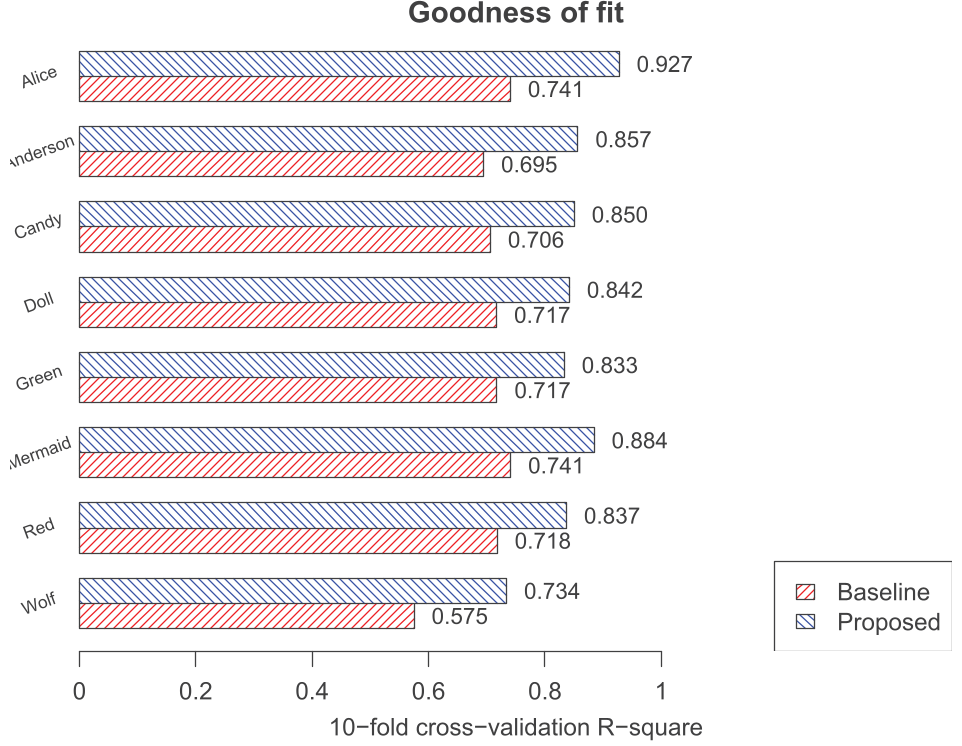 Fig 6. Performance of the proposed linear model (Proposed) vs the baseline (Base) across different game realms.
Critical Insight: Why Does It Work?
The paper reveals a fascinating inverse correlation: nodes with the highest vertex-betweenness usually have low clustering coefficients. In other words, "bridges" don't hang out in tight-knit cliques; they sit in the empty spaces between cliques. By tracking "Dynamic Transitivity," the authors effectively identify which nodes are creating new triangles across previously disconnected groups.
Conclusion & Future Outlook
This work shifts the paradigm of centrality from global pathfinding to local temporal analysis. While the linear model is simple, the features it uses (Attraction and Dynamic Transitivity) are profound.
Limitations: The model relies on knowing the arrival time (timestamp) of edges. In systems where only an "accumulated" graph is available, this method cannot be applied. Future Work: This logic could be extended to Graph Neural Networks (GNNs) as a pre-computed feature to help models understand long-range dependencies without the heavy lifting of global attention mechanisms.