
TempoSpring: Breaking the 2D Barrier in Social Network Analysis
TempoSpring: A new immersive hands-free prototype for visualizing social networks: Demonstration paper
TempoSpring is an immersive, hands-free prototype designed for exploring complex social networks using Microsoft Kinect and OpenGL. It combines stereoscopic 3D visualization with gesture and voice-controlled interactions to facilitate large-scale graph analysis without traditional peripherals.
TL;DR
TempoSpring is an innovative immersive system that replaces the mouse and keyboard with hand gestures and voice commands to explore complex social networks. By leveraging Microsoft Kinect and a multimodal approach, it allows users to manipulate 3D graphs on large screens while broadcasting specific details to mobile devices to prevent visual clutter.
Background: Beyond the Desktop
In the last decade, social network data has exploded in complexity. While the "Visual Analytics" mantra—Overview first, zoom and filter, then details on demand—remains the gold standard, the tools we use to execute it haven't kept pace. Most researchers are still tethered to the WIMP (Windows, Icons, Menus, Pointer) paradigm.
However, as we move toward immersive systems (VR/AR/Large-scale displays), the mouse becomes a bottleneck. The authors of TempoSpring argue that for truly "immersive" analysis, we need interaction models that match the 3D nature of the data.
The Problem: The Focus & Context Dilemma
Two major issues plague current graph visualization:
- Interaction Mismatch: Using a 2D mouse to rotate a 3D graph feels unintuitive and restrictive.
- Information Overload: When you zoom in to see the details of a specific community, you often lose the "big picture" context. Conversely, looking at the whole graph makes individual nodes unreadable.
Methodology: Gestural Freedom and Multimodal Scalability
TempoSpring attacks these problems through two core innovations:
1. Natural Human-Computer Interaction (HCI)
Instead of clicking buttons, TempoSpring maps human physiology to graph mechanics:
- Rotation: Lifting the left hand allows the user to "grab" and rotate the graph around its barycenter.
- Zooming: Mimicking the "pinch-to-zoom" gesture by moving hands together or apart.
- Selection & Aggregation: Users can highlight clusters with a selection frame and use voice commands to merge them into "meta-nodes."
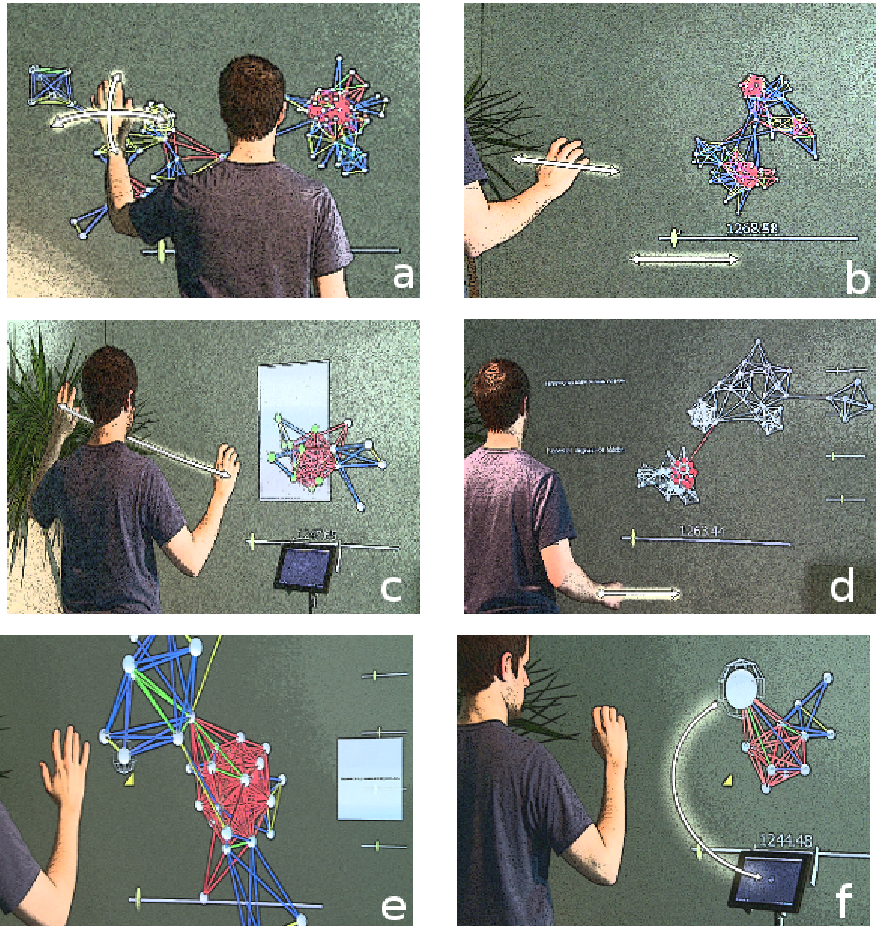 Fig. 1: Diverse hand-gesture mappings for navigation and selection.
2. Meta-Node Broadcasting
To solve the "Focus & Context" issue, the authors introduce a multimodal approach. If a user finds an interesting cluster (meta-node) on the main 3D screen, they can "broadcast" it to a secondary tablet or mobile device. This allows for concurrent exploration: the main screen keeps the global structure visible, while the tablet provides a high-resolution, localized view of the sub-graph.
Experimental Insights
The system utilizes an OpenGL engine capable of Monoscopic, Passive, and Active Stereoscopy. By testing these different visual restitutions, the authors aim to identify which provides the best "depth perception" for unraveling dense "hairball" graphs. Early results suggest that the sense of immersion provided by large-screen stereoscopy significantly enhances the user's ability to identify structural patterns that are invisible in 2D.
Conclusion and Future Outlook
TempoSpring represents a shift toward Embodied Analytics. By removing the physical barriers of the desk and mouse, it allows the analyst to "step into" the data.
Future Directions:
- Usability Quantifiction: The researchers are currently conducting tests to measure exactly how much more efficient gestures are compared to mice for specific graph tasks (e.g., community detection).
- Collaborative Analysis: The hands-free nature of the system opens the door for multiple researchers to stand in front of a screen and manipulate data together in real-time.
While still a prototype, TempoSpring provides a compelling blueprint for the next generation of data exploration tools where the interface is as dynamic as the network itself.