
Ten Years of Cybertech: Engineering Pedagogy Through Robotic Bullfighting
Ten Years of Cybertech: The Educational Benefits of Bullfighting Robotics
This paper reviews ten years of "Cybertech," an interdisciplinary robotics competition and academic course at the Universidad Politécnica de Madrid (UPM). It highlights the "Robotaurus" bullfighting event as a unique educational tool that integrates mechanics, electronics, and AI while achieving significant SOTA status in engineering pedagogy within Spain.
TL;DR
How do you transform a dry engineering syllabus into a high-octane, media-friendly learning experience? UPM’s Cybertech program has spent a decade perfecting this via robotic bullfighting. By blending a rigorous academic course with a spectacular competition, they’ve achieved a rare feat: making students master complex control theory, power electronics, and teamwork through the lens of a cultural tradition reimagined for the silicon age.
Background: Beyond the Classroom
Engineering education faces a perennial crisis: the "silo effect." Students often learn mechanics in one room and C++ in another, rarely seeing how they interact in the messy, high-friction real world. Cybertech was designed to shatter these silos. It positions itself not just as a "club activity," but as a flagship of innovation at the Universidad Politécnica de Madrid (UPM).
The Problem: The Gap Between Theory and "The Arena"
Traditional laboratory practicals are often "canned"—results are predictable, and failure is a minor deduction. Real engineering is brutal. It has budgets, deadlines, and unpredictable environments. The authors identified that students lacked motivation to solve interdisciplinary problems (like power management in solar cars or sensor fusion in maze navigation) when those problems weren't tied to a tangible, competitive goal.
Methodology: The Cybertech Ecosystem
The researchers didn't just build a robot; they built a pedagogical pipeline. The system relies on several innovative "layers":
1. The Multi-Event Strategy
Cybertech isn't one race; it's a hierarchy of challenges:
- Line Following & Maze: Low barrier to entry for beginners to learn PID control and heuristics.
- Solar Cars: Introduces power electronics and renewable energy constraints.
- RoboSim: Focuses purely on AI and strategy without hardware overhead.
- The Bullfighting (Robotaurus): The "Final Boss" of the competition.
2. The Robotaurus Architecture
The unique "Bullfighting" event pits a student-made robot against the organization's Robotaurus.
- The Bull: An autonomous beast that pursues red objects (balloons) using vision and radio-linked position tracking.
- The Bullfighter: Must use a "cape" to deceive the bull and survive for 3 minutes.
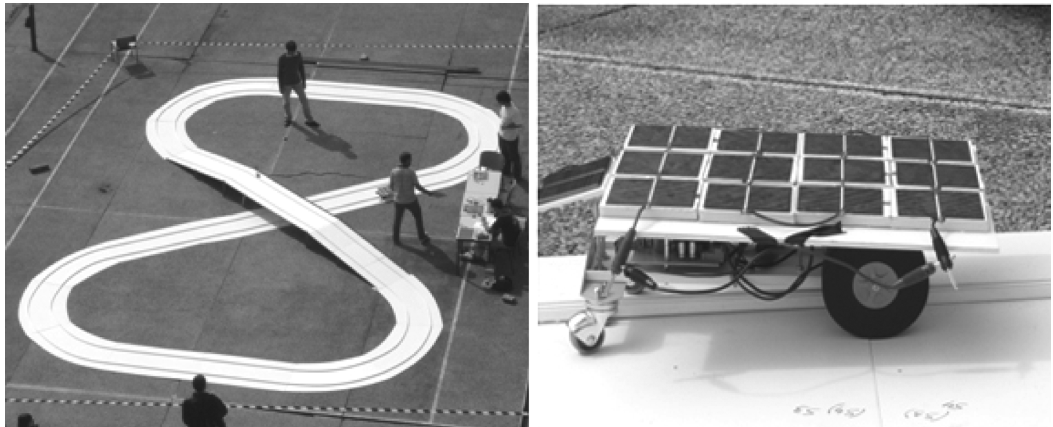 Fig 1: The tiered progression of the Line Following event—from simple ellipses to complex race grids.
3. Integrated Workshops
The academic course (introduced in 2005) provides the "Inductive Bias" necessary for success. It includes five intensive 4-hour workshops covering everything from soldering and microcontrollers to advanced discrete PD controller implementation.
Experimental Results: Data-Driven Pedagogy
The paper provides a quantitative look at student growth. Participation peaked at nearly 200 students per year, showcasing a massive "pull factor" for the engineering department.
Key Statistical Insights:
- Subject Mastery: Students reported the highest progress in Sensors and Electronics, exceeding 85% on self-assessment scales.
- Motivation: Interestingly, "Prizes" was the lowest motivator. The highest scores were for Creativity and the Acquisition of Practical Knowledge.
- Career Impact: 83% reported a significant increase in interest in robotics, and nearly half (47%) consider a career in research as a direct result.
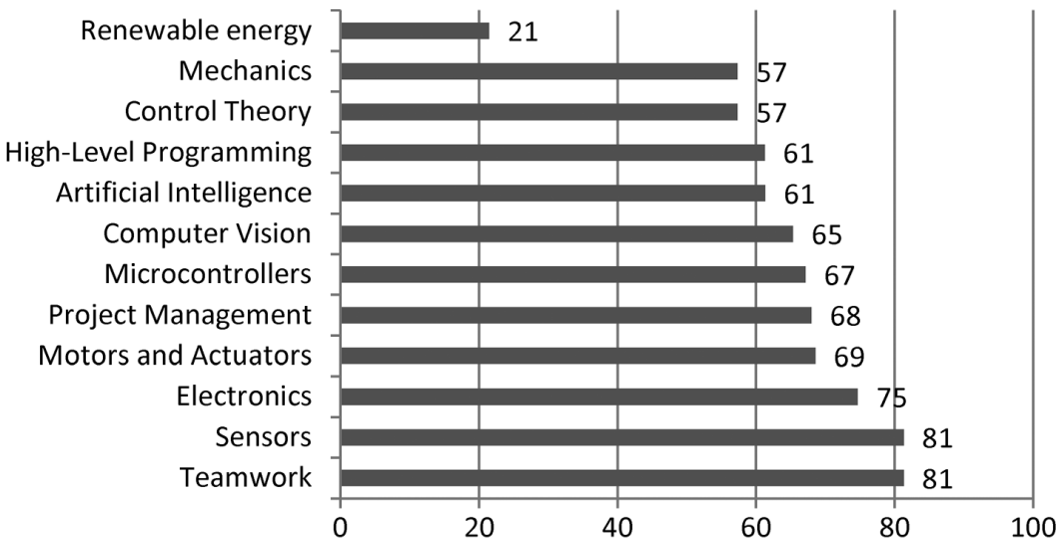 Fig 2: Statistical survey showing that teamwork and sensor integration are the primary areas of student progress.
Critical Insights: Why it Works
The "magic" of Cybertech lies in its Subjective Scaling. Unlike a simple race where the fastest wins, the Bullfighting event includes a panel of professors who score "skill" and "bravery"—much like real bullfighting. This forces students to consider Human-Robot Interaction (HRI) and emotional aesthetics, pushing their designs beyond mere functionality.
Limitations & Future Work
The authors acknowledge that the overhead of hardware can be a barrier. To mitigate this, they are replacing simple simulations with a Soccer League modeled after RoboCup, providing a path to international research standards.
Conclusion
Cybertech proves that when engineering is treated as a "spectacle" and a "craft" rather than just a set of equations, the educational ROI is massive. It transforms students from passive learners into project managers, designers, and innovators ready for the industry’s "arena."
Takeaway for Educators: If you want students to learn how to build a robust system, give them a bull to fight.