
Beyond Intuition: Tencent and Facebook Data Prove Metcalfe’s Law
Tencent and Facebook Data Validate Metcalfe’s Law
This paper empirically validates Metcalfe's Law () using over a decade of financial and user data from Tencent and Facebook. By applying least squares curve fitting, the study demonstrates that the quadratic relationship between network size (MAUs) and value (revenue) consistently outperforms Sarnoff's, Odlyzko's, and Reed's laws.
TL;DR
Is the value of a network really the square of its users? For decades, Metcalfe's Law () was a debated architectural intuition. This research provides the first robust empirical evidence through a comparative analysis of Tencent and Facebook. The verdict: Metcalfe's Law is the most accurate model for network value, but it comes with a hidden catch—costs grow quadratically too.
Perspective: The Battle of Network Laws
In the world of network economics, four competing theories have long fought for dominance:
- Sarnoff’s Law: Value is linear ().
- Odlyzko’s Law: Value grows at .
- Metcalfe’s Law: Value is quadratic ().
- Reed’s Law: Value is exponential ().
While Reed’s law seemed too optimistic and Sarnoff’s too conservative, the industry lacked "hard data" to verify the sweet spot. By analyzing a decade of financial reports from two social media giants—one in a developing market (Tencent) and one global (Facebook)—this paper moves the conversation from philosophy to data science.
Methodology: Science Over Speculation
The authors defined Network Size () as Monthly Active Users (MAU) and Network Value () as Annual Revenue. Unlike previous attempts that "eyeballed" curves, this study used the Least Squares Method to find the best fit.
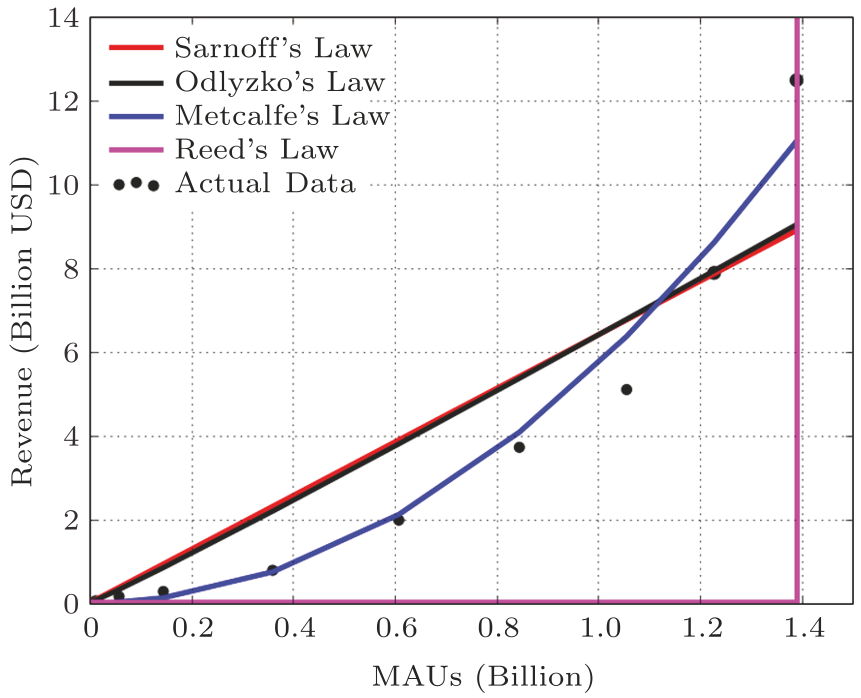 Fig 1: Value curves of Facebook showing the superior fit of the quadratic Metcalfe model.
Key Insight 1: Metcalfe Wins the Value Race
The results were striking. For Tencent, the Root-Mean-Square Deviation (RMSD) for Metcalfe’s Law was only 0.12, whereas Sarnoff’s (1.27) and Odlyzko’s (1.19) were nearly ten times less accurate. This confirms that the "network effect" is not just a buzzword; it is a measurable mathematical reality where utility grows at an accelerated rate as nodes are added.
Key Insight 2: The End of Linear Costs
Perhaps the most significant contribution of this paper is the debunking of the Linear-Cost Hypothesis. Robert Metcalfe originally assumed that while value grows quadratically, costs stay linear ().
The data from both Tencent and Facebook says no.
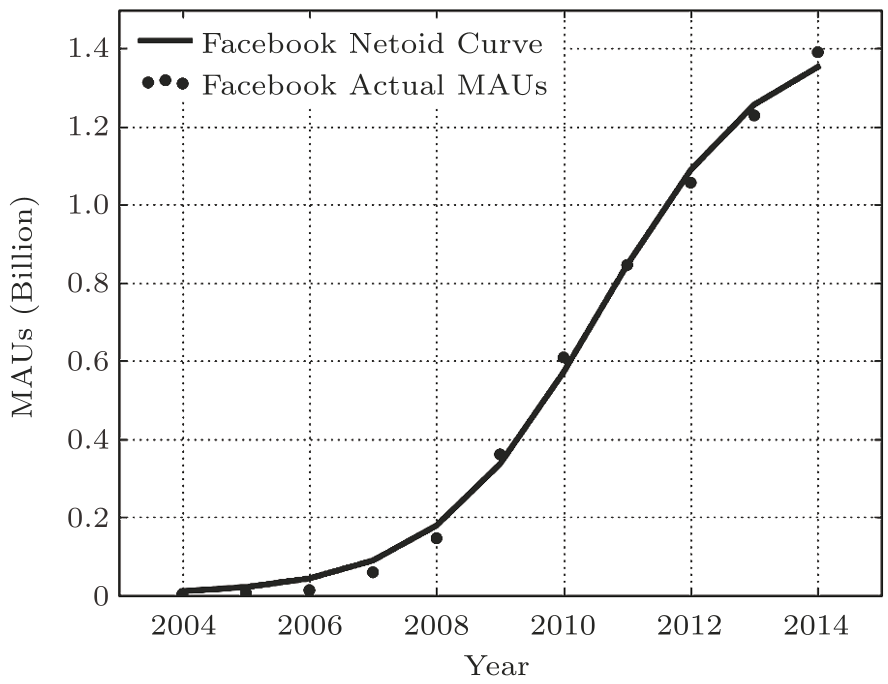 Fig 2: Cost curves of Tencent, demonstrating that operational expenses () follow a quadratic trajectory ().
The study reveals that . This suggests that as a network reaches a massive scale, the complexity of managing interactions, data, and infrastructure grows just as fast as the revenue potential.
The Netoid Growth Trend
The authors also validated the Netoid Function, a S-curve variation used to predict how MAUs grow over time.
- Tencent reached its maximum growth rate () around 2013.8.
- Facebook hit its peak growth point earlier, in 2010.56.
This temporal mapping provides a blueprint for understanding the lifecycle of social giants.
Critical Analysis & Conclusion
Takeaway
Metcalfe’s Law is universally applicable across different cultures and business models (Tencent’s value-added services vs. Facebook’s ad-driven model). It remains the "Gold Standard" for valuing networks.
Limitations
The study uses Revenue as a proxy for Value. While practical for public companies, "value" to a user may not always translate perfectly to dollars in the short term, especially in subsidized or pre-monetized networks.
Future Outlook
As we move into the era of AI and decentralized networks, will these quadratic rules still hold? If AI agents become "nodes" in a network, the could explode, testing the limits of the quadratic cost curves identified here. Platforms must find ways to break the cost trap through technological innovation to maintain profitability at extreme scales.