
UTF: Decoding Social Connections through Tensor Factorization
User recommendation with tensor factorization in social networks
This paper introduces a novel User-Interest-Friend (UTF) framework for social network friend recommendation by leveraging tensor factorization. The core contribution is a 3-order tensor model that captures the latent associations between users, their tagging-based interests, and their social circles, achieving superior performance on real-world datasets like Last.fm.
TL;DR
Researchers from Tsinghua University have developed a new framework called UTF (User-Tag-Friend) that treats social recommendations as a multi-dimensional puzzle. By using Tensor Factorization, the model doesn't just look at who you know, but why you know them—specifically linking your tagging behavior to potential friendships. It outperforms traditional Collaborative Filtering and graph-based methods on real-world Last.fm data.
Problem & Motivation: Beyond the Social Graph
Most friend recommendation systems today (like "People You May Know") rely on Graph-based (GF) methods—essentially looking for "friends of friends." Others use Collaborative Filtering (CF) to find users with similar profiles.
However, these methods ignore a critical piece of the puzzle: Tags. In platforms like Last.fm or Flickr, tags are the purest expression of user interest. The authors identify a gap: how do we mathematically link the triad of a User, their Interests (Tags), and their Friends? Existing models are too "flat" to capture the complex, 3-way interaction where a user chooses a friend because of a specific shared interest.
Methodology: The Power of 3-Order Tensors
The core innovation is the User-Interest-Friend Model. Instead of a 2D matrix, the authors construct a 3D tensor where an entry exists if user has a friend and they share interest .
1. Tensor Factorization
To handle the massive dimensionality and sparsity of social data, the paper employs a factorization approach. The predicted score is calculated by:
- : Low-rank feature matrices for Users, Tags, and Friends.
- : A core tensor that governs how these latent features interact.
2. Learning and Ranking
The model is trained by maximizing the AUC (Area Under the ROC Curve), focusing on ranking potential friends higher than non-friends. Since a user has many interests, the system generates multiple rankings and merges them using Reciprocal Rank Fusion (RRF) to provide a final, singular Top-N list.
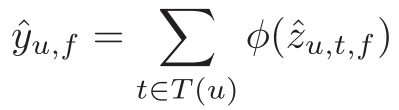 The Score Decomposition: Summing latent interests to predict friendship.
Experiments & Results
The authors tested their method against three baselines: UR (Interest-based), CF (Collaborative Filtering), and GF (Social Graph).
SOTA Performance
Using a crawled dataset from Last.fm (988 users, ~17k tags), the results were conclusive. The UTF model dominated across all metrics (MRR, MAP, Precision, and Recall).
| Method | MRR | Recall | Precision |
|---|---|---|---|
| UTF-32 | 0.0574 | 0.6238 | 0.0062 |
| CF | 0.0446 | 0.4593 | 0.0046 |
| GF | 0.0089 | 0.1303 | 0.0013 |
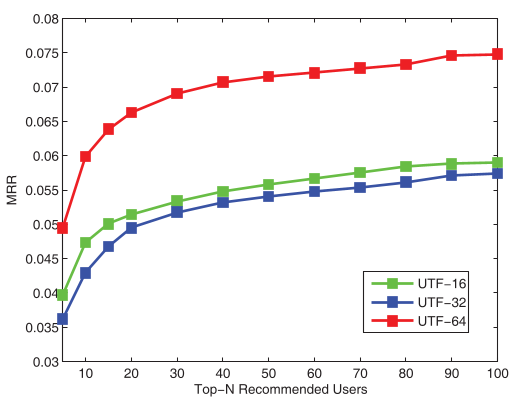 Comparison across different N (number of recommendations). UTF consistently maintains the highest precision and recall.
The Dimensionality Trade-off
The paper also explores the impact of latent dimensions (). Moving from to improves accuracy but increases computational cost. For most systems, a balance at provides the "sweet spot" for performance.
Critical Analysis & Conclusion
This work demonstrates that Tensor Factorization is a superior way to model social interactions because it naturally incorporates "context" (interests) into the relationship.
Takeaway: If you are building a recommendation engine, don't just look at user-item interactions. Look at the triangular relationship between the actor, the action context, and the target.
Limitations: Tensor methods can be computationally expensive to update in real-time. As social networks grow to millions of users, future work must focus on incremental tensor updates or more efficient stochastic gradient descent methods to maintain scalability.