
Deciphering Human Emotions via IoT: Tree-Based Models Lead the Way in Privacy-Preserving Estimation
Testing Machine Learning Models for Individual Emotion Estimation from Indoor Environment Data
This paper evaluates multiple machine learning models—SVM, KNN, Random Forest (RF), GBDT, and Neural Networks—for individual emotion estimation using non-contact indoor environmental data. By leveraging a multi-modal IoT sensor network, the study achieves over 80% estimation accuracy for four emotional states (Happy, Stress, Relax, Sad) using RF and GBDT classifiers.
Executive Summary
TL;DR: Researchers at Chiba University have validated a breakthrough in "non-contact" emotion estimation. By utilizing 14 types of indoor environmental sensors and benchmarking five ML models, they achieved an 80%+ accuracy rate in classifying emotions like Stress and Happiness. The study identifies Random Forest (RF) and Gradient Boosting Decision Trees (GBDT) as the optimal architectures for this task, balancing high precision with minimal computational overhead.
Research Positioning: This work bridges the gap between IoT sensing (Society 5.0) and affective computing, proving that we can understand human well-being without intrusive cameras or wearables.
The Privacy Dilemma in Affective Computing
Current state-of-the-art (SOTA) emotion recognition usually relies on two "intrusive" pillars:
- Visual Data: Analyzing facial micro-expressions via cameras (raises massive privacy concerns).
- Physiological Data: Monitoring RR intervals or skin conductance via wearables (causes user discomfort and requires device maintenance).
The authors argue for a third way: Environmental Perception. Can the temperature, CO2 levels, and even ultrasonic noise in a room tell us how a person feels? The challenge lies in the "noisy" nature of this data and the high dimensionality of sensor arrays.
Methodology: From 14 Sensors to 4 Emotional States
The researchers deployed a dense sensor network capturing variables including humidity, CO2 concentration, blue light, odor, and barometric pressure.
Model Benchmarking
They compared five foundational ML paradigms:
- SVM & KNN: Classic baselines for classification.
- Neural Networks (NN): High-capacity models with three intermediate layers.
- Tree Ensembles (RF & GBDT): Leveraging decision-tree logic to handle non-linear relationships.
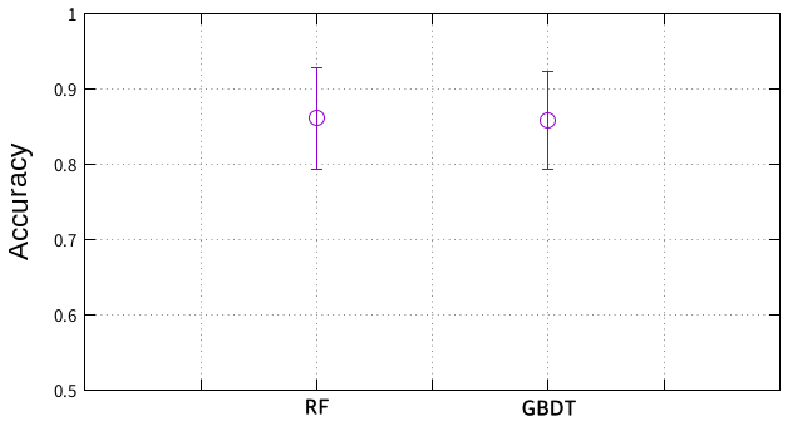 Figure 1: Comparison of estimation accuracy across different ML models. RF and GBDT consistently outperform others.
Key Findings: Efficiency Meets Accuracy
1. The Superiority of Tree-Based Models
The results were decisive: RF and GBDT both hit the 80% accuracy threshold. While Neural Networks are powerful, they suffered from significantly higher fitting times (68s vs. <1s for tree models) without providing an accuracy advantage in this specific IoT context.
2. The Logic of "Less is More"
Through feature importance analysis, the study found that not all 14 sensors are equal. The top contributors to emotion estimation were:
- CO2 Concentration
- Ultrasonic Distance
- Sound Volume
- Blue Light
Reducing the sensor count from 14 to 6 key sensors resulted in negligible performance loss. This is a critical finding for the production of low-cost, low-power consumer IoT devices.
 Table 1: Efficiency metrics showing RF and GBDT providing the fastest inference times.
Critical Analysis & Conclusion
Takeaway: Tree ensemble methods (specifically GBDT) are robust against the noise inherent in indoor environmental data. Their ability to rank feature importance allows for Hardware-Software Co-design, where the sensor array is optimized for the specific software model.
Limitations: The study was conducted on a relatively small cohort (5 main subjects). While the 60-day logging period provides longitudinal depth, a broader demographic sample would be required to claim a "universal" emotion estimator.
Future Outlook: The shift toward GBDT suggests that we might soon see "Emotion-Aware Smart Homes" where the lighting and HVAC systems react to your stress levels—all without a single camera lens ever being pointed at you.