
Leveraging Text Analytics to Bridge the Judicial Gap: A Machine Learning Approach
A Study on Implementation of Text Analytics over Legal Domain
2020-09-08
Summary
Problem
Method
Results
Takeaways
Abstract
This paper proposes a legal support system based on Machine Learning and Text Analytics to assist judges and advocates in the Indian judiciary. The authors utilize a Bag-Of-Words (BoW) model and sentence vectorization to transform unstructured legal documents into actionable digital patterns to expedite justice delivery.
## TL;DR
The Indian judiciary currently grapples with a systemic bottleneck where a limited number of judges must navigate a massive sea of legal documentation. This paper introduces a **Text Analytics-based Legal Support System** designed to digitize manual case files and convert them into structured mathematical vectors. By using a frequency-driven Bag-Of-Words (BoW) approach, the system helps legal professionals identify patterns and core facts in a fraction of the time required by manual review.
## The Motivation: A System Under Pressure
The primary driver of this research is the critical shortage of judicial manpower in India. With only roughly 19 judges per million people, the "Right to Justice" is often delayed. The authors observe that a significant portion of a legal professional's time is spent on **information retrieval and correlation**—tasks that are fundamentally suited for Data Analytics. The insight here is that by treating legal briefs as data objects rather than just text, we can use Machine Learning to highlight the "gravity of the situation" in any given case.
## Methodology: From Hardcopy to Sentence Vectors
The authors propose a rigorous five-phase pipeline to transform the chaotic nature of legal text into a structured dictionary (the "Mega-Document").
### 1. The Digitization & Cleansing Pipeline
Since many legal documents in trial courts exist only on paper, the first step involves scanning and text extraction. This is followed by a classic NLP preprocessing step:
* **Normalization**: Converting all text to lowercase to ensure consistency.
* **Stopword Removal**: Filtering out "the", "is", "at", etc., which carry little semantic value in a legal context.
* **Tokenization**: Splitting sentences into individual word atoms.
### 2. The Bag-Of-Words & Frequency Analysis
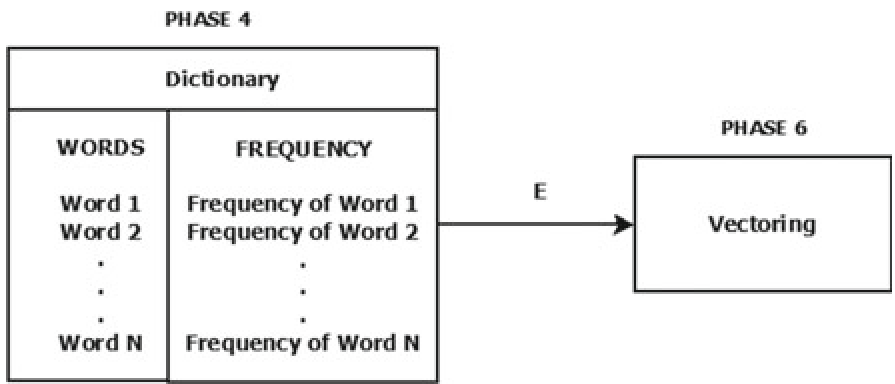
The core of the logic lies in calculating **Term Frequency**. By identifying which words appear most often across a "Mega-Document," the system identifies the thematic pillars of a specific case (e.g., specific criminal codes or recurring names).
### 3. Sentence Vectorization
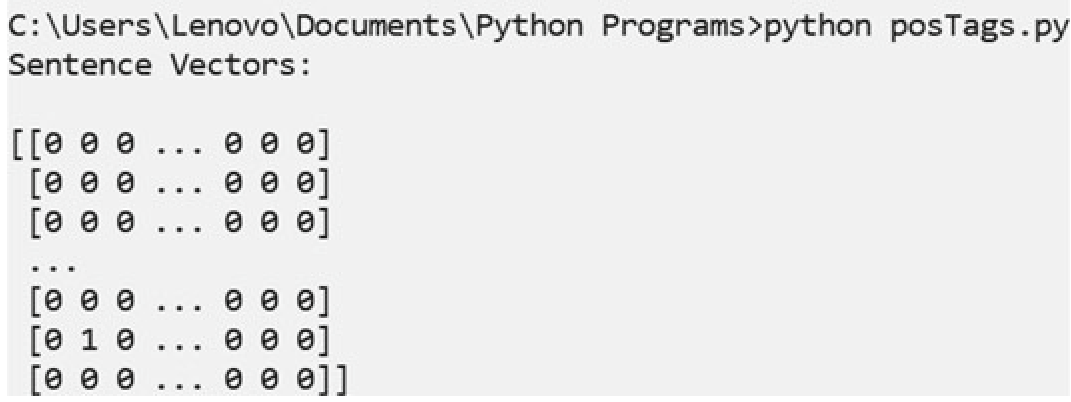
The final "Actionable" output is the creation of binary sentence vectors. Each sentence is represented as a string of 1s and 0s based on whether it contains the "Top-K" most frequent words identified in the Mega-Document. This allows for rapid comparison between different case files.
## Experimental Insights & Results
The implementation, written in Python, demonstrates the ability to extract high-utility keywords from raw judicial facts. For instance, the system can automatically generate a "Top-K" word list that serves as a summary of the most relevant points in a witness statement.
While the Bag-of-Words model is computationally efficient, the authors acknowledge several **inductive biases** and limitations:
* **Sparsity**: The vectors are mostly zeros, which can be inefficient for very large datasets.
* **Context Blindness**: The current model treats words in isolation, potentially missing the subtle semantic shift of legal terminology (e.g., "battery" in a criminal vs. a general sense).
## Critical Analysis & Future Outlook
This work represents a foundational "Step 1" for digital justice. In the academic coordinate system, it serves as a bridge between traditional manual law and modern **LegalTech**.
**The Takeaway**: While the current model relies on lexical frequency, the value lies in its simplicity and explainability—essential components for a system meant to assist a judge. The next evolutionary step for this research would be moving from **Bag-of-Words** to **Transformer-based embeddings** (like BERT or Legal-BERT) to capture the proximity analysis and synonymous relationships that the authors identified as a current limitation.
By automating the "pre-processing" of justice, we can allow judges to focus on the human logic of the law, rather than the clerical burden of data mining.