
TPE-Ensemble: Pushing the Limits of Fine-Grained Emotion Detection in Social Networks
Text emotion detection in social networks using a novel ensemble classifier based on Parzen Tree Estimator (TPE)
The paper introduces a novel ensemble classifier for fine-grained text emotion detection (anger, hate, fear, happiness, sadness, wonder) using a massive committee of 1500 base learners (k-NN, MLP, and DT). It leverages the Tree-structured Parzen Estimator (TPE) for hyper-parameter optimization and Doc2Vector for semantic feature extraction, achieving SOTA performance on both regular and social media (irregular) datasets.
TL;DR
Detecting the subtle nuances of human emotion in text remains a hurdle for AI, especially with the chaotic nature of social media language. This paper presents a sophisticated ensemble framework comprising 1,500 base classifiers (k-NN, MLP, and Decision Trees). By integrating Tree-structured Parzen Estimators (TPE) for automated tuning and Doc2Vector for deep semantic embedding, the authors achieved an astounding 99.49% accuracy on structured text and 88.49% on irregular Twitter data.
Background Positioning
While deep learning (CNNs/Transformers) currently dominates NLP, this work revisits the power of Ensemble Learning. It positions itself as a high-performance alternative that balances interpretability and accuracy, specifically targeting the transition from binary sentiment (positive/negative) to multi-class emotional intelligence (6-7 distinct categories).
The Problem: The Chaos of Human Expression
Fine-grained emotion detection is plagued by:
- Surface-level Features: Simple Bag-of-Words (BoW) ignore semantic context.
- Informal Syntax: Social media "irregular" sentences (slang, quips, irony) break traditional grammatical parsers.
- Hyper-parameter Sensitivity: Models like MLPs or k-NNs are highly sensitive to initial settings, where manual tuning often fails to find the global optimum.
Methodology: The "Committee of 1500"
The core innovation lies in the architectural synergy between semantic feature extraction and an optimized ensemble.
1. Semantic Embedding via Doc2Vector
Unlike Word2Vector which treats words in isolation, Doc2Vector was chosen to preserve the semantic relationships within a sentence. The authors extracted 100 features, finding this to be the "sweet spot" for accuracy across various experiments.
2. Bayesian Optimization: Tree-structured Parzen Estimator (TPE)
TPE is used to solve the optimization problem of finding the best hyper-parameters (e.g., number of neighbors in k-NN, tree depth). It works by modeling —the probability of hyper-parameters given a score—and maximizing the Expected Improvement (EI):
This allows the model to search the parameter space more efficiently than Random or Grid search.
3. The Consensus Mechanism
The model doesn't just "vote." It uses a sophisticated ranking system based on:
- Label Cont: Frequency of the predicted emotion.
- Training Error: Historical performance of the base learner.
- Validation Accuracy: Reliability of the learner during testing.
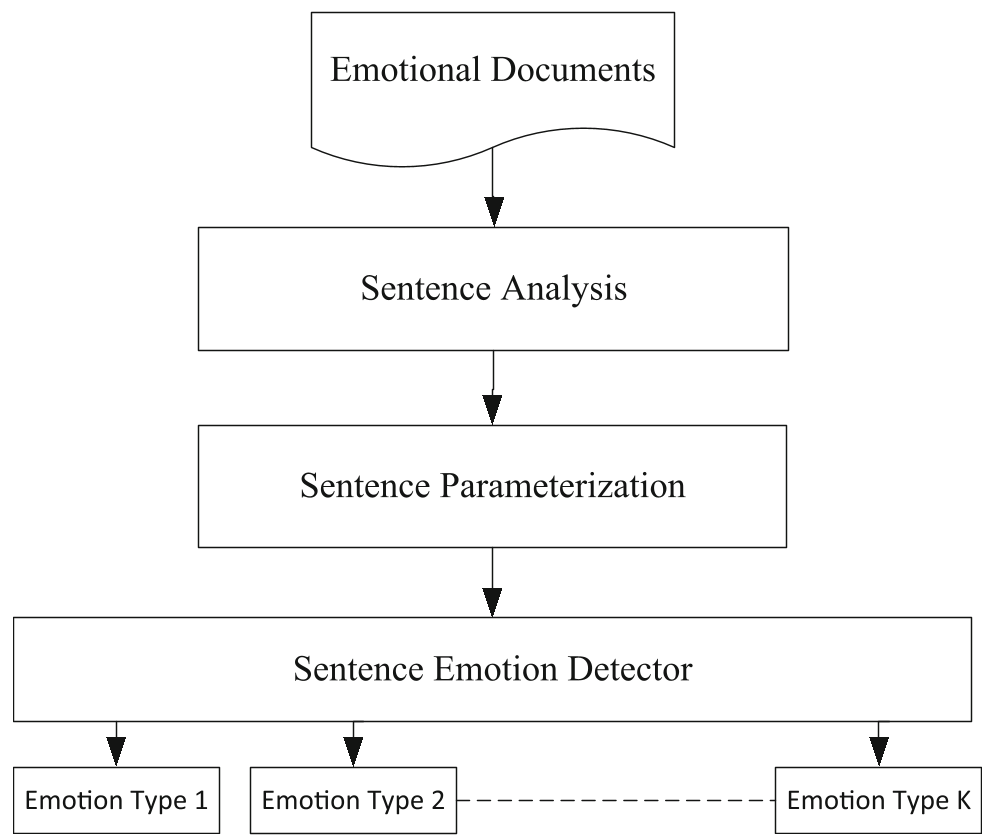 Figure 1: The standard pipeline of text analysis, parameterization, and detection utilized in this framework.
Experimental Validation
The authors tested the model against two types of datasets:
- Regular: ISEAR and OANC (Structured English).
- Irregular: CrowdFlower (Twitter/Social Media).
Performance Highlights:
- Vs. Deep Learning: The ensemble (88.49% on irregular) actually outperformed basic CNN architectures (86.25%) in some scenarios.
- Vs. Ensembles: It significantly outperformed AdaBoost (60.71%) and Random Forest (74.40%) on social media data.
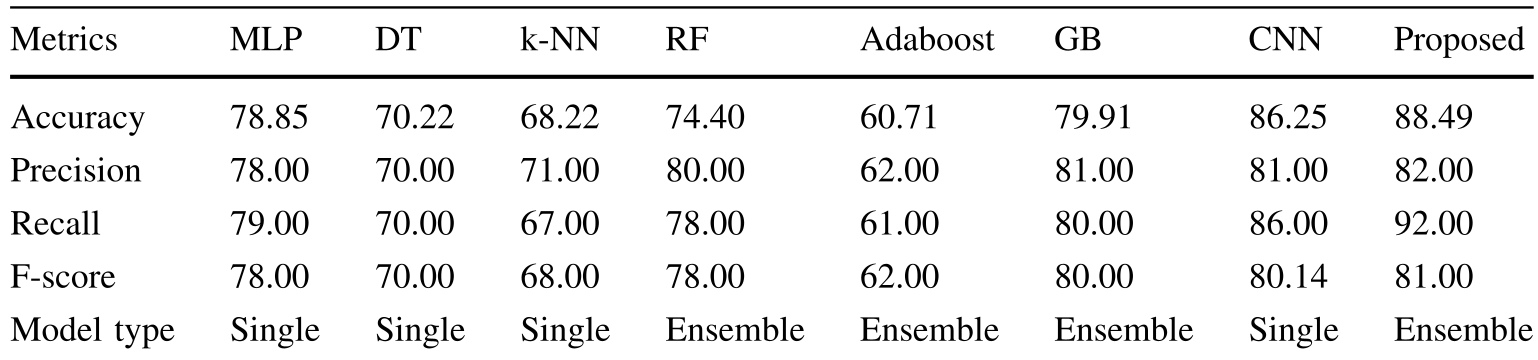 Table: Comparison of Metrics on Irregular Datasets. Note the high Recall (92.00) of the proposed method.
Critical Analysis & Conclusion
Takeaway: This paper proves that a large, diverse committee of "simple" models, if properly tuned through Bayesian methods (TPE) and trained on high-quality semantic embeddings (Doc2Vector), can reach SOTA status.
Limitations:
- Computational Cost: Training 1500 classifiers is resource-intensive. As Table 9 in the paper suggests, the training time (53 units) is nearly as high as a CNN.
- Ensemble Bloat: There is likely significant redundancy among the 1500 classifiers.
Future Work: The authors suggest using clustering to reduce the number of base classifiers without losing accuracy—essentially pruning the committee to keep only the "experts."