
The Human Element: Why Social Networks Succeed Where Pure Software Fails
4395_The Human Element in Social Networking.
The article "The Human Element in Social Networking" explores why many social platforms fail despite solid technical foundations, highlighting the "Reader-to-Leader" framework and human-centric design. Drawing on case studies like Nation of Neighbors (NoN) and the International Children’s Digital Library (ICDL), it emphasizes that sustainable social participation depends on motivational structures rather than just software infrastructure.
TL;DR
Building a social network is not a "Field of Dreams" scenario; technology alone cannot guarantee engagement. Through interviews with HCI pioneer Ben Shneiderman and researcher Anne Rose, this article reveals that long-term success stems from the "Reader-to-Leader" framework. By focusing on recognition, flexible participation levels, and human motivation, developers can transform a static piece of software into a thriving, self-sustaining community.
The "Build It and They Will Come" Fallacy
In the world of software engineering, we often fall into the trap of believing that a superior feature set or a sleek UI is the primary driver of growth. However, Forrest Shull argues that many promising networks never reach the "critical mass" necessary for survival because they treat social interaction as a technical problem rather than a human one.
The pain point is clear: many social platforms are designed "top-down," ignoring the social concerns—altruism, self-interest, and moral principles—that drive real-world communities.
Methodology: The Reader-to-Leader Framework
The core insight provided by Shneiderman is the Reader-to-Leader framework. This model suggests that social participation is a pipeline. For a community to survive, designers must provide a clear pathway for users to advance:
- Readers: Passive consumers of content.
- Contributors: Users who provide small inputs (likes, comments).
- Collaborators: Users who work with others on larger tasks.
- Leaders: The small percentage who initiate discussions, defuse problems, and sustain the community.
Key Design Strategies:
- Pathways for Advancement: Systems must offer a "next level" of involvement.
- Recognition & Rewards: Simple mechanisms like "likes," download counts, or point systems are not just "fluff"—they are vital feedback loops that satisfy the human need for appreciation.
- Power Delegation: High-level leaders should be given more data and administrative power to manage their sub-communities effectively.
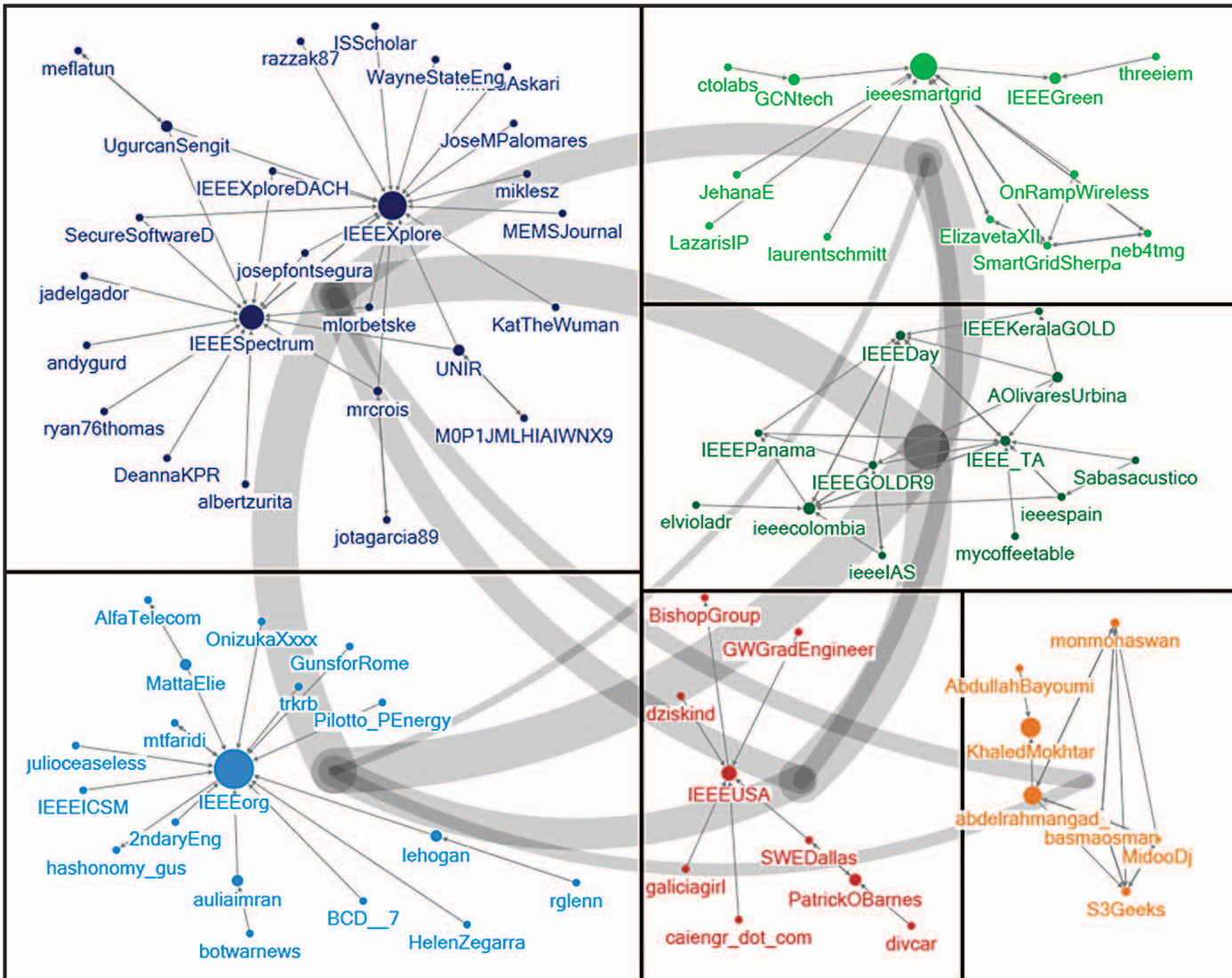 Figure 1: A NodeXL analysis showcasing how social networks cluster by connectedness rather than just sheer volume, highlighting the importance of leadership nodes.
Real-World Evidence: NoN and ICDL
The article contrasts two distinct yet successful systems:
- Nation of Neighbors (NoN): A community safety network. Its success didn't come from a specific "security feature" but from the emergence of local leaders who felt empowered by the platform to protect their neighborhoods.
- International Children’s Digital Library (ICDL): Supporting 61 languages requires 4,000+ volunteers. The ICDL succeeds by matching tasks to talent. Casual users can enter metadata (low time investment), while dedicated experts handle full book translations (high time investment).
The Need for Evolutionary Design
One of the most profound takeaways is the need for flexibility. The ICDL team discovered that an icon of a child sticking their tongue out (intended to represent "humor") was offensive in certain cultures.
Software cannot be static. It must allow for:
- Feedback-Driven Tweaks: A corporation improved its internal social network "tremendously" simply by allowing users to award points to helpful respondents.
- User-Defined Needs: Children searching for books often remember them by color or feeling rather than title or author. The ICDL succeeded because it built features that reflected how its specific audience actually thinks.
 Figure 2: The mission of successful social software is to bridge the gap between technical capability and human enthusiasm.
Critical Insight & Conclusion
The study of social networking principles is moving beyond "clicks" and "impressions" into a deeply interdisciplinary field involving sociologists and domain experts.
The Takeaway for Developers: Your role is moving from "Coder" to "Social Architect." If you are building a collaborative tool, you must ask: How does this code make my user feel seen? How does it help them become a leader? As Shneiderman notes, these motivational structures are potentially "enormously influential for the future security and wealth" of society at large.