
Beyond the Coordinate: Decoding User Similarity through Geosocial Themes
A Thematic Approach to User Similarity Built on Geosocial Check-ins
This paper introduces a thematic approach to measuring user similarity in Location-Based Social Networks (LBSNs) by applying Latent Dirichlet Allocation (LDA) to unstructured "tips" and reviews. It moves beyond simple coordinate-based matching to capture semantic activities, achieving a 77% accuracy rate in pinpointing actual user locations among physical neighbors via a "Commonality" weighting model.
TL;DR
Researchers have developed a new way to tell how "similar" two social media users are, not by where they go, but by the themes of the places they visit. By analyzing unstructured "tips" on Foursquare using Latent Dirichlet Allocation (LDA), this model can predict a user's specific location among 30 neighbors with 77% accuracy, proving that what we say about a place is more telling than just its GPS coordinates.
The "Category" Trap: Why Geospatial Data Isn't Enough
Most recommender systems (like those suggesting friends or nearby restaurants) look at "structured" data: Did you check into a "Cafe"? Was it at these exact coordinates?
However, the authors argue this is "semantically impoverished." Two people might both visit a "Bar," but one is there for the craft beer selection while the other is there for the weekly pub quiz. Standard categories miss these nuances. Furthermore, check-in data is notoriously sparse—most users don't record every single move, leaving massive gaps in their "mobility signature."
Methodology: Turning Text into Signatures
The core innovation lies in treating a user’s activity not as a point on a map, but as a distribution of topics.
1. Topic Modeling (LDA)
The researchers analyzed over 125,000 Foursquare venues. By running LDA on the tips left by users, they extracted 40 distinct topics. A venue is no longer just "Joe's Grill"; it becomes a mixture of Topic A (Barbecue), Topic B (Live Music), and Topic C (Outdoor Seating).
2. The Temporal Window
Similarity isn't static. You might be very similar to a colleague during "Office Hours" but completely different at 10:00 PM. The model creates a 3-hour window around every check-in to compare users' signatures in a specific temporal context.
3. Diagnosticity: Variability vs. Commonality
This is where the "Academic Secret Sauce" comes in. The authors borrowed a concept from cognitive science called Diagnosticity.
- Variability Weighting: Focuses on rare, high-entropy topics. This helps find "soulmates" who share very specific, niche interests.
- Commonality Weighting: Focuses on prevalent, low-entropy topics. This is better for general location prediction because it captures the "mainstream" behavior of a population.
 Table 1 & 2: Examples of unstructured tips and the latent topics (e.g., Tacos, Furniture, Coffee) extracted via LDA.
Experiments: Testing the "Hypothetical Venue"
To validate the model, the authors created a "Hypothetical Venue" for a user—a mathematical ideal of where they should be based on the behavior of their most similar peers. They then checked if the user’s actual location was the most similar to this ideal among its 29 closest physical neighbors.
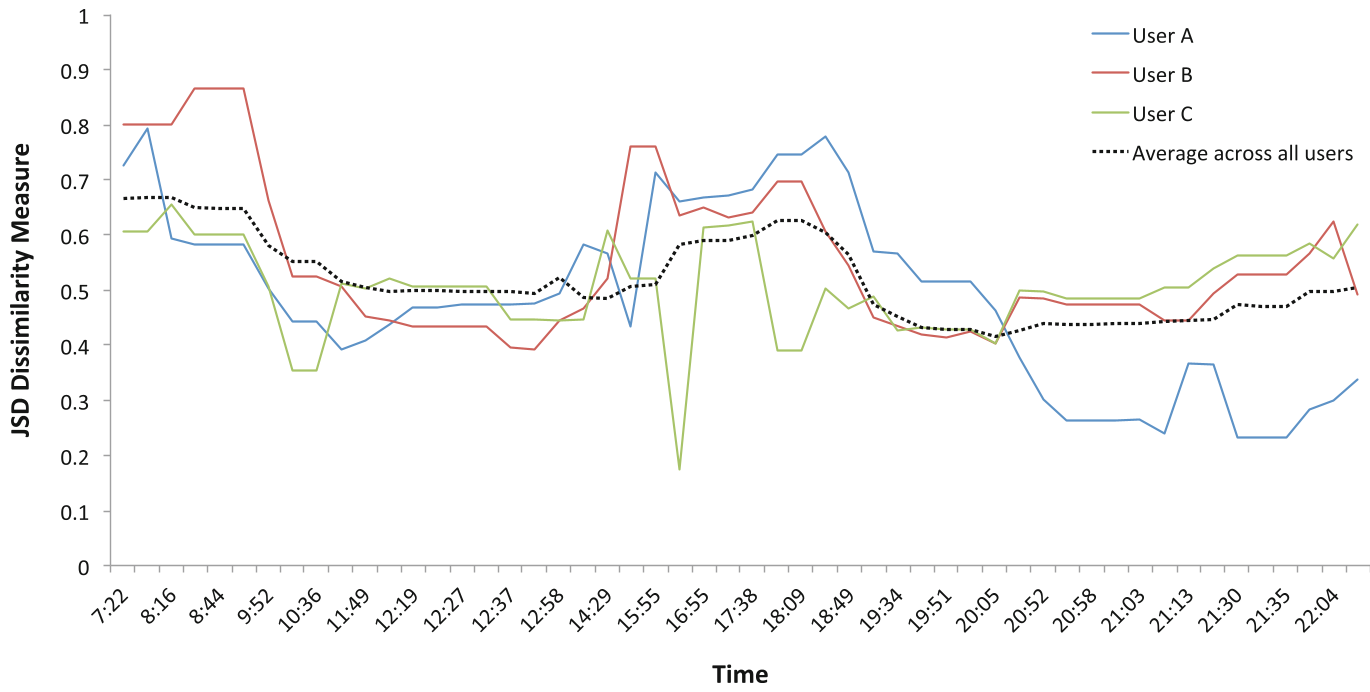 Figure 1: Comparison of three different users to a focal user throughout the day. Similarity is not uniform; it peaks and valleys based on shared activities.
Key Findings:
- Commonality Wins for Prediction: The Commonality model hit the bullseye 77% of the time. This suggests that for predicting where someone is, the most common shared traits are the most reliable.
- The Baseline is Strong: Even a "Random Topic" model (no entropy weighting) achieved 65% accuracy, proving that just using tips (text) is inherently superior to simple categorization.
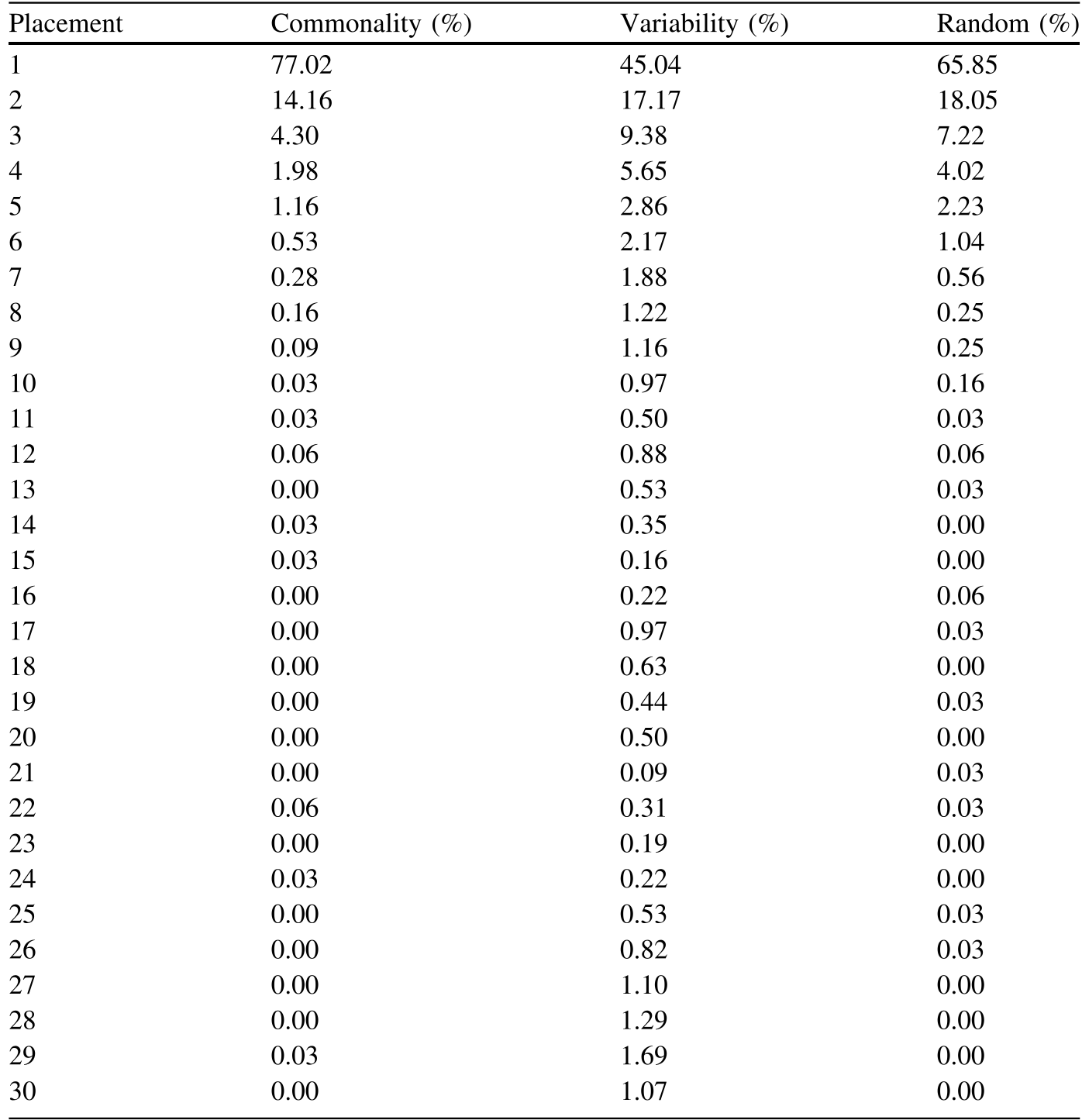 Table 3: The Commonality weight consistently places the actual venue in the top 3 most similar spots 95% of the time.
Critical Insight & Conclusion
The study proves that our "thematic signature"—the collection of reviews, feelings, and descriptions associated with the places we frequent—is a powerful proxy for identity.
Limitations: The model is subject to "crowdsourcing bias." A flashy nightclub might attract more tips than a hospital, potentially skewing the importance of certain venues. Furthermore, people often only check in to "interesting" places, leaving mundane daily routines unobserved.
Future Work: The authors aim to integrate more diverse data sources (like weather or demographic info) and move toward "Activity-by-Activity" similarity, which could revolutionize how local services are recommended on our mobile devices.