
Stochastic Social Dynamics: When Can We Predict the Unpredictable?
Theoretical Computer Science
The paper introduces Stochastic Synchronous Dynamical Systems (SSyDS), a formal graphical framework for modeling social network dynamics like epidemic spreads and influence propagation. It establishes that while reachability is RSPACE(n)-hard, the 1-step predecessor existence problem is solvable in polynomial time for graphs with bounded treewidth and symmetric transition functions.
TL;DR
This seminal work formalizes Stochastic Synchronous Dynamical Systems (SSyDS) to bridge the gap between abstract graph theory and the messy, probabilistic nature of social networks. By mapping epidemic spreads and influence marketing to state-transition problems, the authors delineate a sharp boundary: Reachability (predicting the future) is computationally "hard" (RSPACE-hard), but Predecessor Existence (finding the likely cause) is "easy" (Polynomial-time) under specific graph constraints.
Background: Beyond Determinism
Most early models in graphical dynamical systems were deterministic—if your neighbor has the flu, you're hit. Reality, however, is stochastic. The transition from happens with a probability . The challenge? In a network of nodes, there are possible configurations. We can't just draw the full Markov chain; it would be larger than the number of atoms in the universe for even a small office network.
The Core Mechanism: SSyDS and SSDS
The paper defines an SSyDS as , where:
- is an undirected graph representing social ties.
- is a set of stochastic local transition functions .
The probability of a global state transition is the product of local transitions:
Two Fundamental Problems
- Reachability: Can state A reach state B with probability within steps? (Useful for: Will this virus infect 30% of the city?)
- Predecessor (Pre): Is there an initial state that leads to the current state in 1 step with probability ? (Useful for: Who started this rumor?)
Methodology: The Complexity Frontier
The authors prove that Reachability is extremely difficult. They simulate a Space-bounded Probabilistic Turing Machine using a simple path graph of nodes. This proves that even in a one-dimensional "line" of people, predicting long-term outcomes is RSPACE(n)-hard.
The "Easy" Case: Bounded Treewidth
The paper's most elegant contribution is the polynomial-time algorithm for the Predecessor problem.
Insight: If a graph has a "tree-like" structure (low treewidth) and the rules are "symmetric" (it only matters how many neighbors are in a state, not which ones), we can transform the stochastic problem into a deterministic one.
The authors insert "auxiliary nodes" that act as deterministic switches for probability thresholds. This clever mapping allows them to use dynamic programming on tree decompositions to find pre-images in time.
Experiments & Results: Synchronous vs. Sequential
A fascinating finding involves the Most Likely Successor (Mls):
- In Synchronous systems (SSyDS): Finding the most likely next state is Easy (everyone updates at once based on fixed current info).
- In Sequential systems (SSDS): Finding the most likely next state is NP-hard to even approximate! This is because the order of updates creates a "cascade" of dependencies that is computationally explosive.
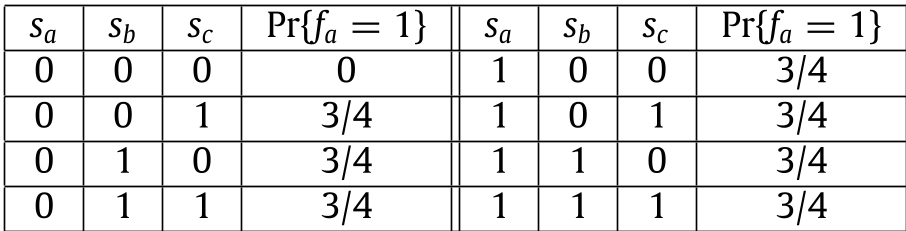 The table above illustrates how even simple 3-input OR functions lead to complex global transitions.
Critical Insight & Future Outlook
The paper reveals a fundamental asymmetry in social dynamics:
- Predicting the future is intractable because of the cumulative variance over time.
- Reconstructing the immediate past is possible if the underlying social structure isn't too "loopy" (i.e., low treewidth).
Future Work: The authors suggest extending this to -step predecessors. In the age of misinformation, being able to trace a rumor back steps in a massive graph could be the holy grail of digital forensics.
Takeaways
- For Developers: If you're building social simulators, remember that sequential update orders are significantly harder to optimize than synchronous ones.
- For Researchers: This proof links the theory of Cellular Automata (CA) directly to RSPACE complexity, opening doors for more rigorous analysis of "Nature-inspired" algorithms.