
SWAP: Reintroducing Accountability to the "Socially Blind" World of Microblogging
Think twice before reposting it: Promoting accountable behavior on Sina Weibo
This paper introduces SWAP (Sina Weibo Analysis Plug-in), a sociotechnical tool designed to combat rumors on microblogging platforms. By applying the "Social Translucence" framework, the system visualizes social data to help users make informed credibility judgments and achieve SOTA-level reductions in impulsive reposting.
TL;DR
Researchers from Fudan University have developed SWAP (Sina Weibo Analysis Plug-in), a tool that uses the concept of Social Translucence to stop rumors at the source: the user's decision to repost. By visualizing poster credibility, community sentiment, and topic history, SWAP significantly increases a user's ability to spot rumors and reduces impulsive, unaccountable sharing.
The Problem: Online Blindness and the Cost of a Click
In the physical world, we use rich social cues to judge credibility. In the virtual world, we are "socially blind." On platforms like Sina Weibo, a rumor can reach millions in minutes because the interface prioritizes speed over verification. Traditional fixes—like deleting posts—are akin to playing "whack-a-mole." The authors argue that the real issue is a lack of accountability caused by the digital medium's anonymity and lack of transparency.
Methodology: The Architecture of Social Translucence
The core innovation of SWAP isn't just a rumor detection algorithm; it is a sociotechnical interface designed around three pillars:
- Visibility: Making "hidden" data public. SWAP aggregates data points that a normal user wouldn't see, such as the poster's history of rumor-spreading and the cumulative sentiment of thousands of comments.
- Awareness: Using animation and step-by-step guides to ensure users actually process this evidence before they have the option to share.
- Accountability: Creating a "peer pressure" mechanism where a user’s decision-making process (e.g., whether they checked the analysis) could be visible to their followers.
The Technical Core
SWAP employs several technical modules to generate this visibility:
- Sentiment Analysis: An SVM classifier trained on the NTUSD (National Taiwan University Semantic Dictionary) to categorize the "collective wisdom" of comments into positive, negative, or neutral attitudes.
- Crowdsourced Topic Tagging: Using the "wisdom of the crowd" to categorize posts into 14 segments (e.g., Food Safety, Public Safety), helping users identify high-risk rumor categories.
- Reverse Image Search: Integrating Google Image API to detect if a "breaking news" photo is actually an old, recycled image.
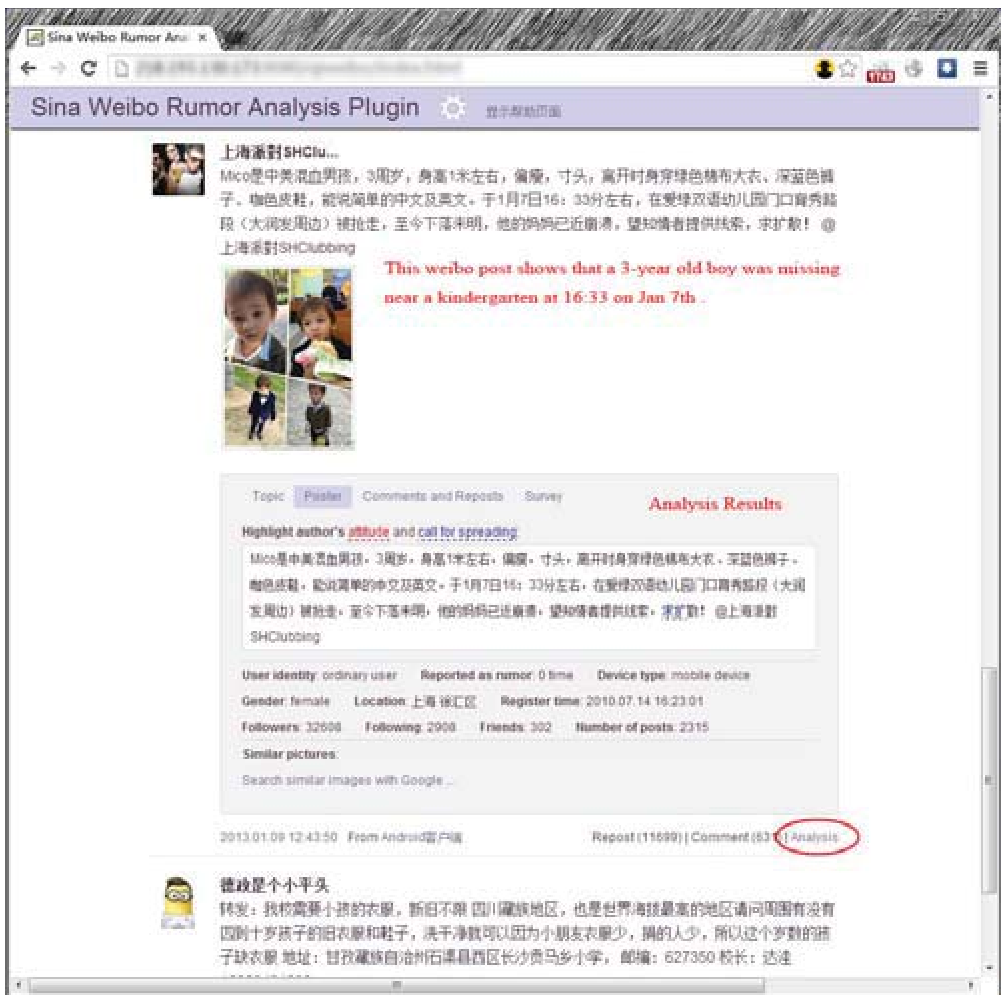 Figure 1: The SWAP interface integrated into the Sina Weibo feed, providing a "Think Twice" analysis link.
Experimental Evidence: Does it Actually Work?
The researchers tested SWAP against a dataset of 11,026 Weibo posts (9,638 of which were confirmed rumors). The results were compelling:
- Judgment Accuracy: There was a statistically significant shift in belief systems. After using SWAP, participants were far more likely to correctly identify rumor posts as "untrustworthy" (p < 0.001).
- Behavioral Change: The "Tendency to Repost" dropped significantly (Cohen’s d = 0.33). Users moved from "reposting in a rush" to "considering the evidence."
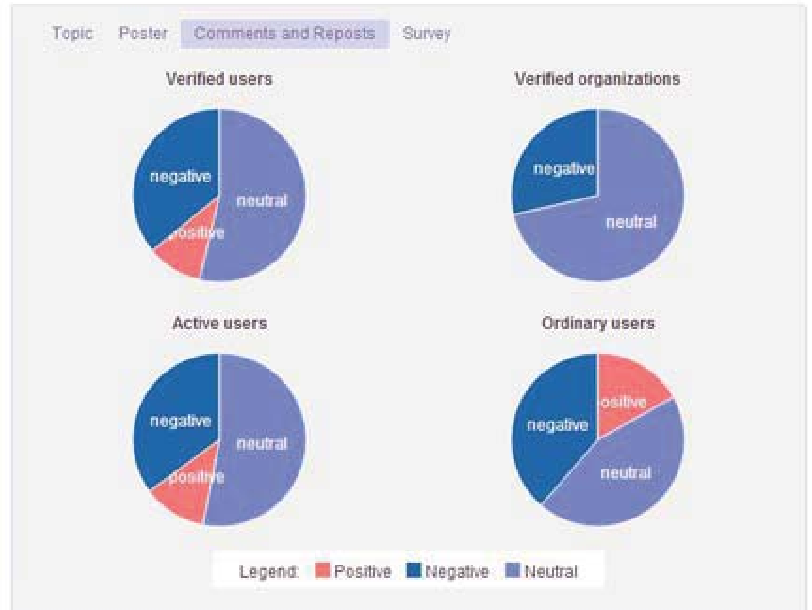 Figure 2: Example of social evidence visualization, including poster history and community attitude distributions.
Critical Insights: Beyond the Algorithm
The most profound finding of the paper is that peer pressure alone isn't the primary driver of accountability. The experiment showed that while users were wary of their reputation, the primary reason they stopped spreading rumors was the internalization of social evidence. When users were presented with the fact that a poster had a history of rumors or that a picture was fake, their sense of personal responsibility naturally increased.
Limitations and Future Outlook
While SWAP is a powerful prototype, it currently relies on a semi-manual database for some "similar rumor" matching. For this to scale to the billions of posts on modern social media, a fully automated, real-time Natural Language Processing (NLP) pipeline would be required.
However, the takeaway for UX designers and AI researchers is clear: Transparency is a feature, not a bug. By building "friction" into the UI via social evidence, we can create a more resilient digital society.
Final Summary
SWAP proves that we don't necessarily need more aggressive censorship to fix social media; we need better mirrors. By reflecting the social context of a post back to the user, we can transition from a "click-first" culture to one defined by accountable, coherent behavior.