
3VSL: Solving the "Bridge" Problem in Multi-Hop Social Trust Assessment
Assessment of multi-hop interpersonal trust in social networks by Three-Valued Subjective Logic
The paper introduces 3VSL (Three-Valued Subjective Logic), a novel computational framework for assessing multi-hop interpersonal trust in Online Social Networks (OSNs). By extending the Beta distribution to a trinomial Dirichlet distribution, 3VSL achieves SOTA accuracy in arbitrary network topologies, moving beyond the series-parallel constraints of traditional Subjective Logic.
Executive Summary
Trust is the invisible currency of Online Social Networks (OSNs). Whether it's online marketing or peer-to-peer security, determining "how much A should trust a stranger C" via an intermediary B is a fundamental challenge. This paper presents 3VSL (Three-Valued Subjective Logic), a robust mathematical evolution of traditional trust logic. Unlike its predecessors, which break down in complex "bridge" topologies, 3VSL utilizes a trinomial Dirichlet distribution to accurately model trust propagation across arbitrary network graphs.
The "Series-Parallel" Bottleneck
In the world of Subjective Logic (SL), researchers typically model trust as a tuple of . However, SL has a fatal flaw: it is mathematically limited to Series-Parallel topologies.
In real life, social networks are messy. They contain "bridge" connections—where multiple paths intersect in ways that cannot be simplified into simple series or parallel strings. Previous SOTA methods dealt with this by simply deleting "unsolvable" edges. As the authors prove, this information loss leads to significant errors in trust estimation.
Methodology: The Power of the Neutral State
The core insight of 3VSL is the introduction of a Neutral State. While Subjective Logic views trust as a binary outcome (Success or Failure), 3VSL treats it as a trinary event:
- Belief: Evidence for trust.
- Distrust: Evidence for lack of trust.
- Neutral: Evidence that has been "distorted" during propagation.
1. From Beta to Dirichlet
By moving from a binary to a trinary events, the underlying math shifts from a Beta Distribution to a Dirichlet Distribution. This allows 3VSL to distinguish between:
- Priori Uncertainty (): I don't know you because I have no data (Lack of evidence).
- Posteriori Uncertainty (): I am unsure because the information I got from B about you was diluted (Distortion).
2. Redefining Operations
3VSL introduces two critical operators:
- Discounting (): Models trust propagation. When A hears B’s opinion of C, the "certainty" is distorted into the neutral state, but the evidence size remains the same.
- Combining (): Combines opinions from multiple paths. 3VSL effectively handles the "re-use" of distorting opinions while ensuring original evidence is only combined once to prevent over-counting.
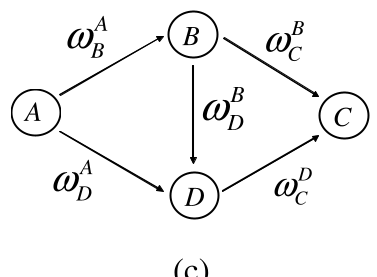 Fig 1: The unsolvable Bridge Topology (c) vs simplified Series/Parallel (a, b).
Experiments and Real-World Validation
To move beyond theoretical simulations, the authors implemented an online survey system to collect real-world trust data from 100 participants. Participants evaluated their 1st and 2nd-hop friends, creating a rare ground-truth dataset for multi-hop interpersonal trust.
Key Findings:
- Accuracy: 3VSL achieved a much tighter fit to human judgment than Subjective Logic.
- Error Distribution: In combining operations, 95% of 3VSL results had an error rate below 20%.
- The Bridge Impact: Numerical analysis demonstrated that the "bridge" edges—those previously ignored by older models—significantly impact the final trust score, especially when the bridge intermediary is well-known.
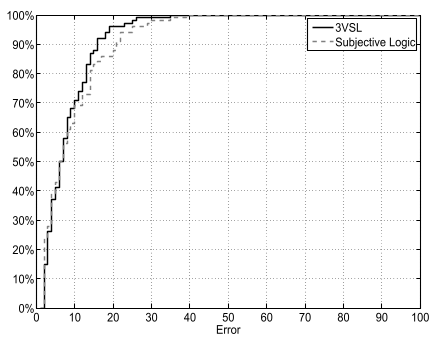 Fig 2: 3VSL (Blue) consistently shows lower average error than Subjective Logic (Red) across both discounting and combining operations.
Conclusion and Deep Insight
The brilliance of 3VSL lies in its recognition that uncertainty is not monolithic. By separating the "uncertainty of ignorance" from the "uncertainty of distortion," 3VSL provides a framework that finally matches the complexity of real-world social graphs.
Takeaway for Practitioners: If you are building recommendation engines or Sybil-defense systems, 3VSL offers a way to calculate trust across complex meshes without the need for heuristic graph simplification. The next step for this field will likely involve merging 3VSL with Bayesian analysis to handle multi-source data streams.