
Being Thrifty on a $100K Wage: The Psychology of Managed Austerity
Being Thriy on a $100K Wage: Austerity in Family Finances
This paper presents an ethnographic study of fifteen middle-to-high income families (average $104K AUD) in Australia, investigating their collaborative financial management practices. The researchers identify a persistent "culture of thrift" characterized by creative mechanisms for saving and behavior control, regardless of significant household income.
TL;DR
Even families earning over $100,000 a year engage in surprising acts of "financial austerity." This ethnographic study by Vyas et al. reveals that middle-class thriftiness isn’t about survival—it’s about psychological warfare against one's own spending habits. From hiding Indonesian Rupiah in closets to using "invisible" wallet compartments, these families use physical hacks to ensure long-term security.
Background: More Money, Same Scarcity Mindset?
In the world of Human-Computer Interaction (HCI), researchers have long studied how the poor "get by." However, this paper shifts the lens toward the affluent. Despite earning an average of $104,000 AUD, the participants in this study felt a profound lack of control over large fixed costs (mortgages, utilities), leading them to apply rigorous, creative discipline to their discretionary spending.
Motivation: Why be Thrifty when You’re Winning?
The authors identify a gap between actual wealth and perceived financial freedom. The research intuition here is that high-income families aren't just managing numbers; they are managing behaviors. The "why" behind their thriftiness is rooted in "Future Economic Security"—a desire to pay off mortgages early or secure overseas holidays, which necessitates a self-imposed "artificial scarcity."
Methodology: Mapping the Domestic Ledger
The researchers visited fifteen homes, conducting deep-dive interviews and asking participants to draw "Financial Maps." These maps (see Figure 1) visualized how income flows from joint accounts to specific "savings silos," often controlled by one partner to maintain discipline.
 Figure 1: A map showing income pooling and the psychological "boxing" of savings.
Key Tactics: Securing Money from Yourself
The most fascinating aspect of the findings is the "Securing" behavior. Participants treated themselves as unreliable actors who needed to be tricked into saving:
- Physical Friction: Using the "Envelope Method" (Figure 3) to physically limit discretionary spending on petrol or dining out.
- Visual Blindness: Hiding cash in zipped sections of wallets so it is "out of eye's view" and thus outside the "spending zone."
- Currency Conversion: One family converted holiday savings into Indonesian Rupiah months in advance so it couldn't be spent locally (Figure 4).
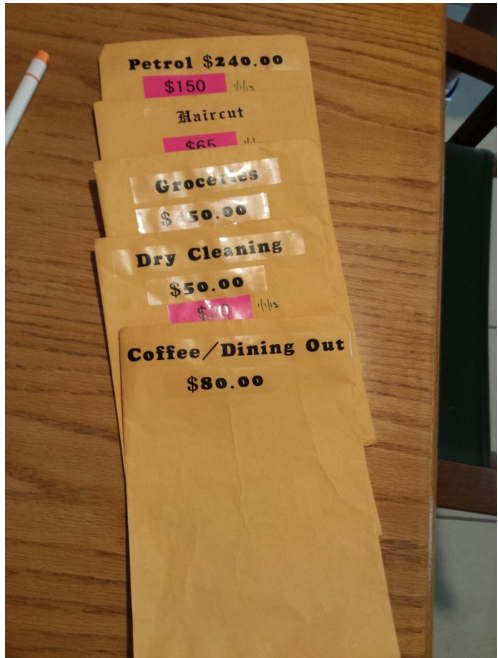 Figure 3: Traditional cash envelopes used to enforce budget limits.
Discussion: Beyond "Fitness Apps" for Finance
Current financial apps often mimic health trackers—they show you what you did after you did it. The authors argue this is insufficient.
SOTA Comparison: While previous SOTA (State-of-the-Art) research like Vines et al. (2014) focused on the "creativity of the poor," this work proves that high-income users also need creative "friction."
Design Implications:
- Interactive Co-creators: Apps should not just record data; they should help users "hide" money or create artificial barriers to spending.
- Contextual Flexibility: Systems need to support the messy, collaborative nature of family finances rather than assuming a single, rational user.
Conclusion & Future Outlook
The study concludes that "thriftiness" is a universal human strategy for managing uncertainty, regardless of the paycheck size. For developers and designers, the takeaway is clear: the future of FinTech isn't just better charts—it's building digital versions of the "zipped wallet pocket" and the "hidden pouch" to protect users from their own impulses.
Limitations: The study is limited to a small sample size in a specific Australian geographic area. Future work should explore if these "stealth savings" tactics vary across different cultures with different attitudes toward debt.