
Beyond the Frame: Decoding Environmental Audio through Time-Frequency Matrix Factorization
Time–Frequency Matrix Feature Extraction and Classification of Environmental Audio Signals
This paper introduces a novel long-term audio feature extraction framework for environmental audio classification, utilizing Matching Pursuit Time-Frequency Distribution (MP-TFD) and Non-negative Matrix Factorization (NMF). The method achieves a significant 10%+ accuracy improvement over traditional MFCC-based systems across 10 diverse audio classes.
Executive Summary
Environmental audio signals are notoriously difficult to classify due to their "messy" nature—abrupt transients, overlapping frequencies, and varying temporal lengths. This paper, published by Behnaz Ghoraani and Sridhar Krishnan, challenges the status quo of short-term frame analysis. By treating the audio signal as a Time-Frequency Matrix (TFM) and applying Non-negative Matrix Factorization (NMF), the authors extract structural insights that traditional features like MFCCs miss. The result is a robust system that outperforms baselines by over 10% and holds its ground even in high-noise environments.
The "Stationarity" Trap: Why Standard Methods Fail
Most audio processing pipelines are built on the assumption that if you look at a small enough slice of sound (typically 20ms), it is essentially "stationary" (the frequency content doesn't change). While this works for steady speech vowels, it fails for environmental sounds:
- Discontinuities: A hammer strike or an insect chirp contains abrupt changes that segmentation breaks apart.
- Global Context: Human ears need roughly 1 second to identify a sound's context. Standard 30ms frames lose the "rhythm" and global structure.
- Resolution Trade-offs: Techniques like Spectrograms are bound by the uncertainty principle—you can have good time resolution or good frequency resolution, but rarely both at the level needed for complex scenes.
Methodology: The TFM-NMF Pipeline
The authors suggest a three-stage approach that shifts the focus from "what is happening now" to "what structures exist in this 3-second window."
1. High-Resolution MP-TFD
Instead of a standard Fourier Transform, the authors use Matching Pursuit (MP). This decomposes the signal into "atoms" from a Gabor dictionary. It is adaptive; it picks the best window length for each part of the sound, resulting in a TFD that is:
- Interference-term free: No "ghost" frequencies between real components.
- Energy-concentrated: It captures the "coherent" sound and leaves the noise behind.
2. Matrix Factorization (NMF)
Once the Time-Frequency Matrix is built, the authors don't just feed the pixels to a classifier. They use NMF to decompose it into:
- Base Vectors (): Representing the "what" (spectral signatures).
- Coefficient Vectors (): Representing the "when" (temporal activation).
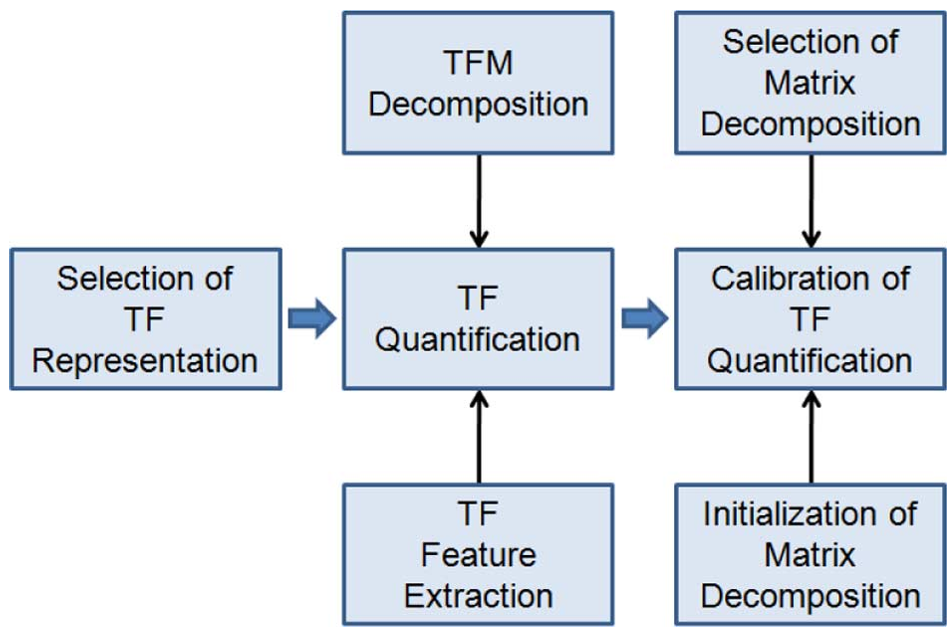
3. Novel Feature Extraction
The breakthrough lies in the seven novel features extracted from these vectors, including:
- Sparsity: Distinguishes between continuous hums (like aircraft) and transient bursts.
- MP Coherency: A measure of how much of the signal fits into clean mathematical "atoms" versus random noise.
Experimental Results: SOTA Performance
The researchers tested their framework on a database of 192 environmental sounds across 10 classes, including aircraft, helicopters, animals, and musical instruments.
| Method | Accuracy (Regular) | Accuracy (Cross-Val) |
|---|---|---|
| Proposed TFM Method | 85.5% | 75.8% |
| Standard MFCC | 74.2% | 67.1% |
The proposed method showed its strongest gains in classes with high nonstationarity, such as Helicopter (100% accuracy) and Drum (90% accuracy).
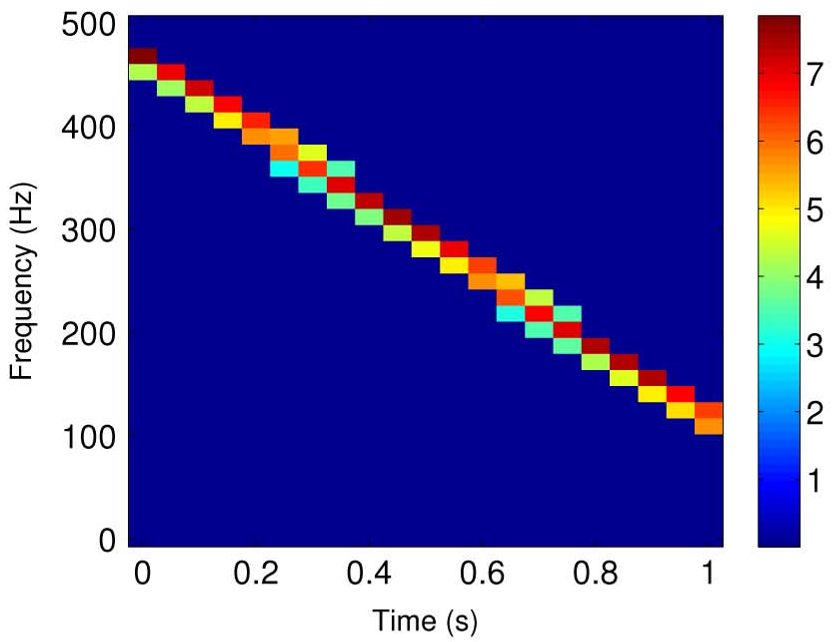 Figure: Note the extreme clarity of the MP-TFD compared to the blurry Spectrogram in tracking rapid transitions.
Noise Robustness: The Silent Hero
A critical finding was that the MP-TFD approach is naturally noise-resistant. Because Matching Pursuit iteratively captures the strongest signal components first, the low-energy random noise is effectively "filtered out" in the residue. The system maintained high performance at 10 dB SNR, whereas spectrogram-based methods required a nearly impossible 50 dB SNR to yield similar results.
Critical Insight & Conclusion
This work demonstrates that long-term structural quantification is superior to short-term statistical averaging for non-speech audio. By using NMF, Ghoraani and Krishnan provided a way to "summarize" a complex 3-second auditory scene without losing the fine-grained details of its transients.
Takeaway for Engineers: If you are building a system for environmental monitoring (e.g., detecting mechanical failure or urban noise), stop looking at frames. Look at the matrix of the sound and decompose its structure.
Limitations
- Computational Cost: Matching Pursuit and NMF iterations are significantly more intensive than a simple FFT.
- Fixed Dictionary: The Gabor atoms may not be the optimal "vocabulary" for every possible environmental sound.