
Profit-Max: Balancing Time and Spread for Optimal Viral Marketing
Time Optimal Profit Maximization in a Social Network
The paper introduces the Time Optimal Profit Maximization (TOPM) problem, which seeks to identify a seed set and an optimal time span to maximize net profit. It proposes the Influence Power Allocation model with Time Span (IPA-T) and an approximation algorithm, Profit-Max, to solve this NP-hard challenge.
TL;DR
In the world of social media marketing, more time doesn't always mean more money. This paper addresses the gap between raw "influence spread" and actual "net profit" by introducing the Time Optimal Profit Maximization (TOPM) problem. The authors propose the IPA-T model and the Profit-Max algorithm, which prove that there is a "sweet spot" in campaign duration that maximizes profit before promotional costs overtake the gains from new activations.
Problem & Motivation: The Hidden Cost of Time
Classic Influence Maximization (IM) research focuses on one thing: activating the maximum number of users given a seed set . However, in reality, running a campaign costs money every day.
The authors observed a critical phenomenon: as time increases, the number of newly activated nodes follows a curve of diminishing returns (becoming stable), while the costs continue to stack up. Furthermore, the "best" influencers for a 10-day campaign might be entirely different from the best ones for a 60-day campaign. Existing SOTA methods like the CD (Credit Distribution) model ignore this temporal dimension, leading to suboptimal marketing strategies.
Methodology: The IPA-T Model and Profit-Max
To solve this, the paper introduces the Influence Power Allocation model with Time Span (IPA-T). Unlike models that assume fixed probabilities, IPA-T uses real action logs (e.g., timestamps of when users actually performed an action like "liking" a post).
1. Influence Power Allocation
If user performs an action within time after user , influence is "credited" back to . This is done recursively to account for indirect influence (ancestors in the propagation chain).
2. The Profit-Max Algorithm
The algorithm iterates through potential time units and performs the following:
- Initialization: Scans action logs to build an influence link list.
- Greedy-CELF: A specialized greedy selection that uses "Cost-Effective Lazy Forward" optimization to pick the best seed nodes without recomputing the entire network's influence every time.
- Profit Calculation: Evaluates
Profit = (Price * Spread) - (Cost * T).
 Figure: The core logic showing how influence spread plateaus while time increases.
Experiments & Results
The authors tested their approach on two major datasets: Last.fm (Music) and Digg (Social News).
Finding the "Profit Peak"
As shown in the charts below, while the "Spread" (number of users) keeps rising slightly, the "Profit" eventually hits a peak and starts to drop sharply as the cost of time begins to outweigh the value of the few remaining users being activated.
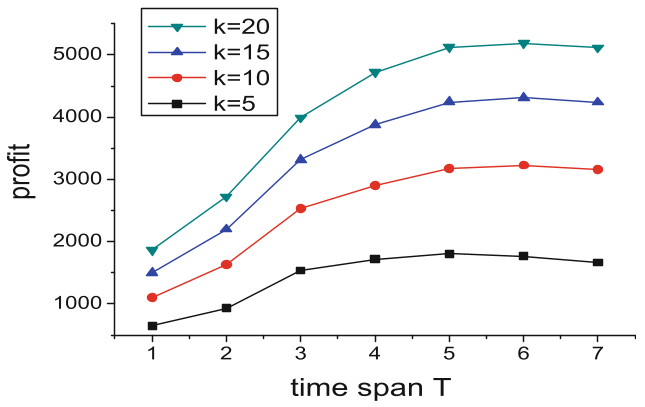 Figure: Profit vs Time T in Last21646 dataset. Note the clear parabolic shape indicating an optimal T.
Comparison with Baselines
Compared to traditional methods like Degree-Max (picking popular nodes) or IC-M-Max, Profit-Max achieved a higher influence spread across all tested time spans, proving that its allocation logic more accurately mirrors real-world propagation.
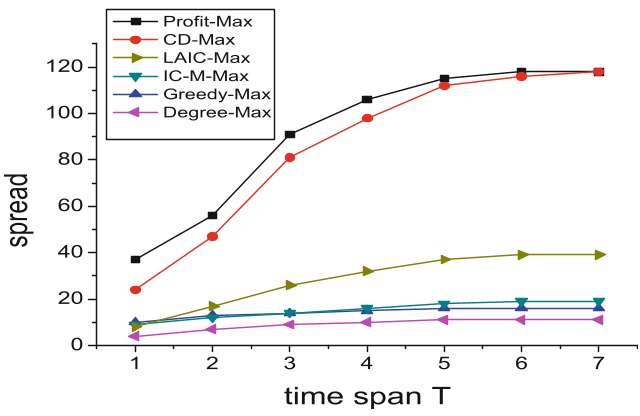 Figure: Spread comparison showing Profit-Max outperforming traditional heuristic models.
Critical Analysis & Conclusion
Takeaway
The primary contribution is the shift from Influence to Profit. By treating time as a cost-bearing resource rather than a passive backdrop, the TOPM problem provides a much more pragmatic framework for actual business use cases.
Limitations
- Linear Cost Assumption: The model assumes
cost * Tis linear. In many real-world scenarios, advertising costs might fluctuate (e.g., peak seasons) or follow non-linear patterns. - Data Dependence: IPA-T relies heavily on high-quality action logs. In new networks where historical data is sparse, the model's predictive power might be limited.
Future Outlook
Future research could examine how this model performs in competitive environments (e.g., two companies competing for the same time-sensitive market) or integrate it with reinforcement learning to dynamically adjust the time span as the campaign unfolds.