
Beyond Simple Counts: Leveraging Time-Sensitive Social Signals for Smarter Ranking
Document Priors Based On Time-Sensitive Social Signals
This paper introduces a novel Language Model (LM) document prior that leverages the temporal characteristics of social signals (e.g., likes, shares, comments) to improve Information Retrieval (IR). By incorporating the "Signal Time" and "Resource Publication Date" into the ranking function, the authors achieve significant performance gains over traditional text-only and time-insensitive social ranking methods.
TL;DR
In the era of social-driven content, a "Like" from three years ago shouldn't carry the same weight as a "Like" from three minutes ago. This paper proposes a method to integrate the recency of social actions and the age of documents into Information Retrieval (IR) models. By treating social signals as time-dependent priors, the researchers improved search precision significantly, proving that when people interact is as important as how many interact.
The "Popularity Trap" in Social Retrieval
Most modern search engines use social signals (likes, shares, comments) as non-textual features to determine a document's importance. However, existing models usually just count these signals. This leads to two major problems:
- The Survival Advantage: An average movie from 2010 has had 14 years to collect likes, whereas a masterpiece released last week has only had 7 days. Counting alone unfairly favors the old.
- Vanished Interest: A viral topic from 2015 might have millions of "Shares," but it is likely irrelevant to a user searching for current trends today.
The authors argue that signals are time-dependent. To capture the true "a priori" significance of a document, we must bias the counting based on the resource's age and the signal's timestamp.
Methodology: The Math of Recency
The authors utilize the Language Modeling (LM) framework for retrieval, where the document prior is no longer uniform but calculated based on temporal social evidence.
1. Estimating Signal Recency ()
Instead of adding 1 to the count for every action, they apply a Gaussian Kernel. Actions closer to the "current time" are assigned a value near 1, while older actions decay toward 0.
 Formula 6: Biasing signal counts using the distance between current time and action time.
2. Normalizing by Resource Age ()
To level the playing field for new documents, they divide the total signal count by the resource's "lifespan." This measures social velocity rather than just volume.
 Formula 7: Adjusting signal count based on the document's publication date.
Experimental Insights
The researchers tested their approach on an IMDb dataset enriched with signals from Facebook, Google+, Twitter, and LinkedIn.
| Model variant | P@10 | MAP | nDCG |
|---|---|---|---|
| Baseline (Text Only) | 0.3700 | 0.2402 | 0.4325 |
| Social (No Time) | 0.4408 | 0.3300 | 0.5974 |
| Social + App Age () | 0.4484 | 0.3366 | 0.6200 |
Key Discoveries:
- Age Normalization is King: Adjusting for the resource's publication date () provided more significant improvements than just looking at the action timestamps ().
- Social Works: Even basic social priors (without time) outperform text-only baselines, but adding the temporal dimension "polishes" the ranking significantly.
- Significant Gains: The
All Criteria TDrun (combining all social networks) achieved the highest nDCG, marking a 43% improvement over the standard Hiemstra language model.
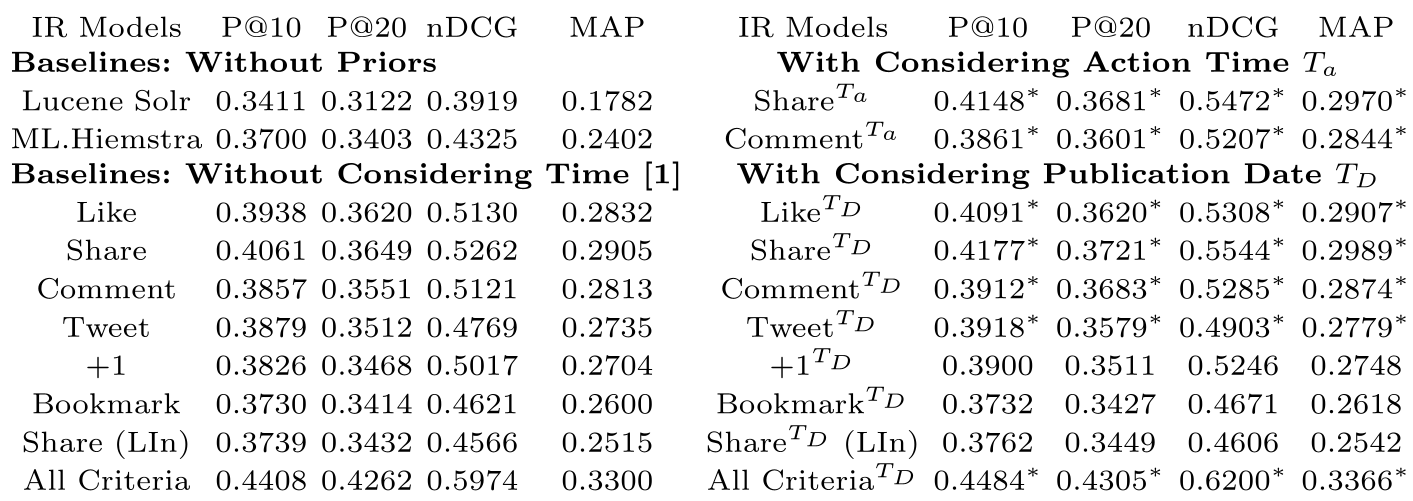 Detailed breakdown of IR model performance across different social signals and temporal settings.
Critical Analysis & Future Outlook
While the results are promising, the study highlights a major industry hurdle: Data Accessibility. The authors noted that most Social Network APIs (Facebook, etc.) provide total counts but often hide the granular timestamps for every individual action. As a result, the authors had to rely on the "Last Action Date" for some metrics.
Takeaway for Devs: If you are building a recommendation engine or a search interface, do not just index like_count. Index (like_count / days_since_published) to surfaces fresh, high-velocity content that would otherwise be buried by legacy hits.
Future Work: The authors suggest exploring "Signal Diversity"—looking at how the variety of signals (e.g., a mix of tweets and shares vs. just pins) evolves over time to predict document relevance.