
Elevating D2D Communication: Integrating Time-Varying Social Intelligence into Resource Allocation
Time-Varying Social-Aware Resource Allocation for Device-to-Device Communication
This paper proposes a social-aware resource allocation scheme for Device-to-Device (D2D) communication that integrates physical and social domains. By utilizing an ARIMA-based prediction model for time-varying social ties and a Potential Game framework, the authors optimize spectrum sharing to favor users with high social influence and content diffusion capabilities.
TL;DR
As mobile devices become ubiquitous, Device-to-Device (D2D) communication is shifting from simple point-to-point links to complex social-aware networks. This paper introduces a sophisticated framework that predicts the fluctuating strength of social ties using ARIMA models and optimizes spectrum resources via Potential Game theory. By prioritizing users within "social communities," the system achieves a 30% boost in utility, significantly enhancing local content distribution.
Behind the Motivation: Why Social Ties Matter
D2D communication allows devices in proximity to bypass the base station, offloading traffic and increasing spectral efficiency. However, most strategies treat users as isolated entities. In reality, humans carry these devices, and their communication patterns are driven by social intimacy.
The authors identify two fatal flaws in current research:
- Static Assumptions: Social relations are not fixed; they evolve over time.
- Behavioral Extremes: Relying on models that assume users are either perfectly selfish or perfectly altruistic ignores the "community" effect where people care about the experience of their social circle.
The Dual-Domain Methodology
The paper proposes a two-domain architecture: the Physical Domain (modeling interference and data rates) and the Social Domain (quantifying human interaction).
1. Predicting Intimacy with ARIMA
Instead of using a simple snapshot of social links, the authors analyze call-log data to calculate an "Intimacy Degree" based on call frequency and reciprocity. By treating these metrics as a time sequence, they apply the Auto-Regressive Integrated Moving Average (ARIMA) model to predict future social bond strengths ().
2. The Social-Community Potential Game
The core innovation lies in the utility function. Rather than maximizing individual throughput, each user seeks to maximize a Social-Community Utility:
eq M_j} \omega_{M_i, M_j} R_{M_j}$$ This equation reveals the physical intuition: a user's value is the sum of their own rate and the weighted rates of their friends. 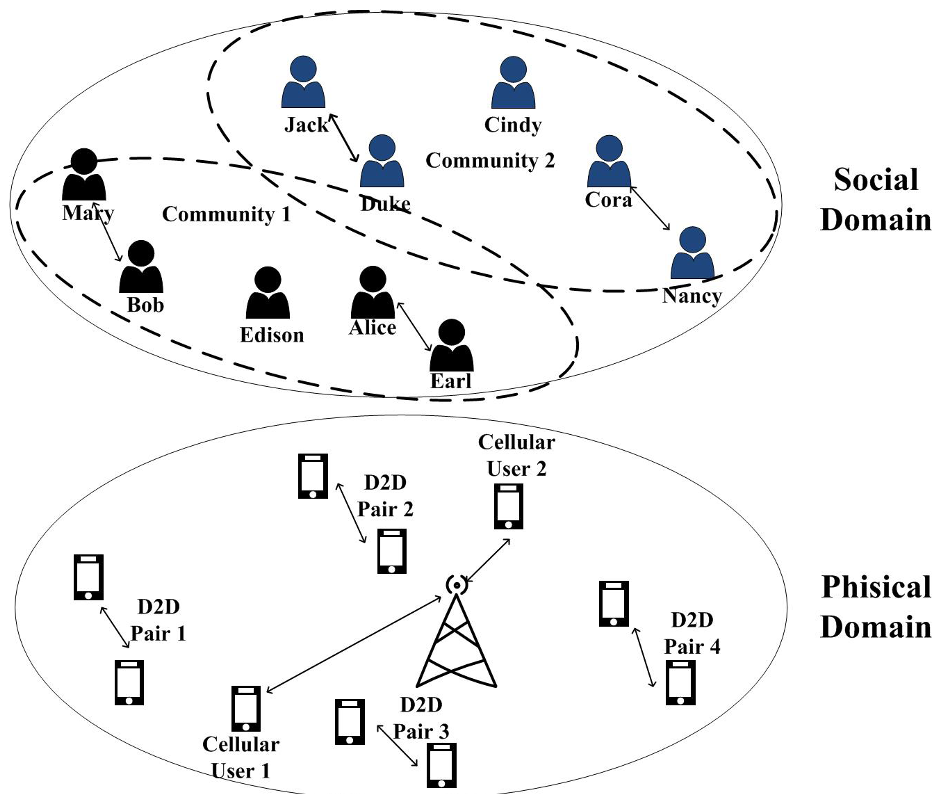 *Figure 1: Illustration of the physical and social domains mapping D2D pairs to community structures.* To solve this, the authors employ **Potential Game** theory. The beauty of this approach is the "Finite Improvement Property"—every local improvement by a user eventually leads to a global **Nash Equilibrium**, ensuring the system stabilizes quickly. ## Performance Benchmarks The proposed algorithm was tested against **Coalition Games (CG)** and **Random Selection (RS)**. * **Utility Gains**: The Social-Aware scheme outperformed CG by ~30% and RS by over 50% as the number of D2D links grew. * **Convergence**: The algorithm demonstrates rapid convergence, typically reaching equilibrium within a few dozen iterations, making it viable for real-time deployment. 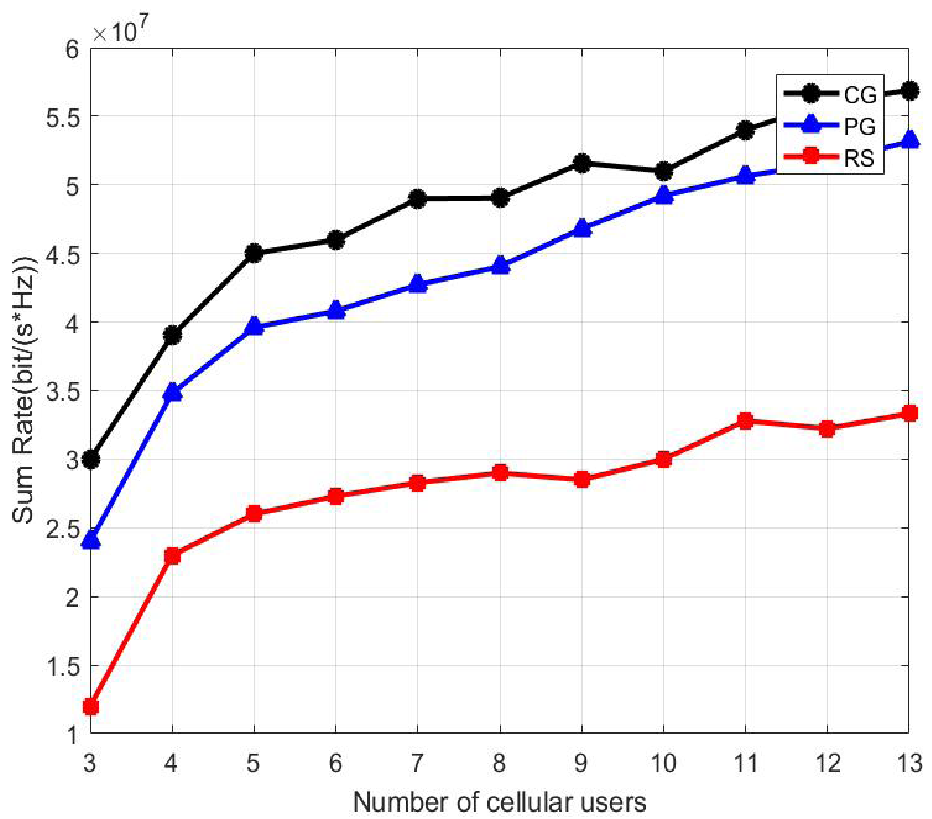 *Figure 2: Social community utility scales efficiently with the number of D2D and cellular users.* ## Critical Insights & Future Directions While the Potential Game ensures stability, there is a minor trade-off in **Fairness**. Because the system prioritizes "socially central" users to maximize content spread, peripheral users might see slightly lower gains (as evidenced by a lower Jains Fairness Index compared to selfless coalition models). **Future Outlook**: The authors suggest that combining this social-aware resource allocation with **Mode Selection** (deciding when to switch between cellular and D2D modes) will be the next frontier in optimizing 5G/6G edge networks. ### Takeaway This research shifts the paradigm of resource management from "signal-centric" to "user-centric." By understanding *who* is talking to *whom*, networks can move data more intelligently, turning social behavior into a measurable technical advantage.