
Timing Matters: Why Your Viral Marketing Campaign Needs a Schedule, Not a Launch
15297_Timing Matters Influence Maximization in Social Networks Through Scheduled Seeding.
The paper introduces a "Scheduled Seeding" approach for Influence Maximization (IM) in social networks, moving beyond traditional initial-phase seeding. By optimizing both the selection and the specific timing of node activations, it establishes a new strategic paradigm for viral marketing and information diffusion.
TL;DR
Most Influence Maximization (IM) research asks "Who should we target?" This paper asks a more powerful question: "When should we target them?" By shifting from an Initial Seeding approach to a Scheduled Seeding approach, the authors demonstrate a massive 10%–70% boost in total network activation.
The Blind Spot of Static Seeding
In the classical IM paradigm, you pick your "influencers," seed them at , and hope for the best. This assumes the network is a static pond where you drop a few stones. In reality, social networks are stormy seas with three complex realities:
- Stochasticity: You don't actually know a node's threshold until the process starts.
- Diminishing Social Effect: People forget. If friends don't coordinate their influence, the "vibe" dies out (Limited Attention).
- State-Dependency: Sometimes a seed only "takes" if the target's environment is already primed by others.
The Method: Three Pillars of Scheduling
The authors break down the advantage of timing into three distinct mathematical insights:
1. Exploiting Stochastic Dynamics
By waiting to see who gets infected "for free" via viral spread, a marketer can save their budget. If a high-value node is likely to be activated naturally, the scheduler waits and uses that budget on a different node later, preventing "over-seeding."
2. Combating the Diminishing Social Effect
In many models, a node's infectiousness decays (the transition in SIR). If you seed all influencers at once, their influence might expire before they can collectively push a high-threshold neighbor over the edge. Scheduled seeding allows for "just-in-time" activations.
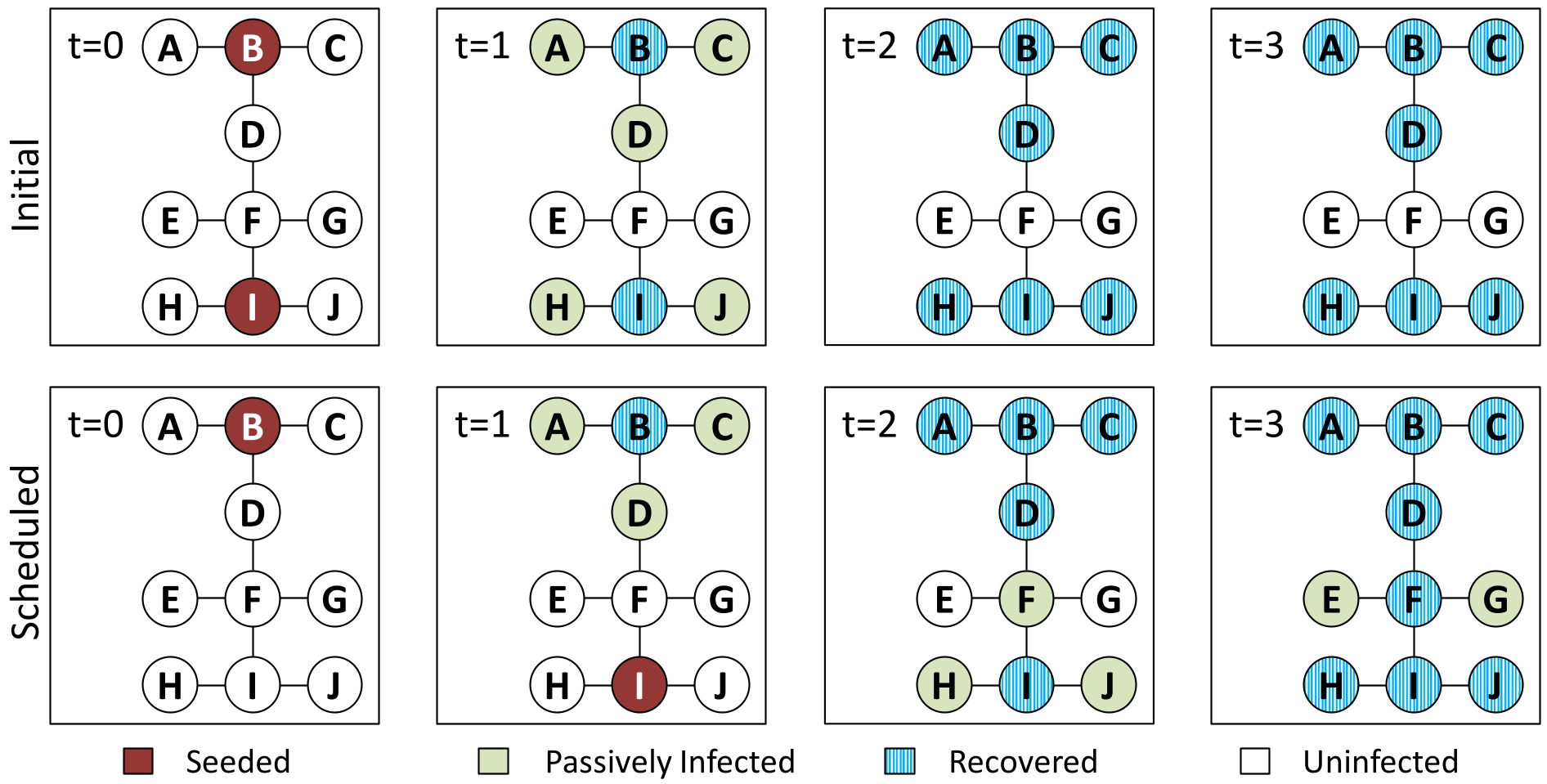 Figure 6: A comparison showing how staggered seeds (bottom) reach 10 nodes while initial seeding (top) only reaches 7.
3. State-Dependent Seeding
In this setting, an external "nudge" (seeding) only works if the target's neighbors are already active. An initial strategy fails here because the network isn't primed yet. A scheduled strategy seeds one node to prime its neighbors, then seeds those neighbors, creating a ladder effect.
Key Experiments & Results
The researchers tested these concepts on datasets like the Enron email network and Game of Thrones character interactions.
The Performance Gap
The gains were universal but varied by context. In the Independent Cascade and Linear Threshold models, the "Step-by-Step" and "Incremental" approaches consistently outperformed the static "Initial" approach.
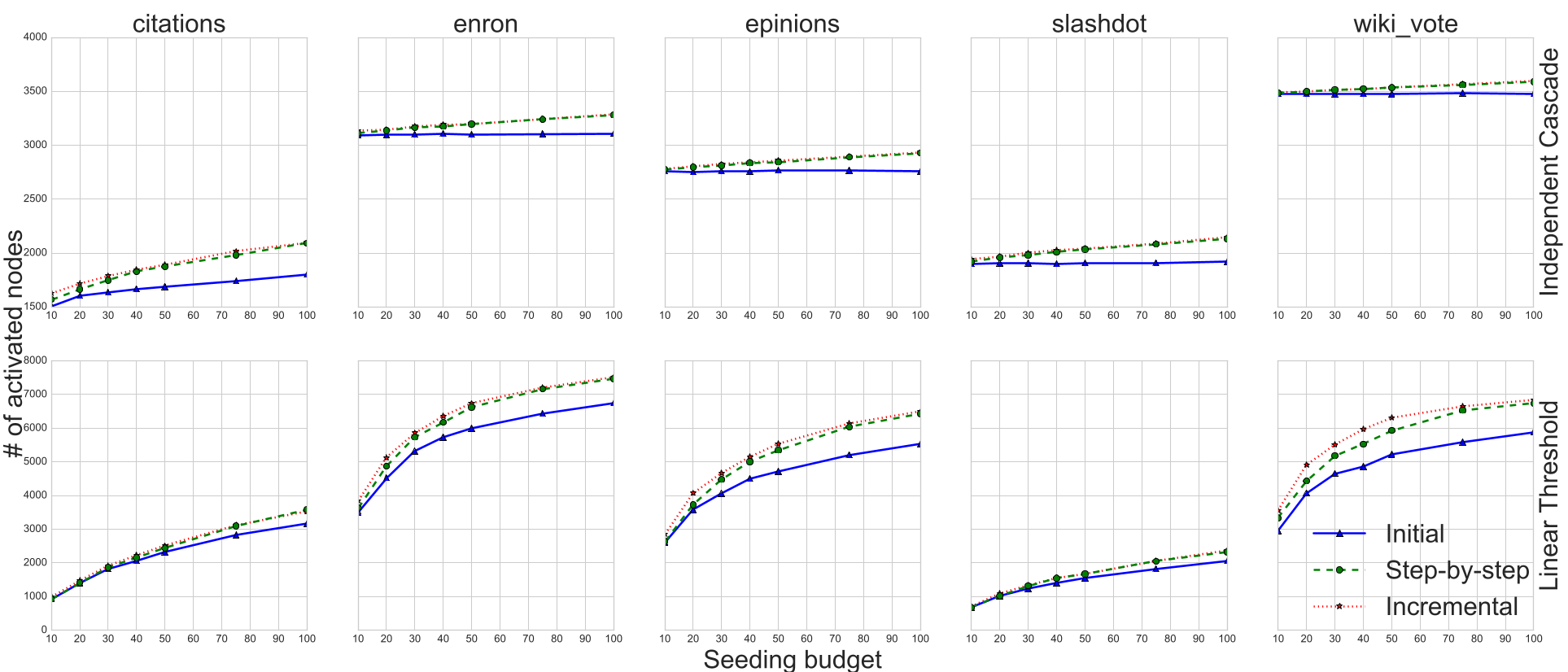 Figure 2: Performance across different network topologies. Scheduled approaches (solid/dashed lines) consistently sit above the initial approach (crosses).
The "S-Curve" Discovery
In state-dependent seeding, the authors found a critical mass effect. If the initial infected population () is too small or too large, scheduling doesn't matter. But in the "Goldilocks zone" (intermediate ), the scheduled approach can be 150% more effective.
Critical Analysis
The paper makes a compelling case for Sequentiality. The primary trade-off is Time. While scheduled seeding results in more total infections, it takes longer. For a flash sale, initial seeding might still be king. For long-term brand building or behavioral change (like public health), scheduling is clearly superior.
The Integer Linear Programming (ILP) formulation provided is rigorous but computationally expensive for massive networks. Future research will likely focus on approximating these optimal schedules using Reinforcement Learning.
Conclusion
"Timing Matters" bridges the gap between theoretical graph metrics and the messy, temporal reality of social interaction. It proves that a smaller budget used wisely over time can defeat a massive budget used all at once. For tech leaders and data scientists, the message is clear: Stop treating launch day as the end of the campaign; it’s just the first step in a scheduled sequence.