
Top-k Team Recommendation: Moving Beyond Simple Tasks in Spatial Crowdsourcing
Top-k Team Recommendation in Spatial Crowdsourcing
The paper introduces the Top-k Team Recommendation (TopkTR) problem in spatial crowdsourcing, a task designed to recommend the most cost-effective groups of workers for complex tasks requiring multiple skills. The authors develop a two-level framework incorporating a greedy approximation algorithm and an exact algorithm with pruning techniques (TTR-ExactPrune) to solve this NP-hard problem efficiently.
TL;DR
In the evolving landscape of spatial crowdsourcing (Gigwalk, Gmission), tasks are becoming increasingly complex. This paper addresses the TopkTR (Top-k Team Recommendation) problem: how to select the cheapest teams of workers that collectively cover all required skills, while respecting spatial proximity, individual worker capacities, and ensuring no "free-riders" exist in the team. The authors prove this is NP-hard and offer a dual-level framework for both approximate and exact solutions.
Motivation: The Shift from Micro-tasks to Collaboration
Most existing spatial crowdsourcing literature treats tasks as "simple and trivial"—think of taking a picture of a shelf or verifying a location. However, real-world O2O (Online to Offline) scenarios often involve complex projects like room renovation or party planning.
The problem is not just finding any team, but the top-k cheapest teams because:
- Budget Constraints: Requesters need the lowest cost.
- Capacity Limits: A worker might be jack-of-all-trades but master-of-none; they can't do everything at once.
- No Free-Riders: Every member of the team must be essential to covering the required skill set.
Methodology: The Two-Level Framework
The authors tackle the complexity through a clever Two-Level-Based Framework. Instead of finding teams at once, they solve for the top-1 team and then "shrunken" the solution space to find the next best one.
1. The Strategy
The framework maintains a Priority Queue of teams. Once the cheapest team () is found, the algorithm systematically excludes each worker from and searches for the best team in those new sub-spaces. This ensures that the global top-2 must be a local top-1 in one of these sub-spaces.
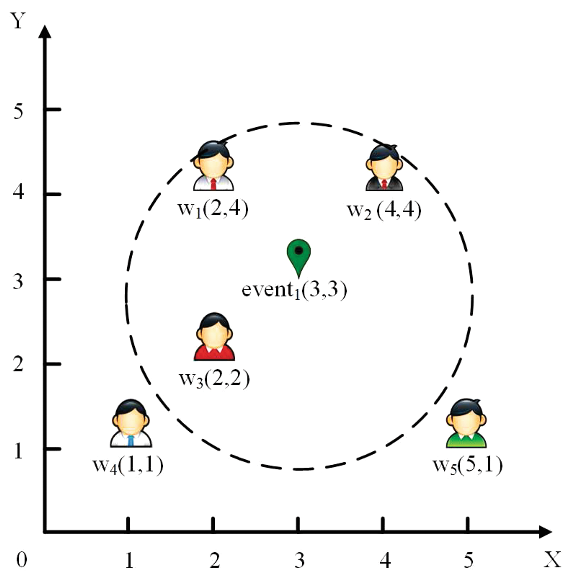 Fig 1. Spatial distribution of workers and the target task range.
2. Approximate vs. Exact
- TTR-Greedy: Uses a greedy benefit-per-price ratio to pick workers until skills are covered, then "refines" the team to remove free-riders. It offers a approximation ratio.
- TTR-ExactPrune: A state-enumeration approach that uses bitmasking to track skill coverage. Its "Pruning" power comes from the current cheapest known cost—if a partial team's cost already exceeds our best candidate, it's discarded immediately.
Experimental Insights
The researchers tested their approach on the gMission dataset (11,205 workers) and synthetic data.
| Factor | Result Trend | Reason |
|---|---|---|
| **Worker Cardinality $ | W | $** |
| **Required Skills $ | E_t | $** |
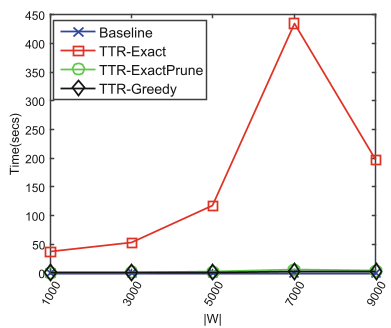 Fig 2. Performance comparison (Efficiency and Utility) as worker count and team size k vary.
Key Takeaway from Experiments: TTR-Greedy is the MVP for production. It achieves nearly the same cost-efficiency as the exact algorithm but finishes in a fraction of the time, making it suitable for real-time mobile recommendations.
Critical Analysis & Conclusion
The No Free-Rider constraint is the most fascinating aspect of this work. In many optimization problems, "over-coverage" is ignored; here, the authors recognize that hiring an extra person who contributes nothing to the required skills is a waste of resources for the requester.
Limitations
- Skill Weighting: The model assumes all skills have equal priority. In reality, a "lead violinist" might be more critical/expensive than a "backup dancer."
- Dynamic Availability: Workers are assumed to be static during the recommendation window, which might not hold in highly volatile crowdsourcing markets.
Future Outlook
This framework lays the groundwork for Social-Spatial Crowdsourcing, where team recommendation might also consider the "social harmony" or previous collaboration history of the workers, alongside their skills and price.