
TDMCE: Decoding the Pulse of Social Media through Content and Emotion
A Topic Discovery Model Based on Content and Emotion in Microblogs
The paper introduces TDMCE (Topic Discovery Model based on Content and Emotion), a unified probabilistic graphical model designed for microblog topic discovery. It effectively handles short-text sparsity by integrating user feedback (comments/forwarding) and synchronizing textual content with emotional labels to achieve superior clustering performance.
TL;DR
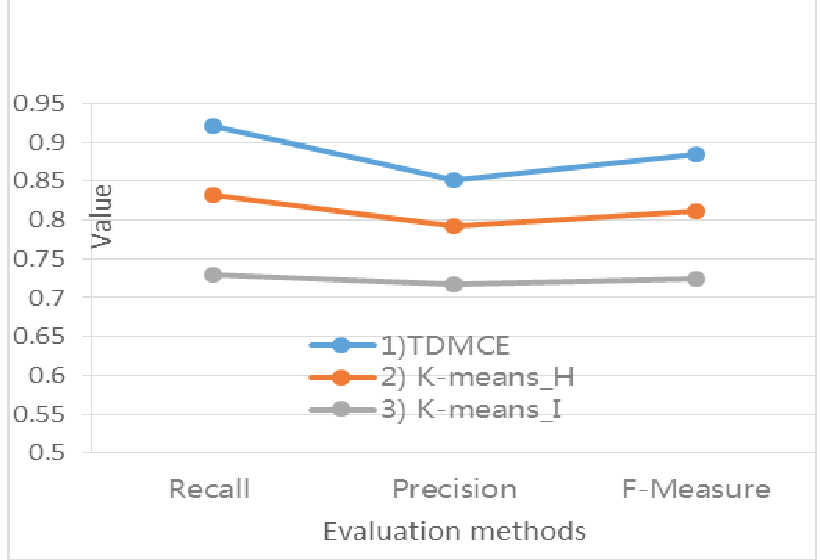
Microblogs are a goldmine of real-time information, but their brevity makes them a nightmare for traditional topic discovery. This paper presents TDMCE, a model that solves the "sparse semantics" problem by augmenting short texts with user feedback (comments and retweets) and joint-modeling textual content with emotional labels. By treating emotions as first-class citizens in a probabilistic model, it achieves an F-measure of 88.46%, outperforming standard clustering by over 16%.
The Sparsity Trap: Why Traditional Topic Models Fail
The fundamental challenge in microblogging platforms like Twitter or Sina Weibo is the 140-character limit. Traditional algorithms like Latent Dirichlet Allocation (LDA) rely on word co-occurrence; when a document only has 10-20 words, the co-occurrence matrix is too sparse to build reliable topic distributions. Moreover, microblogs are not just factual—they are deeply emotional. A model that ignores the "outraged" or "joyful" sentiment of a post misses the very core of why that topic is trending.
Methodology: Enriching Meaning through Feedback and Emotion
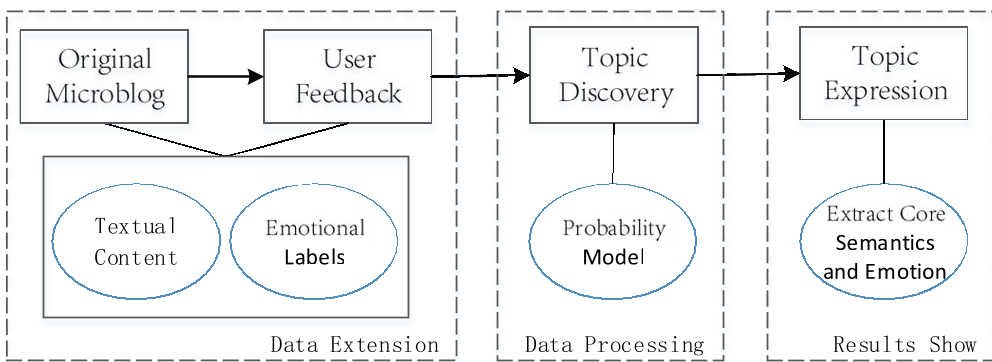
The authors propose a three-tier architecture: Data Extension, Topic Discovery (MCM), and Topic Expression.
1. Data Extension (The Semantic Bridge)
Instead of analyzing a post in isolation, the model pulls in the "echoes" of that post—the comments and forwarding texts. The intuition is powerful: comments about "Apple Watch" will likely contain related terms like "wearable" or "battery," effectively expanding the feature space of the original sparse post.
2. The Microblog Clustering Model (MCM)
The core innovation is a unified probabilistic graphical model. The authors treat emotional labels similarly to words, assuming they follow a multinomial distribution influenced by the latent topic .
The joint distribution is defined as:
By using Gibbs Sampling, the model iteratively assigns microblogs to topics by evaluating how well the post’s words and its emotions fit into a specific cluster.
Experimental Results: Precision Beyond Text
The authors tested TDMCE against a dataset of over 50,000 microblogs covering topics like the "World Cup" and "MH370 crash."
- The Power of Feedback: Comparing K-Means on raw content (72.4% F-measure) vs. K-Means on enriched feedback data (82.1% F-measure) proves that feedback is a critical semantic expander.
- The TDMCE Edge: By adding the probabilistic emotion modeling, TDMCE pushed the F-measure to 88.46%.
Case Study: Topic 0 (The World Cup)
The model didn't just find keywords like "Brazil" and "Football"; it successfully extracted dominant emotions like "applause," "laugh," and "heart." This provides a 360-degree view: we know what they are talking about and how they feel about it.
Critical Insight & Future Outlook
The genius of this work lies in its recognition of the Inductive Bias of social media: users express consensus through shared emotions. While a user might use different words to describe a tragedy, their emotional "signals" (tears, candles) are highly consistent.
Limitations: The model currently treats all feedback with a simple weight; however, in the age of "ratio-ing" and Twitter feuds, comments might sometimes contrast with the original post's topic or sentiment. Future work could benefit from Attention Mechanisms to selectively weight feedback that is semantically aligned with the source.
Conclusion
TDMCE is a robust step forward for social media analytics. It proves that in the world of big data, "short" doesn't have to mean "meaningless"—as long as you look at the surrounding emotional and structural context.