
Earth System Science: A Paradigm Shift or Just Aspirational Rhetoric?
A topic network analysis of the system turn in the environmental sciences
This study utilizes Correlated Topic Models (CTMs) and network analysis to evaluate the "system turn" in environmental sciences—the shift from disciplinary silos to holistic Earth system science. Analyzing 133,670 article abstracts from 1990–2019, the authors find that climate topics remain weakly integrated and the discourse is still fragmented into four largely homogeneous disciplinary domains.
TL;DR
For decades, the scientific community has heralded a "system turn"—a transition from isolated environmental studies to a holistic Earth System Science (ESS). This paper puts that claim to the test using text-mining on over 133,000 research abstracts. The verdict? The "system turn" is largely a signalling device rather than a reality in scientific practice. Research remains stubbornly siloed within traditional disciplinary boundaries.
Motivation: The Complexity Gap
The Earth is a "single, complex, dissipative, dynamic entity" where agriculture impacts biodiversity, which in turn affects climate feedback loops. While we have overwhelming evidence of these functional interactions, scientific research has historically been reductionist.
The authors ask a critical question: Has the environmental science community actually unified to reflect this complexity, or is "Earth system science" merely a buzzword used to construct new objects of global governance?
Methodology: Mapping the Scientific Mind
The researchers employed Correlated Topic Models (CTMs). Unlike standard LDA, CTMs acknowledge that if a paper discusses "Climate Adaptation," it is likely to also discuss "Sustainability," creating a correlation matrix that can be visualized as a network.
1. The Climate Marker
Since the climate system is the linchpin of Earth System Science, it should be the most "connected" node. The authors tracked five climate-related topics (Energy, REDD, Carbon Storage, Adaptation, and GHGs) to see how deeply they were embedded in non-climate literature.
2. Community Detection
Using the Louvain method, the researchers partitioned the entire scientific discourse into clusters. If ESS were real, these clusters would be "topically diverse" (mixing oceans, forests, and policy). If not, they would be "homogeneous" (grouped by old-school disciplines).
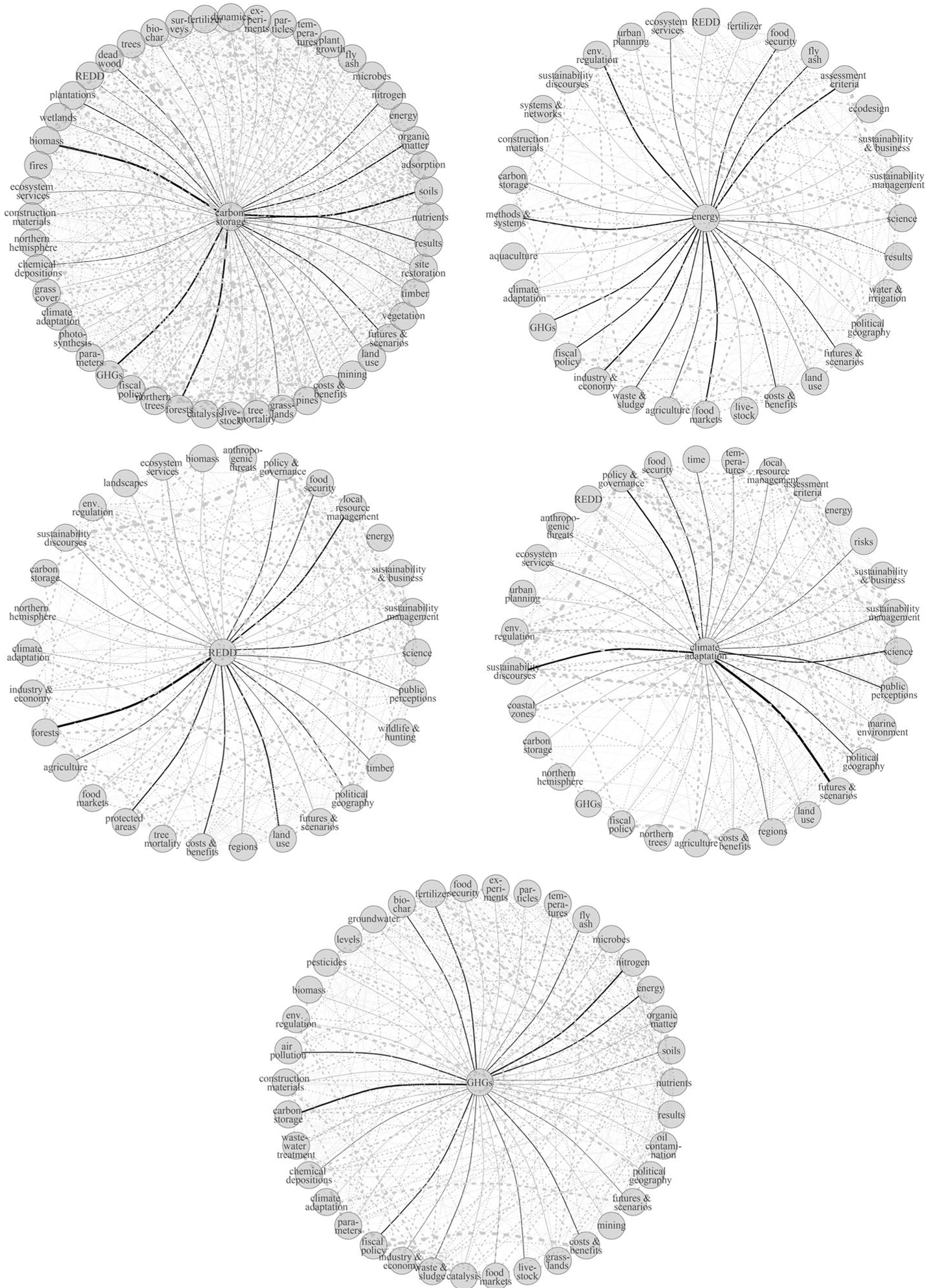 Figure 1: Ego networks showing the correlation of climate topics with other themes. Note that many connections are conceptual rather than substantive.
Key Findings: The Silos Remain
The empirical evidence suggests that the "paradigm shift" is stalled:
- Weak Integration: Climate topics exhibited surprisingly low weighted degree centrality. They are not the "hubs" one would expect in a systemic framework.
- Conceptual over Substantive: Most climate linkages were linked to abstract concepts (e.g., "Sustainability Discourses") rather than functional environmental components (e.g., "Marine Ecosystems").
- Disciplinary Homogeneity: The community detection revealed four distinct domains. As shown in the data, clusters like "Forests/Ecosystems" and "Energy Systems" remain highly isolated from one another.
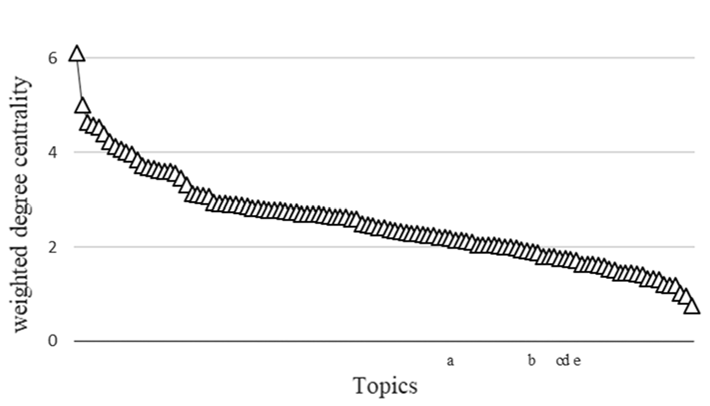 Figure 2: Distribution of weighted degree centralities (left). Climate topics (a-e) consistently fall on the lower end of the spectrum.
Critical Insight: The Paradox of ESS
The study reveals a profound paradox: we have the evidence for a complex Earth system, but our scientific infrastructure—the way we write, cite, and categorize—cannot yet process that complexity.
The authors suggest that Earth System Science functions as "Earth system governmentality." It is more useful for policymakers to create a new "global" object to govern than it is for scientists to actually change their specialized research habits.
Conclusion & Future Outlook
This analysis serves as a sobering "reality check" for the environmental sciences. While labels like the "Anthropocene" or "Planetary Boundaries" gain popularity, the underlying structure of scientific inquiry is still following the "status quo bias" of the 20th century.
Future Work: To truly see if a turn is happening, we need longitudinal studies. While this paper was a static snapshot (1990-2019), using Structural Topic Models (STMs) to track topic frequency shifts over time could reveal whether we are slowly inching toward integration or if the silos are actually hardening.