
WDS-LDA: Bridging the Semantic Gap in Social Network Topic Representation with Hybrid AI
10377_A Topic Representation Model for Online Social Networks Based on Hybrid Human-Artificial Intelligence.
This paper introduces WDS-LDA, a topic representation model designed for online social networks using a Hybrid Human-Artificial Intelligence (H-AI) approach. By integrating word-distribution sensitivity and manual adjustment weights into the standard Latent Dirichlet Allocation (LDA) framework, it achieves superior topic differentiation and interpretability.
TL;DR
Topic detection in the era of "Big Data" social networks often suffers from a lack of human-centric interpretability. The WDS-LDA (Word-Distributed Sensitive LDA) model addresses this by fusing traditional probabilistic modeling with human cognitive feedback. By weighting words based on their distribution sensitivity and manual adjustments, the model produces topics that are not just statistically significant, but semantically distinct and human-readable.
The Core Challenge: Why Standard LDA Falls Short
While Latent Dirichlet Allocation (LDA) is the industry standard for uncovering latent themes in text, it has a glaring weakness in social media contexts: differentiation. In noisy environments like Sina Weibo or X (formerly Twitter), common words often bleed across topics. A word like "Champion" might appear in sports, politics, and entertainment, rendering it useless for distinguishing between them. Modern systems remain "computer-centered," ignoring the intuitive semantic boundaries that human intelligence provides effortlessly.
Methodology: The Three Pillars of WDS-LDA
The authors propose a hybrid approach that re-measures the importance of words using three distinct weights:
- Inside Weight (): Uses information entropy to measure how evenly a word is distributed across documents within a specific topic. A high weight indicates a "common core" word for that topic.
- Outside Weight (): Measures distribution across different topics. A high outside weight suggests a word is a "generalist" and should be penalized to improve topic differentiation.
- Manual Adjustment Weight (): This is the Human-AI (H-AI) component. It tracks historical user behavior—which words were manually added or deleted by human experts—to create a feedback loop that refines the model over time.
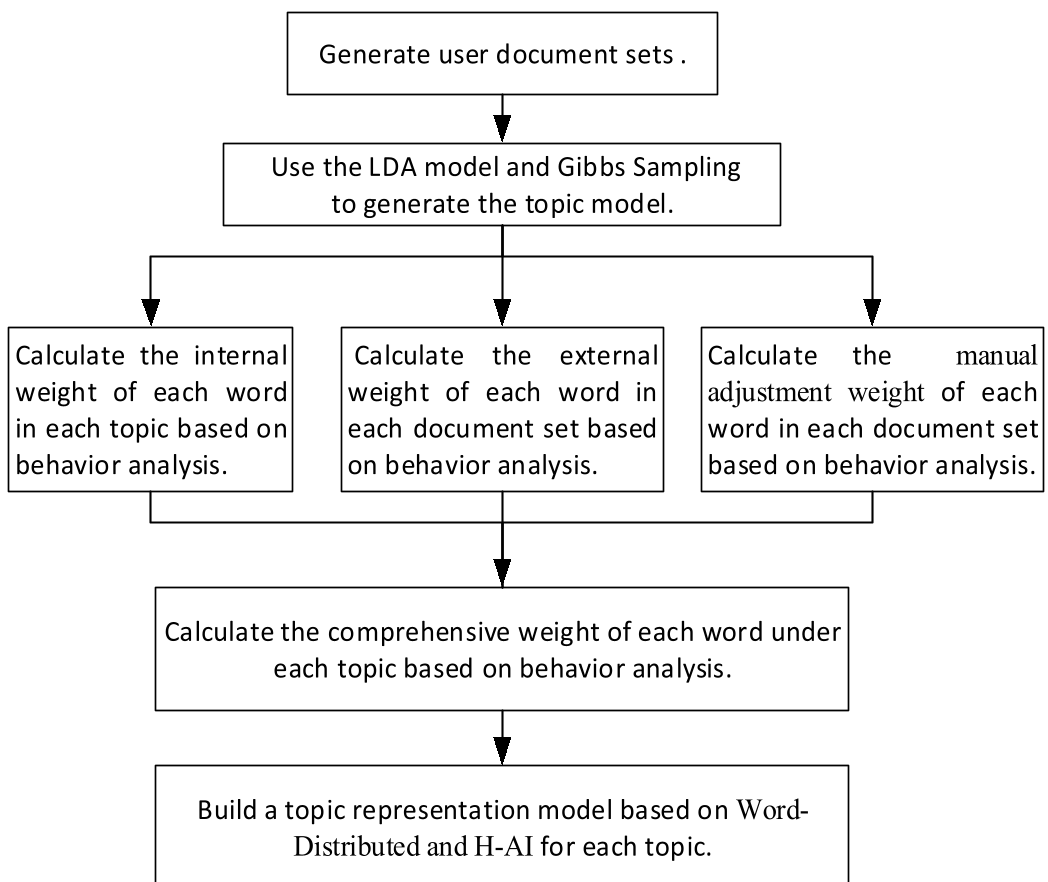
The final representation is a linear combination of the standard LDA output and this new distribution-sensitive logic:
Empirical Evidence: Human Wisdom Matters
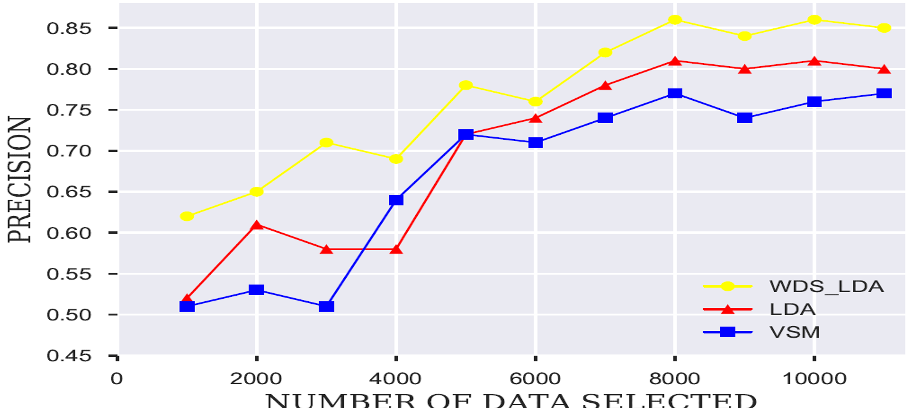
The researchers tested WDS-LDA on over 11,000 Sina Weibo documents. Key findings include:
- The Optimal Balance: The model performs best at , suggesting a 60/40 split between statistical probability and distribution sensitivity is the "sweet spot."
- The Power of H-AI: Precision and F-measure scores showed a steady climb as manual adjustments increased, proving that the model successfully "learns" from human intervention.
- Stability: The system hits its stride at approximately 100 topics for this dataset size, with performance stabilizing as the number of manual adjustments reaches 140.
Critical Insight & Future Work
The true value of WDS-LDA lies in its acknowledgement that AI is not yet a replacement for human cognitive mapping, especially in the nuanced world of social discourse. By treating human feedback as a persistent weight rather than a one-off correction, the model builds a growing "wisdom base."
Limitations: The primary trade-off is computational cost and the requirement for human labor. Future Prospects: The authors aim to integrate social graph data (likes, shares, and user relationships) to further refine topic accuracy, suggesting that the "who" and "how" of a message are just as important as the "what."
Conclusion
WDS-LDA represents a significant step toward Augmented Intelligence in natural language processing. By mathematically formalizing human intuition, it transforms raw social media noise into structured, actionable insights for public opinion control and information recommendation.