
TSIM: Unleashing Hypergraph Learning for Topic-Specific Influence in Social Media
11277_Topic-Sensitive Influencer Mining in Interest-Based Social Media Networks via Hypergraph Learning.
The paper introduces Topic-Sensitive Influencer Mining (TSIM), a framework designed to identify influential users and images within interest-based social networks like Flickr. It utilizes a hypergraph learning approach to fuse multi-modal data, achieving State-of-the-Art performance in topic-level influence estimation and recommendation tasks.
TL;DR
Social influence is rarely "one size fits all"—a world-class photographer has massive influence in photography but perhaps none in quantum physics. This paper proposes Topic-Sensitive Influencer Mining (TSIM), a framework that moves beyond generic popularity by using Hypergraph Learning to fuse visual features, textual tags, and social interactions. By modeling these high-order relationships, TSIM identifies the true "thought leaders" of specific niches, significantly improving friend and content recommendations.
Background & Motivation: The Multi-Modal Challenge
In interest-based networks like Flickr, influence is inherently multi-modal. A user's impact is defined by the images they share (visual), the tags they use (textual), and the community feedback they receive (social links).
Previous SOTA methods suffered from two primary flaws:
- Modality Blindness: They relied heavily on text, ignoring the rich semantic data in images.
- Topic Agnosticism: They calculated a global influence score (like PageRank), which fails to distinguish an influencer's specific area of expertise.
The authors' insight is that a Hypergraph is the perfect mathematical structure to capture these "one-to-many" and "many-to-many" relationships that a simple graph cannot.
Methodology: The TSIM Framework
The TSIM framework operates through a three-stage pipeline: Hypergraph Construction, Topic Learning, and Influence Ranking.
1. Multi-Modal Hypergraph Construction
The system defines two types of hyperedges:
- Homogeneous Hyperedges: Connect images based on visual similarity (using features like GIST and LBP) and shared textual tags.
- Heterogeneous Hyperedges: Connect users to images through "Interest" (favorites/comments) and "Interaction" (links between two users via shared content).
2. Hypergraph Regularized Topic Model (HRTM)
To solve the problem of sparse tags, the authors propose HRTM. It extends Probabilistic Latent Semantic Indexing (PLSI) by adding a hypergraph-based manifold regularization term. This ensures that images that are visually or textually "close" in the hypergraph share similar topic distributions.
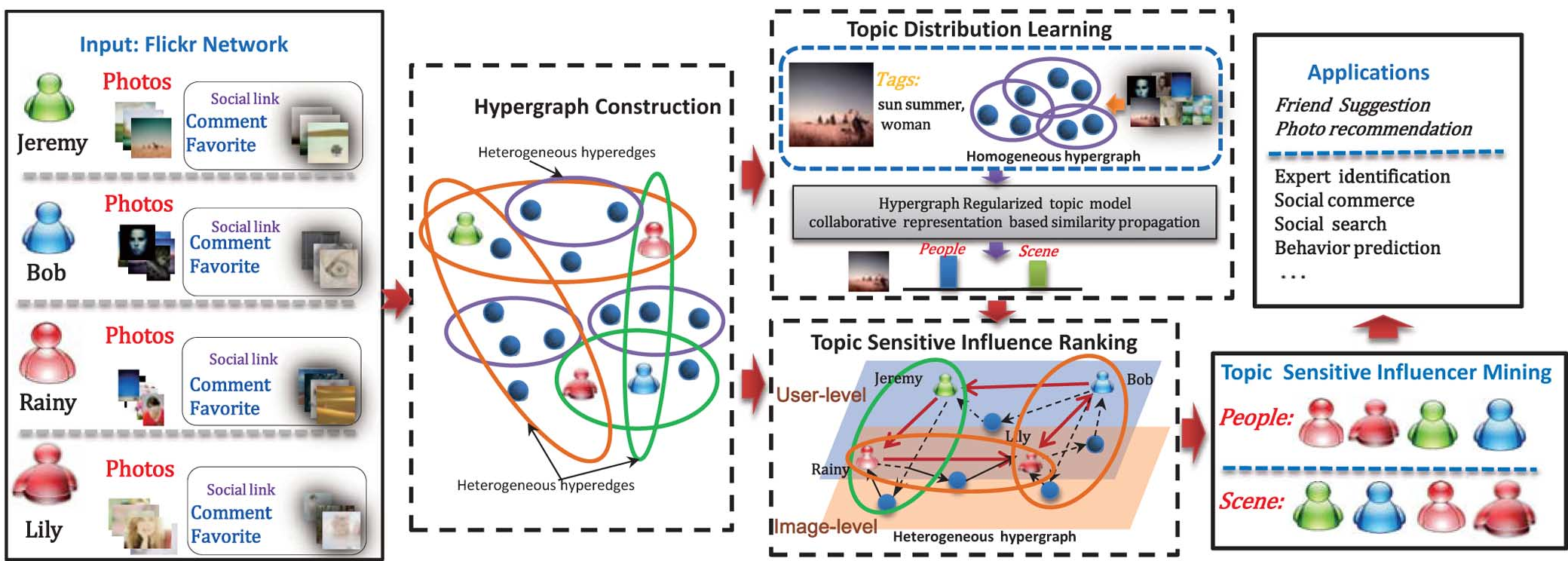 Fig 1: The TSIM architecture showing the flow from hypergraph construction to topic-sensitive ranking.
3. Topical Affinity Propagation
Finally, the "influence" is calculated using a modified Affinity Propagation algorithm. This doesn't just rank users by degree; it propagates "influence messages" across the heterogeneous hyperedges, effectively asking: "How much does this specific topic flow from User A to Image B, and then to User C?"
Experimental Validation
The authors tested TSIM on a real-world Flickr dataset (2,314 users, 556k photos).
Topic Learning Accuracy
The proposed HRTM was compared against standard PLSI and Corr-LDA. By leveraging visual-textual consistency through the hypergraph, HRTM achieved higher classification precision across multiple categories (People, Architecture, Sunset, etc.).
Recommendation Performance
TSIM's true value shines in recommendation tasks. Whether suggesting new friends or photos, the topic-sensitive approach outperformed generic PageRank and content-based filtering.
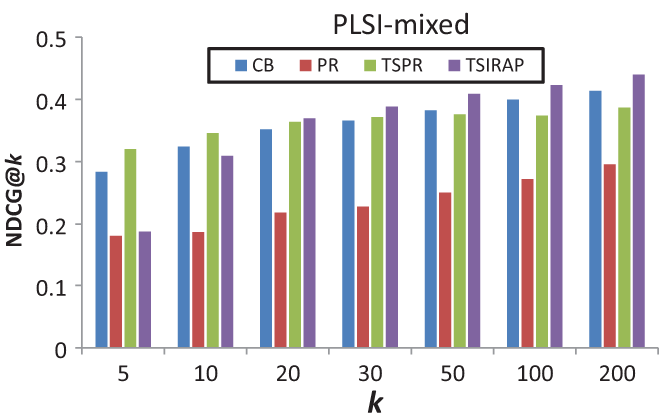 Fig 2: Comparison of NDCG scores for friend suggestion. TSIM (Red) consistently stays at the top.
Critical Insight & Conclusion
The genius of TSIM lies in its treatment of social links not just as "votes," but as topic-specific bridges. By using a Generalized EM algorithm to solve the hypergraph-regularized objective, the authors provide a robust way to handle the noise and sparsity inherent in user-generated content.
Takeaway: If you are building a recommendation engine for content-rich platforms, ignore generic influence. The future belongs to models that understand the manifold of user interests through hypergraph high-order structures.
Limitations: The computational complexity of hypergraph construction can be high for billion-scale networks, suggesting a need for more efficient sampling or approximation techniques in future iterations.