
Retweet Prediction: Why Topic-Specific Emotion is the Missing Link
Topic specific emotion detection for retweet prediction
This paper presents a novel approach for retweet prediction by focusing on topic-specific emotion detection. It introduces three prediction models (PM1-PM3) that leverage the conjunctive effect of latent topics (extracted via Twitter-LDA) and fine-grained emotional states based on Plutchik’s wheel of emotion.
TL;DR
While most recommendation engines ask what you are interested in (topics), they often ignore how you feel about those topics. This research demonstrates that the secret to predicting retweets lies in the intersection of content and affect. By modeling topic-specific emotions, the researchers achieved superior accuracy over traditional TF-IDF and hashtag-based methods.
Background Positioning
In the ecosystem of information diffusion, retweet prediction is the holy grail. Prior work has largely treated "Topic Interest" and "Sentiment" as independent parallel tracks. This paper bridges that gap, positioning itself as a pioneer in exploring the conjunctive impact of latent topics and nuanced emotional states (Joy, Anger, Trust, etc.) on user decision-making.
The Motivation: Moving Beyond "Like" and "Dislike"
Why do we retweet? Is it because we like the topic? Not necessarily. We might retweet a political post because it triggers Anger or a viral clip because it sparks Joy.
The authors' key insight is that a user's "Emotional Signature" is not universal. For instance, a user might frequently retweet Sports content that reflects Surprise, but only retweet Politics if it reflects Disgust. If a model only looks at the topic (Politics) or the emotion (Disgust) in isolation, it misses the personalized context that actually drives the "Retweet" click.
Methodology: The Core Architecture
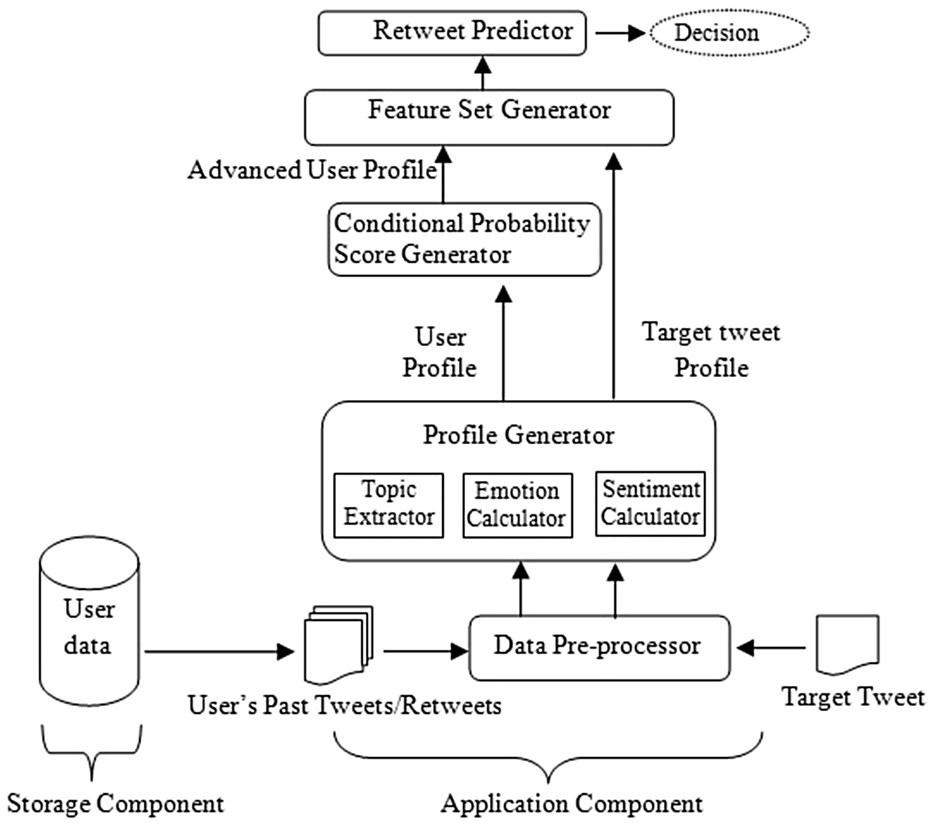
The system employs a sophisticated pipeline to transform raw tweets into a probabilistic user profile.
1. Topic and Emotion Extraction
- Twitter-LDA: Unlike standard LDA, this version is optimized for the short, "one-topic-per-tweet" nature of microblogs.
- Dual Lexicon Scoring: To handle the informal language of Twitter, the authors combined the NRC Word-Emotion Lexicon with a specialized Twitter-based lexicon. This allows the system to generate a 10-dimensional vector (8 basic emotions + Positive/Negative sentiment).
2. Probabilistic Modeling
The magic happens in the Conditional Probability Generator. Instead of a simple count, the model calculates:
- : How likely is a user to engage with a topic given they are feeling a certain way?
- : What specific emotions does this user typically broadcast regarding a specific subject?
Experiments & Results
The authors tested three proposed models (PM1, PM2, PM3) against four conventional baselines (CM1-CM4).
Key Findings:
- Nuance Wins: Models using 8-dimensional emotions (PM1, PM2) outperformed those using simple 2-dimensional sentiment (CM2).
- Conjunction is Key: Models that accounted for the mutual effect of topic and emotion (PM1, PM2) significantly outperformed those that treated them as independent features (CM1).
- Stability of Emotion: Interestingly, PM2 () generally performed best, suggesting that a user’s emotional reaction to a specific topic is more stable and predictable than their choice of topic under a specific emotional state.
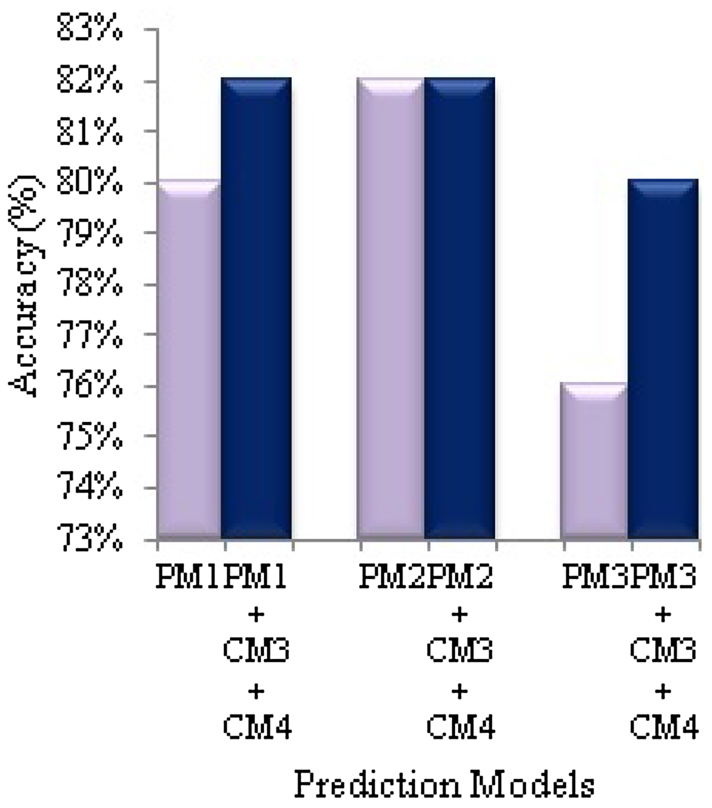 (Note: As seen in Figure 6, the weighted F1-scores of PM1 and PM2 consistently tower over the TF-IDF (CM3) and Hashtag (CM4) baselines.)
Critical Analysis & Conclusion
Takeaway
The "Topic + Emotion" paradigm is a powerful upgrade for social media analytics. It moves us away from cold content matching toward a more "human-centric" understanding of digital behavior.
Limitations
- Lexicon Dependency: The model relies on pre-defined lexicons. It may struggle with irony, sarcasm, or rapidly evolving internet slang that hasn't yet been codified.
- Active User Bias: The study focused on "active users" (100-300 retweets per two weeks). The model's performance on "lurkers" or less active accounts remains an open question.
Future Outlook
The next frontier is the integration of deeper latent attributes. As the authors suggest, incorporating personality traits (the "Big Five") and core value systems could further refine the accuracy of these models, turning retweet prediction into a comprehensive mirror of the human psyche.