
QALeaderRank: Redefining Authority in the Age of Social Q&A
Identifying Topical Opinion Leaders in Social Community Question Answering
The paper introduces QALeaderRank, a comprehensive framework for identifying topical opinion leaders in Social Community Question Answering (SCQA) platforms like Zhihu or Quora. By integrating a novel influence-ranking algorithm (QARank) with three specific metrics for topical expertise, the method effectively finds users who are both influential and knowledgeable.
TL;DR
In platforms like Quora and Zhihu, being famous isn't the same as being an authority. This paper presents QALeaderRank, a framework that identifies "Topical Opinion Leaders" by blending social network influence with verified domain expertise. Unlike previous models that only look at follower counts or answer quality, QALeaderRank uses a novel random surfer model that accounts for the "authority" of a user's answers, reducing the identification error rate by over 50% compared to state-of-the-art baselines.
The "Celebrity vs. Expert" Problem
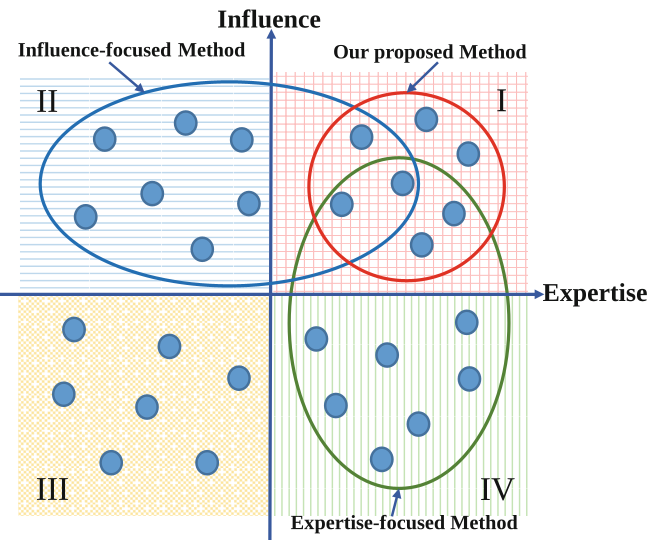
In the ecosystem of Social Community Question Answering (SCQA), we often see two types of suboptimal results when searching for leaders:
- The Famous Amateur: A user with millions of followers (Type II) who comments on a topic they know little about. Their reach is wide, but their depth is shallow.
- The Silent Scholar: A highly knowledgeable expert (Type IV) who provides brilliant answers but has no social following. Their depth is great, but their reach is localized.
The authors argue that a true Topical Opinion Leader must exist in the intersection ("Zone I")—possessing both the social megaphone and the intellectual credentials.
Methodology: Social Reach meets Knowledge Authority
The QALeaderRank score is calculated as a product of two pillars: Topical Influence (Inf) and Topical Expertise (ES).
1. QARank: The Social Engine
While traditional algorithms like PageRank or TwitterRank treat all "links" between users similarly, QARank introduces a critical weight: Knowledge Authority.
- Homophily Validation: The authors first proved statistically that users follow others with similar interests (homophily exists).
- Transition Probability: When "jumping" from one user to another in the network graph, the probability is determined by the topical similarity between the two users and the total votes the followee has received in that topic. This ensures that influential nodes are those that actually provide "satisfactory" content.
2. Expertise Measure: The Performance Pillar
Expertise isn't just about one metric. The authors use three:
- Capacity: Using a -score to penalize those who ask many questions but provide few answers.
- Satisfaction: The average "upvotes" per answer, filtering out "spammers" who post high volumes of low-quality content.
- Contribution: The sheer volume of answers in a specific topic.

Experimental Results: Performance Breakdown
The team crawled 1.41 million users from Zhihu to test their hypothesis. The results were striking:
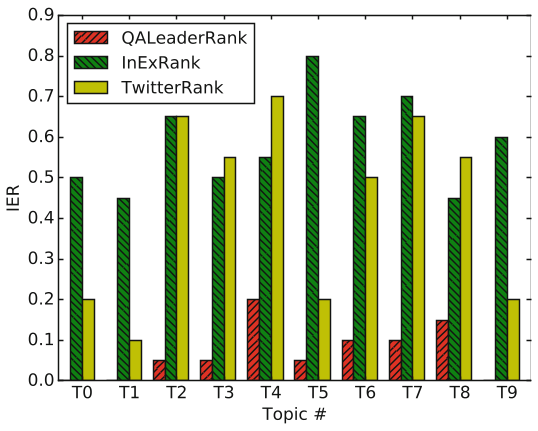
- Error Rate Reduction: The "Identification Error Rate" (IER) measures how many identified "leaders" actually fall below the community average in followers or votes. QALeaderRank maintained an IER below 20%, whereas TwitterRank often failed (identifying popular users who had zero expertise in the specific topic).
- Multi-Topic Capability: The model successfully identified "polymaths"—users who are authorities in both "Internet" and "Finance," for example.
Critical Insight & Conclusion
The core takeaway from this research is that Social Influence in SCQA is "Topic-Sensitive." You cannot measure a user's value by their global follower count alone (); you must look at how those followers interact with specific nodes of knowledge.
QALeaderRank effectively weeds out "paid posters" (high contribution, low influence) and "celebrity noise" (high influence, low quality), providing a blueprint for how modern social platforms can rank content and users to prioritize true expertise.
Future Outlook: While the model is robust, it relies heavily on "votes." Future iterations might need to account for "vote manipulation" or "sentiment analysis" in comments to ensure that "negative influence" (controversial but wrong users) isn't mistaken for leadership.