
Beyond Simple Ratings: Integrating Dynamic Social Relationships into TOPSIS Decision Making
A Decision Making Method Based on TOPSIS and Considering the Social Relationship
The paper introduces a hybrid decision-making method that combines the TOPSIS (Technique for Order Preference by Similarity to an Ideal Solution) framework with social network analysis. By integrating trusted friends' recommendations and filtered online buyer ratings, the method constructs a robust preference model that utilizes the Hawkes Process to dynamically weight social relationships and SVD for buyer interest clustering.
TL;DR
To address the information overload in online shopping, this paper proposes a decision-making framework that combines TOPSIS with dynamic social relationship modeling. By using the Hawkes Process to weight friend influences and SVD to filter online reviews, the authors solve the data sparsity problem and achieve a Rank-Based Precision (RBP) of 0.93, significantly outperforming traditional collaborative filtering.
Problem & Motivation: The Noise of the Crowd
When making a purchase, we often balance two sources of information: the opinions of our inner social circle and the aggregated "wisdom" of strangers (online ratings).
Current SOTA methods face two critical failures:
- Static Bias: They treat social relationships as static links, ignoring that a friend you interacted with yesterday is likely more influential than one you haven't spoken to in a year.
- Sparsity: Collaborative filtering breaks down when there are few ratings for a product, and broad social recommendations often lack product-specific expertise.
The authors' insight is to treat social interaction as a self-exciting process—where one interaction increases the probability of future ones—and use this to create high-fidelity weights for a multi-criteria decision process.
Methodology: The Core Engine
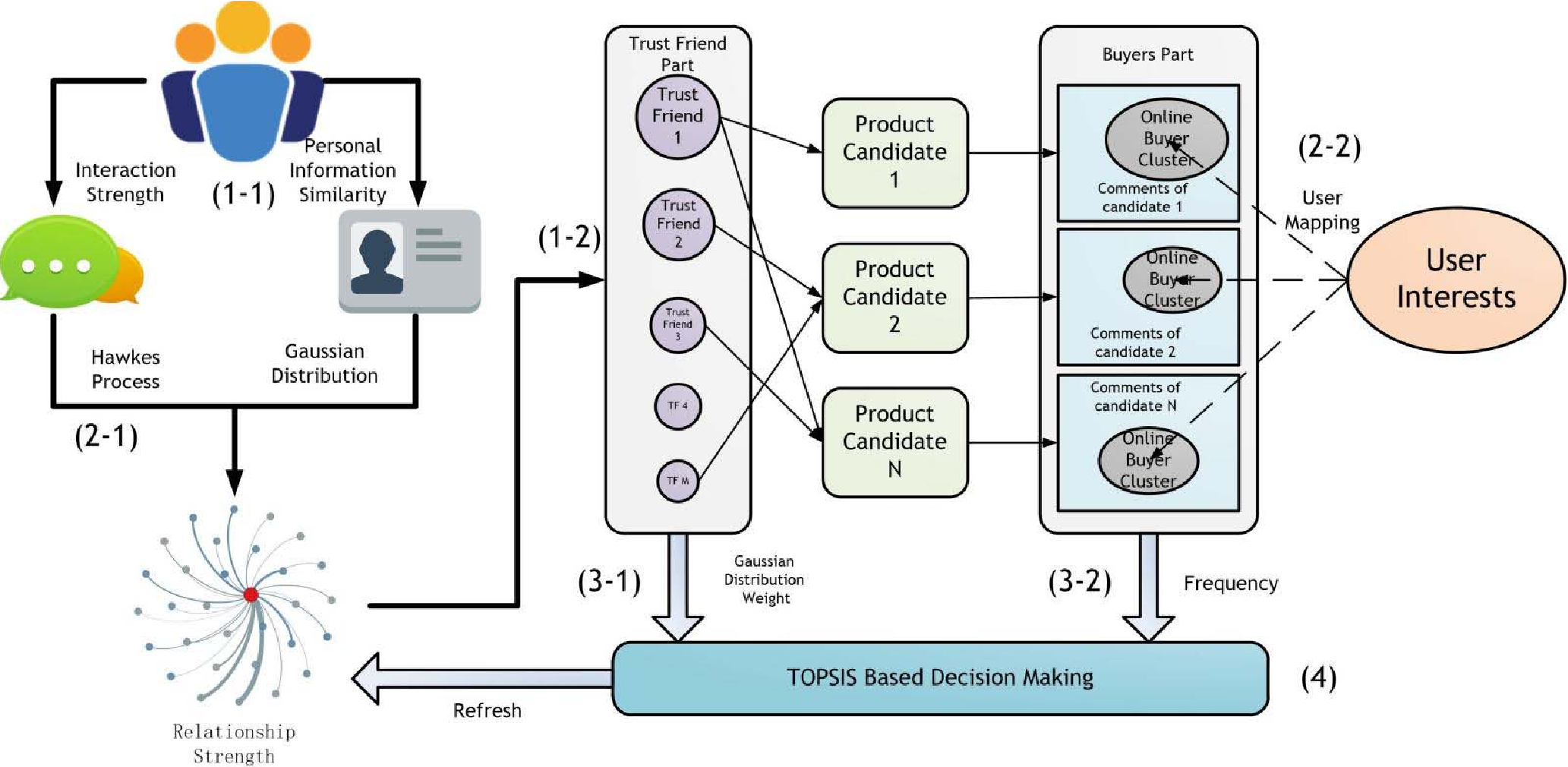
The architecture is a three-stage pipeline designed to simulate the natural human decision-making process.
1. Dynamic Relationship Strength (Hawkes Process)
The paper treats interactions (comments, re-posts, quotes) as a point process. Using the Hawkes Process, the "Interaction Strength" is calculated by considering how past interactions influence current relationship value , incorporating a decay coefficient .
- Logic: Comments carry more weight than mere re-posts.
- Formula Insight: The basic strength is bolstered by the summation of weighted past behaviors .
2. Expert Buyer Filtering (SVD)
To avoid "rating pollution" from buyers with different tastes, the system uses Singular Value Decomposition (SVD). It maps buyer comment keywords into a latent cluster space and selects only those "experts" whose interest vectors align closely with the target user.
3. TOPSIS Aggregation
Finally, the "Trusted Friends" (TFs) and "General Buyer Ratings" (GBRs) are fed into a TOPSIS matrix. TOPSIS identifies the "Ideal Solution" (a product with perfect ratings from everyone) and the "Negative Ideal Solution," then ranks candidates based on their geometric distance to these points.
Experiments & Results
The authors validated their model using a combination of social data from Twitter, Facebook, and QQ, alongside Amazon's SNAP dataset.
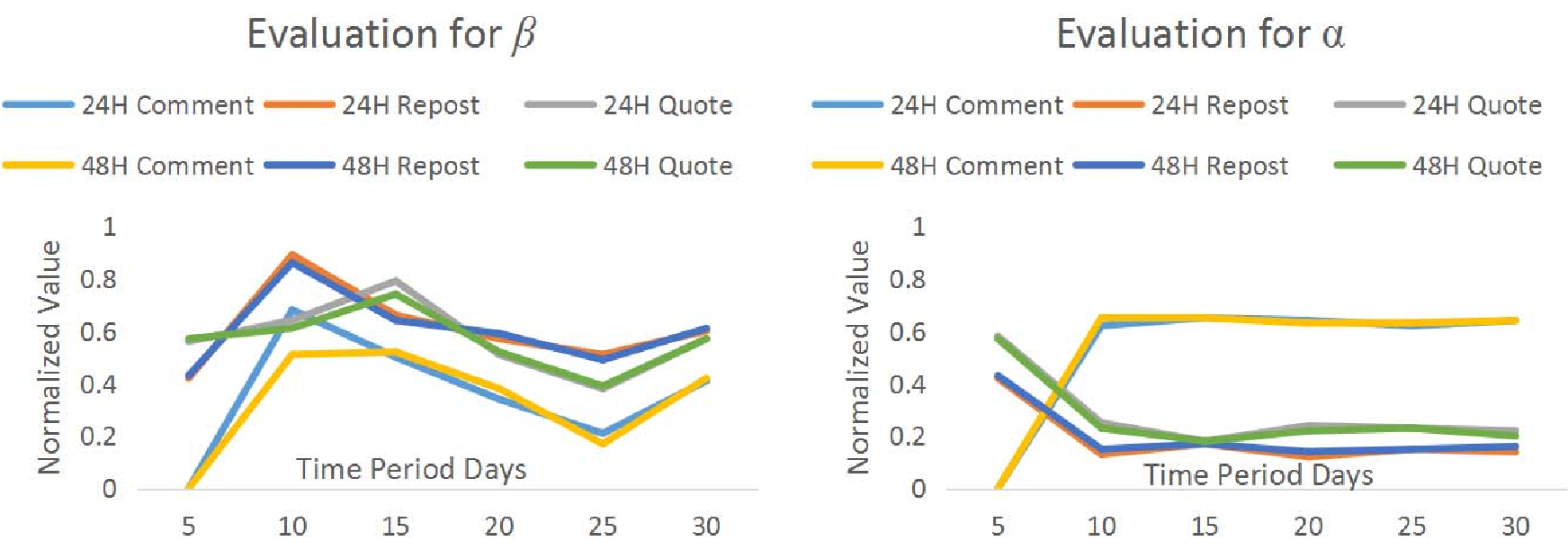
Parameter Stability
The training results in Fig. 4 demonstrate that different interaction behaviors have distinct decay rates. Comments prove to be the most "stable" indicator of relationship strength over a 30-day period.
SOTA Benchmarking
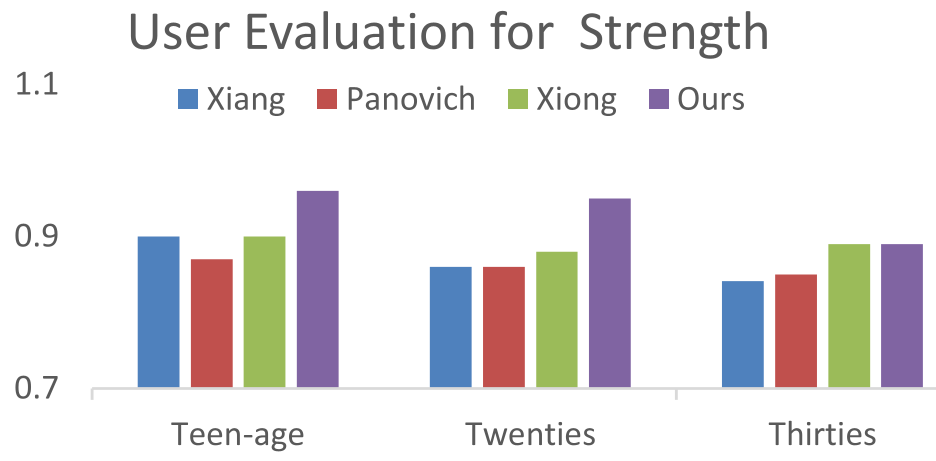
Compared to prominent social recommendation models like Ma (Social Trust Ensemble) and Rendle (Factorization Machines), this method achieved:
- RBP (Rank-Based Precision): 0.93 (vs. 0.73 - 0.89 for others).
- NDMP: 0.22, indicating a closer alignment with actual user preferences.
Critical Analysis & Conclusion
Takeaway
The integration of the Hawkes Process is a masterstroke in social computing. It transitions social weighting from a "snapshot" (who are your friends?) to a "video" (how is your friendship evolving?). By combining this with the structural rigor of TOPSIS, the researchers have created a system that is both mathematically sound and psychologically intuitive.
Limitations
- Ground Truth Subjectivity: The "relationship strength" ground truth remains reliant on user self-reporting, which can be inconsistent.
- Cold Start for Buyers: If a product has zero reviews, the system defaults entirely to friend suggestions. While this solves the sparsity problem, it reintroduces a bias toward the user's social bubble.
Future Outlook
This framework is highly extensible. Beyond online shopping, it could be applied to Group Decision Support Systems (GDSS) for corporate strategy or public policy, where the "social relationship" is replaced by "professional influence" and "expert credibility."